CXC registrar and CEO Dr Wayne Wesley said the January 2026 examinations, which were administered via e-assessment for the first time in CXC’s history, went smoothly. He said CXC administered a fully electronic and hybrid examination as part of its digital transformation journey across the region.
Speaking during a media conference on March 13 from CXC’s offices in Barbados, he said over 10,481students sat examinations across 17 Caribbean states, for a total of 17,695 subject entries.
“Examinations ran from January 5-29, 2026, four days more than the 2025 schedule. This was done to accommodate the new electronic delivery modality for high-volume subjects such as mathematics and English.”
He said special humanitarian consideration was granted to students in Jamaica who were affected by Hurricane Melissa. He said a total of 708 subject entries across 29 centres, representing approximately four per cent of the total entries, were allowed to use the traditional paper-based method in 12 CSEC subjects.
Wesley said based on the January 2026 session, students across the Caribbean are ready for e-examinations and CXC is ready to meet the moment.
“The initial feedback from our student candidates, who are, in the vast majority, digital natives, has been very positive. Living and operating in the digital domain comes naturally for our students. We must design learning assessments that are congruent and aligned with how they process knowledge and learn, and improve new and existing competencies.
“We are also happy to report positive experiences from the countries where these examinations were conducted, with both electronic and hybrid delivery. This is not to say there were no challenges or room for improvement, but I wish to assure everyone that none of these challenges compromised the integrity of the January 2026 examinations.”
He said where operational issues arose, they were addressed swiftly at the centre level, with support from education ministries, IT administrators and technicians or in direct collaboration with CXC.
“Be assured that in all cases where examinations occurred, candidates were not awarded the full amount or loss of time in all cases submitted for compassionate consideration will be reviewed and processed in accordance with established procedures. No candidate will be adversely penalised as a result of the irregularities that were outside CXC’s or their control.”
Wesley said the success of the session demonstrates that digital examinations delivery is not only viable, but is the future of our Caribbean.
He said security was top of the line for CXC. He said cybersecurity and ensuring the environment was secure were at the top of the agenda as the organisation moved forward with e-assessment. He said they had just completed a retreat looking at building security from a data-driven perspective all the way through to cybersecurity and AI intervention.
“One of the advantages of using electronic means is that the paper will be available at the time of sitting, not before and not after. It cuts down on the amount of hands holding and touching the paper before it is released to students. That’s one way we’re looking at security. Even the development of the paper is being scrutinised to ensure all areas are covered.”
CXC director of operations Dr Nicole Manning said 96 per cent of examinations were administered electronically. She said real-time incident logging meant there was same-day incident resolution at centres. She said there was a full audit trail for each candidate, ensuring they were compensated for time lost, given that some examinations would have started late.
She said the hybrid delivery produced comparable outcomes to the traditional paper-based delivery, validating the e-assessment/hybrid e-assessment model.
“The digital natives performed with confidence and our assumptions about their readiness were confirmed by data. We are confident that the candidates performed just as well as they would have done in previous years.”
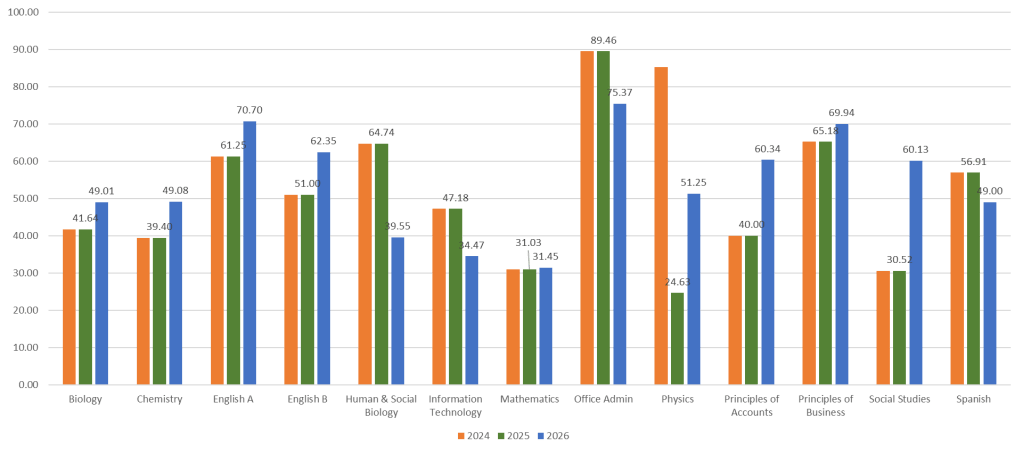
She said nine of the 13 subjects offered saw great increases, with mathematics showing one of the smallest percentage increases, while some subjects had great decreases.
Mathematics had an increase of less than one per cent from 2025, moving to 31.45 per cent from 31.03 per cent. The other subjects have varying levels of increases: Biology – 49.01 per cent from 41.64 per cent; Chemistry – 49.08 per cent from 39.4 per cent; English A – 70.7 per cent from 61.25 per cent; English B – 62.35 per cent from 51.0 per cent; Human and Social Biology – 39.55 per cent down from 64.74 per cent; information technology – 34.47 per cent down from 47.18 percent; office administration 75.37 per cent down from 89.46 per cent; Physics 51.25 per cent from 24. 63 per cent; Principles of Accounts – 60.34 per cent from 40.0 per cent; Principles of Business 69.94 per cent from 65.18 per cent; Social Studies 60.13 per cent from 30.52 per cent; and Spanish 49.0 per cent down from 56.91 per cent. (See chart below).
Image courtesy CXC
Manning said there was a concerning degree of absenteeism across the region, with 35 per cent of candidates being absent.
“We are still encouraging the region, that for every student who registers for an exam but you do not turn up, it means you have missed the opportunity of performing and achieving. It is important to note that the confidence of your teachers and your parents and community support is saying to you, at least turn up. We want to encourage the candidates for May/June examinations, even if it is that you’re feeling unprepared, we are encouraging you, it may be that you are more prepared than you realised and it’s important just to show up.”
She said CXC did surveys to determine the cause of absenteeism, which were mostly lack of preparedness, as well as other issues on the day of the exam. She said CXC was working with ministries to provide additional support, especially for students doing the exam privately.
She said for Trinidad and Tobago, the participation was a bit lower than normal, with absenteeism also being a concern.
Manning said some of the technical challenges faced were internet connectivity, electrical outages and delays in candidates getting to centres. She said no issues lasted longer than 30 minutes and CXC worked with utility providers and local registrars to ensure examinations were carried out, including sharing timetables. She said mechanisms were embedded to ensure that students did not lose time, including for hardship considerations.
She said CXC had developed a digital model and was ensuring that a digital maturity assessment was being done on an annual basis. She said the organisation was working with territories to ensure that the digital maturity of students was aligned to what exists in CXC.
Wesley said the January 2026 session was an opportunity for schools to assess their readiness to administer e-assessments for the May/June examinations.
Manning said for May/June, only subjects that can only be tested electronically would be administered by e-assessment, such as animation and digital media. She said for those examinations, most subjects would not necessarily be administered electronically, but there are territories who have done fully electronic exams.
She said there were no irregularities or instances of collusion between students in this session, as opposed to May/June 2025.
Discover more from Paula Lindo - Our histories, stories, present, future.
Subscribe to get the latest posts sent to your email.
