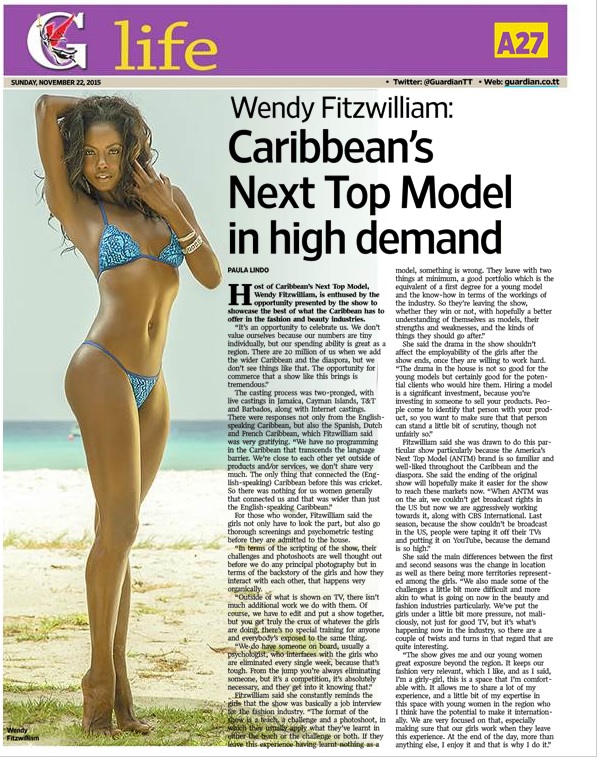
Host of Caribbean’s Next Top Model, Wendy Fitzwilliam, is enthused by the opportunity presented by the show to showcase the best of what the Caribbean has to offer in the fashion and beauty industries.
“It’s an opportunity to celebrate us. We don’t value ourselves because our numbers are tiny individually but our spending ability is great as a region. There are 20 million of us when we add the wider Caribbean and the diaspora, but we don’t see things like that. The opportunity for commerce that a show like this brings is tremendous.”
The casting process was two-pronged, with live castings in Jamaica, Cayman, T&T and Barbados, along with internet castings. There were responses not only from the English-speaking Caribbean, but also the Spanish, Dutch and French Caribbean, which Fitzwilliam said was very gratifying. “We have no programming in the Caribbean that transcends the language barrier. We’re close to each other yet outside of products and/or services, we don’t share very much. The only thing that connected the (English-speaking) Caribbean before this was cricket. So there was nothing for us women generally that connected us and that was wider than just the English-speaking Caribbean.”
For those who wonder, Fitzwilliam said the girls not only have to look the part, but also go through thorough screenings and psychometric testing before they are admitted to the house. “In terms of the scripting of the show, their challenges and photoshoots are well thought out before we do any principal photography but in terms of the backstory of the girls and how they interact with each other, that happens very organically. Outside of what is shown on TV, there isn’t much additional work we do with them. Of course we have to edit and put a show together, but you get truly the crux of whatever the girls are doing, there’s no special training for anyone and everybody’s exposed to the same thing.”
“We do have someone on board, usually a psychologist, who interfaces with the girls who are eliminated every single week, because that’s tough. From the jump you’re always eliminating someone, but it’s a competition, it’s absolutely necessary, and they get into it knowing that.”
Fitzwilliam said she constantly reminds the girls that the show is basically a job interview for the fashion industry. “The format of the show is a teach, a challenge and a photoshoot, in which they usually apply what they’ve learnt in either the teach or the challenge or both. If they leave this experience having learnt nothing as a model, something is wrong. They leave with two things at minimum, a good portfolio which is the equivalent of a first degree for a young model and the know-how in terms of the workings of the industry. So they’re leaving the show, whether they win or not, with hopefully a better understanding of themselves as models, their strengths and weaknesses and the kinds of things they should go after.”
She said the drama in the show shouldn’t affect the employability of the girls after the show ends, once they are willing to work hard. “The drama in the house is not so good for the young models but certainly good for the potential clients who would hire them. Hiring a model is a significant investment, because you’re investing in someone to sell your products. People come to identify that person with your product, so you want to make sure that that person can stand a little bit of scrutiny, though not unfairly so.”
Fitzwilliam said she was drawn to do this particular show particularly because the America’s Next Top Model brand is so familiar and well-liked throughout the Caribbean and the diaspora. She said the ending of the original show will hopefully make it easier for the show to reach these markets now. “When ANTM was on the air, we couldn’t get broadcast rights in the US but now we are aggressively working towards it, along with CBS International. Last season, because the show couldn’t be broadcast in the US, people were taping it off their TVs and putting it on YouTube, because the demand is so high.”
Fitzwilliam said the main differences between the first and second seasons was the change in location as well as there being more territories represented among the girls. “We also made some of the challenges a little bit more difficult and more akin to what is going on now in the beauty and fashion industries particularly. We’ve put the girls under a little bit more pressure, not maliciously, not just for good TV, but it’s what’s happening now in the industry, so there are a couple of twists and turns in that regard that are quite interesting.”
“The show gives me and our young women great exposure beyond the region. It keeps our fashion very relevant, which I like, and as I said, I’m a girly-girl, this is a space that I’m comfortable with. It allows me to share a lot of my experience, and a little bit of my expertise in this space with young women in the region who I think have the potential to make it internationally. We are very focused on that, especially making sure that our girls work when they leave this experience. At the end of the day more than anything else I enjoy it and that is why I do it.”
Discover more from Paula Lindo - Our histories, stories, present, future.
Subscribe to get the latest posts sent to your email.
