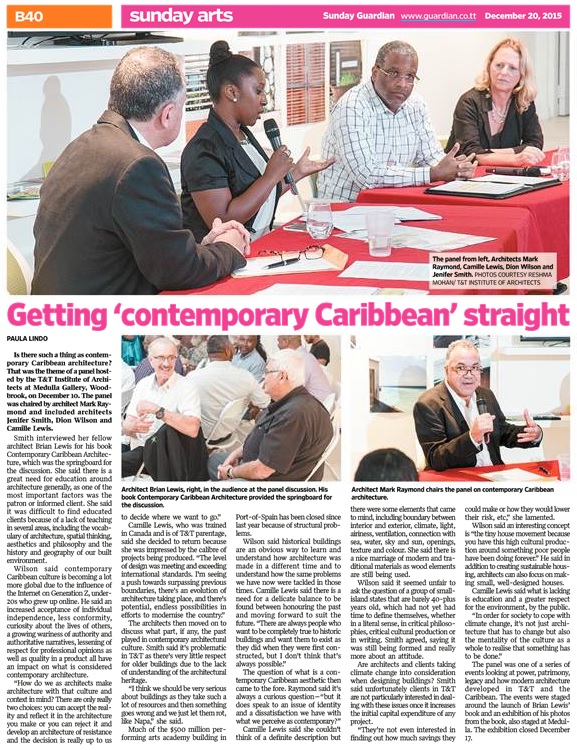
Is there such a thing as contemporary Caribbean architecture? That was the theme of a panel hosted by the T&T Institute of Architects at Medulla Gallery on December 10. The panel was chaired by architect Mark Raymond and included architects Jenifer Smith, Dion Wilson and Camille Lewis.
Smith said there is a great need for education around architecture generally, as one of the most important factors was the patron or informed client. She said it was difficult to find educated clients because of a lack of teaching in several areas, including the vocabulary of architecture, spatial thinking, aesthetics and philosophy and the history and geography of our built environment.
Wilson said contemporary Caribbean culture is becoming a lot more global due to the influence of the internet on Generation Z, under-20’s who grew up online. He said an increased acceptance of individual independence, less conformity, curiosity about the lives of others, a growing wariness of authority and authoritative narratives, lessening of respect for professional opinions as well as quality in a product all have an impact on what is considered contemporary architecture.
“How do we as architects make architecture with that culture and context in mind? There are only really two choices: you can accept the reality and reflect it in the architecture you make or you can reject it and develop an architecture of resistance and the decision is really up to us to decide where we want to go.”
Lewis, who was trained in Canada and is of T&T parentage, said she decided to return because she was impressed by the calibre of projects being produced. “The level of design was meeting and exceeding international standards. I’m seeing a push towards surpassing previous boundaries, there’s an evolution of architecture taking place, and there’s potential, endless possibilities in efforts to modernize the country.”
The architects then moved on to discuss what part, if any, the past played in contemporary architectural culture. Smith said it’s problematic in T&T as there’s very little respect for older buildings due to the lack of understanding of the architectural heritage. “I think we should be very serious about buildings as they take such a lot of resources and then something goes wrong and we just let them rot, like NAPA.”
Wilson said historical buildings are an obvious way to learn and understand how architecture was made in a different time and to understand how the same problems we have now were tackled in those times. Lewis said there is a need for a delicate balance to be found between honouring the past and moving forward to suit the future. “There are always people who want to be completely true to historic buildings and want them to exist as they did when they were first constructed, but I don’t think that’s always possible.”
The question of what is a contemporary Caribbean aesthetic then came to the fore. Raymond said it’s always a curious question “but it does speak to an issue of identity and a dissatisfaction we have with what we perceive as contemporary.”
Lewis said she couldn’t think of a definite description but there were some elements that came to mind, including boundary between interior and exterior, climate, light, airiness, ventilation, connection with sea, water, sky and sun, openings, texture and colour. She said there is a nice marriage of modern and traditional materials as wood elements are still being used.
Wilson said it seemed unfair to ask the question of a group of small-island states that are barely 40-plus years old, which had not yet had time to define themselves yet, whether in a literal sense, in critical philosophies, critical cultural production or in writing. Smith agreed, saying it was still in formation and really more about an attitude.
Are architects and clients taking climate change into consideration when designing buildings was the final question. Smith said unfortunately the clients in T&T are not particularly interested in dealing with these issues once it increases the initial capital expenditure of any project. “They’re not even interested in finding out how much savings they could make or how they would lower their risk, etc.” Wilson said an interesting concept is “the tiny house movement because you have this high cultural production around something poor people have been doing forever.” He said in addition to creating sustainable housing, architects can also focus on making small, well-designed houses.
Lewis stated what is lacking is education and greater respect for the environment, by the public. “In order for society to cope with climate change, it’s not just architecture that has to change but also the mentality of the culture as a whole to realize that something has to be done.”
The panel was one of a series of events looking at power, patrimony, legacy and how modern architecture developed in T&T and the Caribbean.
Discover more from Paula Lindo - Our histories, stories, present, future.
Subscribe to get the latest posts sent to your email.
