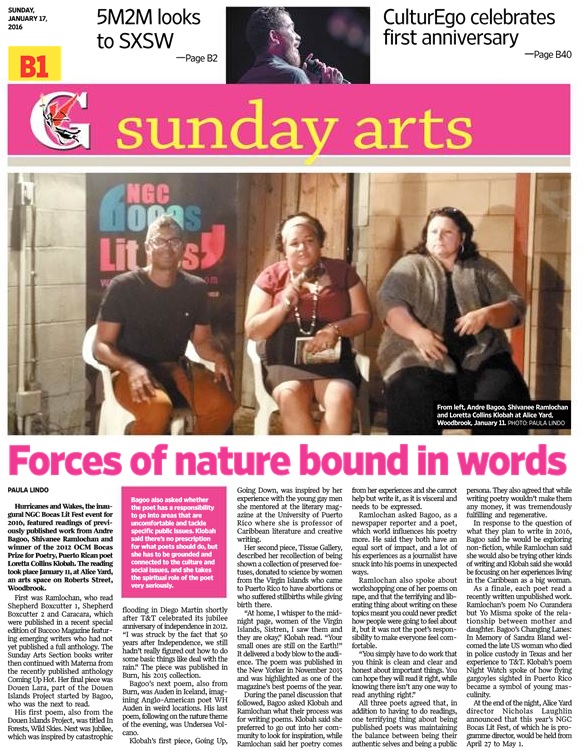
Hurricanes and Wakes, the inaugural NGC Bocas Lit Fest event for 2016, featured readings of previously published work from Andre Bagoo, Shivanee Ramlochan and winner of the 2012 OCM Bocas Prize for Poetry, Puerto Rican poet, Loretta Collins Klobah.
First was Ramlochan, who read “Shepherd Boxcutter 1,” “Shepherd Boxcutter 2” and “Caracara”, which were published in a recent special edition of Buccoo Magazine, featuring emerging writers who had not yet published a full anthology. She then continued with “Materna” from the newly published anthology Coming Up Hot. Her final piece was “Douen Lara,” part of the Douen Islands Project started by Bagoo, who was the next to read.
His first poem, also from the Douen Islands Project, was titled “In Forests, Wild Skies.” Next was “Jubilee,” from his collection Burn, which was inspired by catastrophic flooding in Diego Martin shortly after T&T celebrated its Jubilee Anniversary of Independence in 2012. “I was struck by the fact that 50 years after Independence, we still hadn’t really figured out how to do some basic things like deal with the rain.”
Bagoo’s next poem, also from Burn, was “Auden in Iceland,” imagining American poet W. H. Auden in weird locations, and his last poem, following on the nature theme of the evening, was “Undersea Volcano.”
Klobah’s first piece, “Going Up, Going Down,” was inspired by her experience with the young gay men she mentored at the literary magazine at the university where she works and was written in honour of them.
Her second piece, “Tissue Gallery” described her recollection of being shown a collection of preserved fetuses, donated to science by women from the Virgin Islands who came to Puerto Rico to have abortions or who suffered stillbirths while giving birth there. The last line of the poem, “at home, I whisper to the midnight page, women of the Virgin Islands, sistren, I saw them and they are OK. Your small ones are still on the earth,” delivered a body-blow to the audience. The poem was published in the New Yorker in November 2015 and was also chosen as one of the 20 best poems of the year.
During the panel discussion which followed, Bagoo asked Klobah and Ramlochan what their process was for writing poems. Klobah said she preferred to go out into her community to look for inspiration, while Ramlochan said her poetry comes from her experiences and she cannot help but write it, as it is visceral and needs to be expressed.
Bagoo also asked whether the poet has a responsibility to go into areas that are uncomfortable and tackle specific public issues. Klobah said there’s no prescription for what poets should do, but she has to be grounded and connected to the culture and social issues, and she takes the spiritual role of the poet very seriously.
Ramlochan asked Bagoo, as a Parliamentary reporter and a poet, which world influences his poetry more. He said they both have an equal sort of impact, and a lot of his experiences as a journalist have snuck into his poems in unexpected ways.
Ramlochan also spoke about workshopping one of her poems on rape, and that the terrifying and liberating thing about writing on these topics meant you could never predict how people were going to feel about it, but it was not the poet’s responsibility to make everyone feel comfortable. “You simply have to do work that you think is clean and clear and honest about important things. You can hope they will read it right, while knowing there isn’t any one way to read anything right.”
All three poets agreed that, in addition to having to do readings, one of the most terrifying things about being published poets was maintaining the balance between being their authentic selves and being a public persona. They also agreed that while writing poetry wouldn’t make them any money, it was tremendously fulfilling and regenerative.
In response to the question of what they plan to write in 2016, Bagoo said he would be exploring non-fiction, while Ramlochan said she would also be trying other kinds of writing and Klobah said she would be focusing on her experiences living in the Caribbean as a big woman.
As a finale, each poet read a recently written unpublished work. Ramlochan’s poem “No Curandera But Yo Misma” spoke of the relationship between mother and daughter, while Bagoo’s “Changing Lanes: In Memory of Sandra Bland” welcomed Bland and her experience to T&T. Klobah’s poem Night Watch spoke of how flying gargoyles sighted in Puerto Rico became a symbol of young masculinity.
At the end of the night, Alice Yard facilitator Nicholas Laughlin announced that this year’s NGC Bocas Lit Fest would held from April 27 to May 1 and the anthology Coming Up Hot would be launched during the week.
Discover more from Paula Lindo - Our histories, stories, present, future.
Subscribe to get the latest posts sent to your email.
