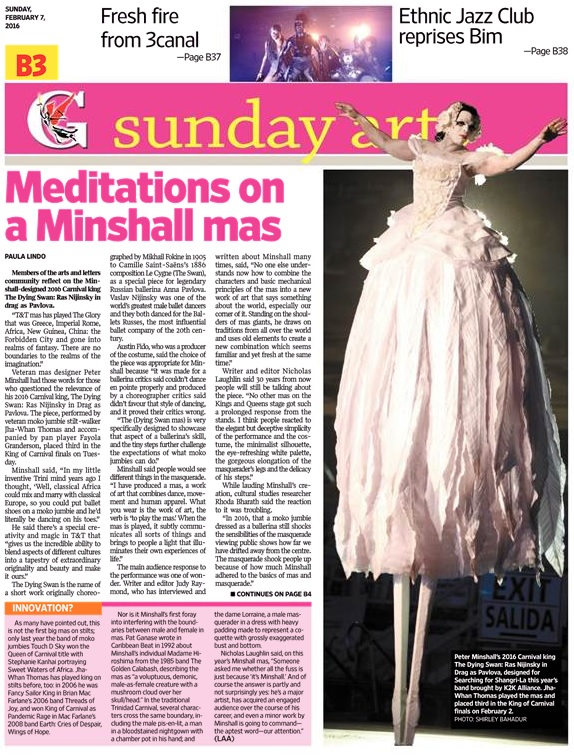
“T&T mas has played the glory that was Greece, Imperial Rome, Africa, New Guinea, China, the Forbidden City and gone into realms of fantasy. There are no boundaries to the realms of the imagination.”
Veteran masman Peter Minshall had those words for those who questioned the relevance of his 2016 Carnival King piece, “The Dying Swan: Ras Nijinsky in drag as Pavlova.”
The piece, performed by veteran Moko Jumbie stilt-walker Jha-Whan Thomas and accompanied by pannist Fayola Granderson, placed third in the finals on Tuesday.
Minshall said “in my little inventive Trini mind years ago I thought well classical Africa could mix and marry with classical Europe, so you could put ballet shoes on a Moko Jumbie and he’d literally be dancing on his toes.” He said there’s a special creativity and magic in T&T which “gives us the incredible ability to blend aspects of different cultures into a tapestry of extraordinary originality and beauty and make it ours.”
“The Dying Swan” was originally choreographed by Mikhail Fokine in 1905 to Camille Saint-Saëns’s 1886 composition The Swan, as a special piece for legendary Russian ballerina Anna Pavlova. Vaslav Nijinsky was one of the world’s greatest male ballet dancers and they both danced for the Ballets Russes, the most influential ballet company of the 20th century. Producer Austin Fido said the choice of the piece was appropriate for Minshall because “it was made for a ballerina critics said couldn’t dance en pointe properly and produced by a choreographer critics said didn’t favour that style of dancing, and it proved their critics wrong. The piece is very specifically designed to showcase that aspect of a ballerina’s skill, and the tiny steps further challenge the expectations of what Moko Jumbies can do.”
Minshall said people will see different things in the masquerade. “I have produced a mas, a work of art that combines dance, movement and human apparel. What you wear ‘is’ the work of art, the verb is ‘to play the mas.’ When the mas is played, it subtly communicates all sorts of things and brings to people a light that illuminates their own experiences of life.”
The main audience response to the performance was one of wonder. Writer/editor Judy Raymond, who has interviewed and written about Minshall many times, said “no one else understands now, how to combine the characters and basic mechanical principles of the mas into a new work of art that says something about the world, especially our corner of it. Standing on the shoulders of mas giants, he draws on traditions from all over the world and uses old elements to create a new combination which seems familiar and yet fresh at the same time.”
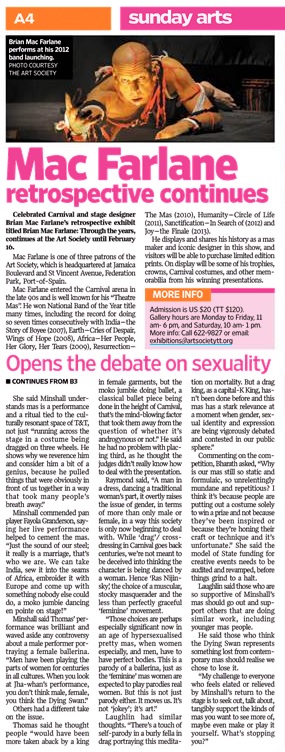
Writer/editor, Nicholas Laughlin, said 30 years from now people will still be talking about the piece. “No other mas on the Kings and Queens stage got such a prolonged response from the stands. I think people reacted to the elegant but deceptive simplicity of the performance and the costume, the minimalist silhouette, the eye-refreshing white palette, the gorgeous elongation of the masquerader’s legs and the delicacy of his steps.”
While lauding Minshall’s creation, Cultural Studies Researcher Rhoda Bharath said the reaction to it was troubling. “In 2016, that a Moko Jumbie dressed as a ballerina still shocks the sensibilities of the masquerade viewing public shows how far we have drifted away from the center. The masquerade shook people up because of how much Minshall adhered to the basics of Mas and Masquerade.” She said Minshall understands mas is a performance and a ritual tied to the culturally resonant space of T&T, not just “running across the stage in a costume being dragged on three wheels. He shows why we reverence him and consider him a bit of a genius, because he pulled things that were obviously in front of us together in a way that took many people’s breath away.”
Minshall commended pannist Fayola Granderson, saying her live performance helped to cement the mas, “just the sound of our steel, it really is a marriage, that’s who we are, we can take India, sew it into the seams of Africa, embroider it with Europe and come up with something nobody else could do, a Moko Jumbie dancing en pointe on stage!”
Minshall said Thomas’ performance was brilliant and waved aside any controversy about a male performer portraying a female ballerina. “Men have been playing the parts of women for centuries in all cultures. When you look at Jha-whan’s performance, you don’t think male, female, you think the Dying Swan.”
Others had a different take on the issue. Thomas said he thought people “would have been more taken aback by a King in female garments, but the Moko Jumbie doing ballet, a classical ballet piece being done in the height of Carnival, that’s the mind-blowing factor that took them away from the question of whether it’s androgynous or not.” He said he had no problem with placing third, as he thought the judges didn’t really know how to deal with the presentation.
Raymond said “a man in a dress, dancing a traditional woman’s part, it overtly raises the issue of gender, in terms of more than only male or female, in a way this society is only now beginning to deal with. While “drag”/cross-dressing in Carnival goes back centuries, we’re not meant to be deceived into thinking the character is being danced by a woman. Hence “Ras Nijinsky,” the choice of a muscular, stocky masquerader and the less than perfectly graceful “feminine” movement.”
“Those choices are perhaps especially significant now in an age of hypersexualised pretty mas, when women especially, and men, have to have perfect bodies. This is a parody of a ballerina, just as the “feminine” mas women are expected to play parodies real women. But this is not just parody either. It moves us. It’s not “jokey,” it’s art.”
Laughlin had similar thoughts. “There’s a touch of self-parody in a burly fella in drag portraying this meditation on mortality. But a drag king, as a capital-K king, hasn’t been done before and this mas has a stark relevance at a moment when gender, sexual identity and expression are being vigorously debated and contested in our public sphere.”
Commenting on the competition, Bharath asked “Why is our mas still so static and formulaic, so unrelentingly mundane and repetitious? I think it’s because people are putting out a costume solely to win a prize and not because they’ve been inspired or because they’re honing their craft or technique and it’s unfortunate.” She said the model of State funding for creative events needs to be audited and revamped, before things grind to a halt.
Laughlin said those who are so supportive of Minshall’s mas should go out and support others that are doing similar work, including younger mas people. He said those who think “The Dying Swan” represents something lost from contemporary mas should realize we chose to lose it. “My challenge to everyone who feels elated or relieved by Minshall’s return to the stage is to seek out, talk about, tangibly support the kinds of mas you want to see more of, maybe even make or play it yourself. What’s stopping you?”
Transcribed unedited interviews below
Minshall 1-
What made you choose that particular piece, what was the thinking? I don’t know. I’ve known of the ballet, seen it quite a few times in the classic format on the television and years ago when I was working on a show for Radio City Music Hall, something in my little inventive Trini mind that’s familiar with the Moko Jumbie and is also familiar with the classical ballet, thought ‘well classical Africa could mix and marry with classical Europe, so you’re going to put some ballet shoes on a Moko Jumbie and he’d literally be dancing on his toes. That just sat with me for years and years and years and I suppose its time to happen was now. I got caught up in the momentum and somebody said yes Minsh let’s do it and I didn’t have a band and usually you need a band to have a King and so I called the K2K Kings up and they had in fact earlier in the year kindly approached me with a view to do a collaborative piece for their band but somehow the conversation never lifted off the ground. I had gone to their fabulous launching and I thought this is right down my alley, so I rang them up and they said “Mr. Minsh, welcome to the fold.
We live on the island of Trinidad, it is most aptly called Trinity, it is Africa, India and Europe and lots of other little bits and pieces and tributaries flowing in between. My own theory on the pan is that it is the incredible offspring of the piano and the tassa drum, you don’t have to be an anthropologist to just dot the i’s and connect the t’s. And the pan and the fancy tailor and the flag woman are twin births in our history at the same time, even before Independence. There’s a creativity and a magic on this island, it’s very special, and we have the incredible ability of taking this from here, that from there and something from somewhere else and blending them together in a tapestry of extraordinary originality and beauty and making it ours.
Swan song? – I, in collaboration with a handful of dear friends, have made a mas. A mas is a work of art that combines dance, movement and human apparel. What you wear ‘is’ the work of art, the verb is ‘to play the mas,’ you play the mas. When the mas is played, it can communicate subtly all sorts of things to all sorts of people. The mas brings to people a light that illuminates their own experiences of life. Some will see this in it, some will see that in it, some will see the other.
Who better placed on the planet than us to marry classical Africa with classical Europe and do something that the world has never seen before, a Moko Jumbie dancing en pointe, on stage.
Relevance – I am bewildered by the question. T&T Mas, that has played the glory that was Greece, Imperial Rome, Africa, New Guinea, China, the Forbidden City and then gone into realms of fantasy, myself, Red, River, Tapestry, there are no boundaries to the realms of the imagination.
There was one important thing that was not acknowledged and that is the pannist, onstage, who accompanies the Swan, live. Her name is Fayola Granderson and in all the fuss being made over Minshall, there is one third person. There is Jha-whan Thomas, who plays the Swan, myself and there is Fayola Granderson who accompanies the Swan live on stage, please you must give her credit. Fayola adds so much, just the sound of our steel, it really is such a marriage, that’s who we are, we can do this, we can take India and sew it into the seams of Africa and embroider it with Europe and come up with something that nobody else could do
Why Jha-whan? Ever since Shakespeare, all through Chinese opera, in Japanese Kabuki, men play the parts of women, it’s traditional, ancient theatre and in fact Jah-wan was chosen to play it because of his extraordinary talent as a Moko Jumbie stilt-walker, he could play a giraffe. When you see it really, when you look at it, you don’t think male, female, you think the Dying Swan, and all through Shakespeare, just recently on Broadway, an all-male cast played Twelfth Night. Everyone knows that, in all the arts and all the cultures, but I also deliberately named the piece… Nijinsky and Pavlova both danced with the Ballet Russes, which was the most famous ballet company in all of the 20th century, Picasso, Coco Chanel designed for them, Stravinsky composed music for them, Njinksy and Pavlova were the very top of the top of their time and Jha-whan Thomas is at the very top of the top in our time on our island, man people swear Jha-whan born with Moko Jumbie sticks, so he plays the Dying Swan, and I think and most people agree that he does it quite brilliantly.
Judy Raymond – I haven’t looked closely at the other costumes this year, but from a decade of covering Dimanche Gras, I can say they are almost always a variation on a fancy Indian or a giant clamshell-shaped thing on wheels that the masquerader drags along around/behind him—or herself. Occasionally there are special effects with darkness/music/fireworks. it would be relevant to mention that I’ve interviewed Minshall many times and written about his work for many years.
Minshall doesn’t overestimate the value of originality, but no one else understands how to combine the characters and basic mechanical principles of the mas into a new work of art that says something about the world, and especially our corner of it, now. He draws on traditions from all over the world—because they’re all ours too (just as he drew on the work of Alexander Calder to produce his human mobiles)—and especially stands on the shoulders of mas giants and uses old elements to create a new combination—in this case, an African moko jumbie combined with European ballet—so that it seems familiar and yet fresh at the same time. Which is a characteristic of great art.
Here Minshall has stripped away all the froufrou to achieve the simplicity that only a master artist can, and yet this costume is very profound and works on all sort of levels.
To touch on just one: because it involves a man in a dress, dancing a part traditionally associated with a woman, it overtly raises one of the issues—gender, in terms of more than the most unquestioned male/female dichotomy—that this society is only now beginning to deal with. Yes, a crude “drag”/cross-dressing goes back centuries as one of the many inversions that feature in Carnival (but has there been a cross-dressed king or queen before?) and is reflected in this mas: we’re not meant to be deceived into thinking the character is being danced by a woman. Hence “Ras Nijinsky,” the choice of a muscular, stocky masquerader and the less than perfectly graceful, “feminine” movement.
And those choices are perhaps especially significant now in an age of hypersexualised pretty mas, when women especially have to have perfect bodies: genitals barely covered, not an ounce of fat, exaggerated nails/hair/makeup/spray tan/glitter/lashes way out there/stiletto boots on the road, etc (men can get away with ripped bodies and six-packs). This is a parody of a ballerina, just as the extent to which women are expected to play a “feminine” mas nowadays is so extreme that it’s a parody of real women.
And yet this is not just parody either—it moves us. It’s not “jokey,” it’s art.
Austin – I’ve been fascinated by the connections that are there, that intersection between the Moko Jumbie and the ballet is fairly obvious, its balance and its strength and it has a combined grace and that’s at the core of ballet and when you put the Moko Jumbie in that context, those are the common factors between the two. It speaks to me of what Minshall has long catered for, which is a recognition of Mas as Art, and if Mas is Art, then Mas must be capable of expressing the full range of human emotions, it can’t just be a cheerful thing or a sad thing, that’s one-dimensional art, a painting as opposed to an art form. You’re certainly showing people if it hasn’t occurred to them before or they refuse to recognize it that if ballet is considered the richer art form, that’s because they haven’t seen how a different art form can explore similar terrain and in this case he’s made it extremely explicit, he’s collided the Moko Jumbie and the ballet.
I’m not familiar with Carnival or Mas or how it gets made. About 10 days ago, I’d heard about this idea and I know Minshall was thinking about it quite seriously and he and Jah-wan had had some conversations but it became quite clear that something happened and there was a funding issue and there wasn’t any money to make it happen and I suggested to him I could give a go at getting some funding for it. So 10 days ago, this wasn’t going to happen and it’s not work I did, I put the word out to a few people and with relatively small donations, and two bigger ones from First Citizens Bank and Jimmy Aboud, but mostly with small donations from prvate individuals, we raised the money necessary to purchase the material and to get started on the fabrication in 48 hours. It’s not an expensive costume but it’s a very carefully tailored costume and when he’s up on stilts he’s wearing over 200 yards of fabric so a lot has gone into it which needed to be purchased and the people who answered the call made that happen in less than 48 hours and that made the team, the Friday before prelims we had funding, Monday was buying fabric, the first stitch was laid down on Tuesday and we were on the stage on Thursday.
Something about how the costume was put together in less than a week
I think Minshall wants to talk about is his motivation for the mas and what its significance is to him and what he hopes people get from it as they watch it but to me that’s almost a separate story about a crowd-sourced King.
The selection of the ballet solo is not just because it is extremely famous nor because it is associated with Anna Pavlova, but because it’s an archetype of that particular art form, but also Fokine himself as a choreographer was often accused of using too barefootedness and flatfooted-ness in his choreography so he made a point of creating a work that was largely en pointe. That was also significant for Pavlova because, although she died having been recognized as one of the greatest ballerinas of all time, in the earlier stages of her career, she was considered essentially someone who would never reach the highest level of ballet because her body was all wrong, her feet were too arched, her legs were too thin, her ankles were too weak, she didn’t have the necessary physique to be capable of doing what prima ballerinas were supposed to be doing in her era. She changed that perception but her dancing was often regarded as technically inferior, it was her ability to communicate emotion with the movements she was capable of that made her reputation in the interpretation of ballet. One of her technical limitations was that she couldn’t dance en pointe because of her feet, so she physically modified her shoes to be able to dance on her toes, she put pieces of wood in her shoes to give her a platform and that has now incidentally become the standard for ballet shoes, but in her day she was considered to be cheating.
So this piece was made for a ballerina who wasn’t thought to be able to dance en pointe properly and produced by a choreographer who was thought not to favour that style of dancing, so it’s an extremely apt selection by Peter Minshall for many reasons. For him it starts with the simple observation that there is a similarity of form between a Moko Jumbie and a ballerina en pointe and he picked a piece that is very specifically designed to showcase that aspect of a ballerina’s skill. This also speaks to the performance of the piece by Jha-whan, who isn’t running the full length of the stage, or making elaborate movements and this is because it’s influenced by the original choreography, which is designed for small steps and en pointe dancing and that’s another area of common ground because it further challenges the expectations of what Moko Jumbies do of making these tiny instead of giant steps. Secondly, there’s a parallel between the physical limitations of Pavlova and those of the Moko Jumbie. Pavlova perfromed the piece over 4,000 times so it should be interesting to see what Jha-whan makes of it as he continues to perform it.
It’s not an accidental choice, it’s very apt and very deliberate because you need to showcase this common ground. If this captures people’s interest and imagination, maybe Minshall himself, maybe Jha-whan, maybe other people will explore other routines, but in this particular instance in this particular moment, the Dying Swan, I’d struggle to think of a better selection.
Jha-whan has played many characters so I think part of the beauty of the presentation and the challenge of the performance is to see how he can handle playing of a woman and I think it isn’t any different from playing any other character.
For me it was a fantastic finale and experience, the crowd really seemed to love it, reacted very positively, the technical crew seemed to love it, and I loved it. I have no complaints of the whole experience. I don’t know about the judging criteria. I think Jha-whan delivered something memorable and it’s been an honour for me to see it really.
Jha-whan – the performance has taken a stage of its own. What the people are lamenting on are what they felt on the performance, but the reviews so far have been overwhelming. It’s always something I have to be better than the last and will have an even greater impact, but I think for me it will be better, but the work never stops. The reception is what is surprising because I thought they would have been more taken aback by the fact that it’s a King in female garments, but the phenomenal thing is that it’s the Moko Jumbie doing ballet, that’s the mind-blowing factor that took them away from the question of whether it’s androgynous or not, it’s just the mere fact that it’s a ballet piece being done in the height of Carnival, a classic piece. I was drawn to the piece because Minshall has been yearning to do the work for years and I know him personally. When I last played my Mas in 2012 and I fell, I went to him for counselling and he said Jah I understood what went on and the unforturnate situation reminded him of the Greek tragedy of when the Earth fell and he nurtured me around that time and told me there are so many things that could happen and you just have to do the work and I kept that in the back of my head meaning that his passion is still a living thing so when he came to me, I had other proposals to do Kings for other bands but I immediately gravitated to him because I understood where he was from a long time and it would have helped him to embrace a new chapter of his work or a new chapter in his work. So it’s informative for us both
I don’t think the judges could quite comprehend what was before them and would be confused so putting it first or last would be expected because it’s something totally out of the box and they wouldn’t know what to do with it. To me it’s a winner and marks from a judge wouldn’t tell me if my performance was good or not.
I have no problem with the placing. I knew we would have come last or something, really and truly. It’s a winner, we know it’s a winner and something out of the box but the judges didn’t have a clue what to do with it, if to accept it or not, and then I think the controversy would have been if they gave me the first place and all the other persons who win and what have you and talked about a man in a dress at Carnival, it would have been a big conflict of interest.
I am exceptionally proud of the reviews and I know it’s bound for bigger jobs and I will continue performing it just to represent what we do in T&T, we are creative persons and there is no limit to that.
Editor and writer Nicholas – Mas, in the most essential sense of the word, is not a passive spectacle. It’s an exchange between masquerader and audience — an exchange of energy, of emotion. So the most basic measure of the success of a mas-work is how the audience responds. No other mas on the Kings and Queens stage got the kind of prolonged response from the stands that The Dying Swan did. Thirty years from now, people will still be talking about it.
I think in the first place people reacted to the elegant but deceptive simplicity of the costume and the performance — the minimalist silhouette, the eye-refreshing white palette, the gorgeous elongation of the masquerader’s legs and the delicacy of his steps. It’s remarkable to me how the generally male energy of the Moko Jumbie is subverted here without sacrificing presence or scale. And then there’s the touch of self-parody in the fact of a burly fella in drag portraying this meditation on mortality.
The Dying Swan isn’t epoch-defining like Mancrab and doesn’t have the sheer populist joy-makingness (to invent a word) of Tan Tan and Saga Boy, but it’s audacious in the mere fact that it’s a cross-dressing king. As we all know, there’s nothing new about drag in mas, and Minshall’s done it before —remember Madame Hiroshima? But a drag king, so matter-of-factly presented on one of Carnival’s traditional big stages, as a capital-K king, hasn’t been done before. As many people have said, this maswork has a stark relevance at a moment when gender and sexual identity and expression are being vigorously debated and contested in our public sphere.
Someone asked me whether all the fuss is just because “it’s Minshall.” And of course the answer is partly and not surprisingly yes: he’s a major artist, has acquired an engaged audience over the course of his career, and even a minor work by Minshall is going to command — the aptest word — our attention.
At the same time, I wonder why we don’t similarly or at least adequately engage with the work of younger maspeople trying to explore and innovate in the artform. Who do exist! For example, we should be discussing and criticising with similar vigour the moko jumbie queen and king from the very small band Touch D Sky, and asking why nobody has commissioned Marlon Griffith to come back from Japan and make a full-scale mas in Port of Spain.
The Dying Swan has obviously elegiac overtones: people are also responding to it with a sense that it represents something that’s been “lost” from contemporary mas. But that something got lost because we chose to lose it. My challenge to everyone who feels a sense of elation or relief at Minshall’s return to the stage is this: seek out, talk about, tangibly support the kinds of mas you want to see more of. Maybe even make it yourself, play it yourself. What’s stopping you?
Rhoda – I’ve lots of mixed feelings about it. Minshall has been around for several decades. The concept of the Moko Jumbie is something that has been around for more than a century as a masquerade form and in 2016, that a Moko Jumbie dressed as a ballerina is still the thing to shock the sensibilities of the masquerade viewing public is a little bit unsettling for me in that it tells you how far we have drifted away from the center and how far back we have to go and dig, because the reason that that piece of masquerade shook people up in the last four or five days has everything to do with how much Minshall has adhered to the basics of what is Mas and Masquerade. He understands that masquerade is a performance, it is not just “run across the stage in a costume that is being dragged on three wheels,” it is a production, there are elements to a production and he built on that, he understands that masquerade is spectacle, he understands that masquerade is ritual and that that ritual is tied to so many different things in a space that has so many different cultures resonating. I felt it was particularly instructive that he chose to use ideas of the Creolization process, so you have something that is African-based in terms of its origin, being overlaid by something that is considered to be classical European and then you had classical European music being played on the New World steelpan. So merging and mixing the elements in that way, I felt gave us something that was new. So for me it was important that we could still do things like this and see it be put on display and see how we can pull from all the things that are here, because we have all the resources and the tools here and Minshall shows why we think of him with so much reverence and why we consider him to be a bit of a genius, because he took things that were right there in front of our faces, that are fairly straightforward and obvious and pulled everything together in a way that took many people’s breath away. So I was grateful and thankful for that but sitting at the show last night and looking on at most of the presentations, I kept asking, “Why is our masquerade still so static, so formulaic, so unrelentingly mundane and repetitious?” And I think it’s because people here are putting out a costume for prizes, they’re not putting out a costume because they’ve been inspired or because they’re honing their craft or technique, they’re putting out costumes to win a prize and that it is unfortunate. I think that’s partly why Mark Lyndersay’s latest piece about State funding for Carnival has resonated with me so deeply. I really think we need to start looking at the model of State funding of creative events and see what is working and what is not working and get rid of the things that aren’t working, otherwise things are going to grind to a halt.
Discover more from Paula Lindo - Our histories, stories, present, future.
Subscribe to get the latest posts sent to your email.
