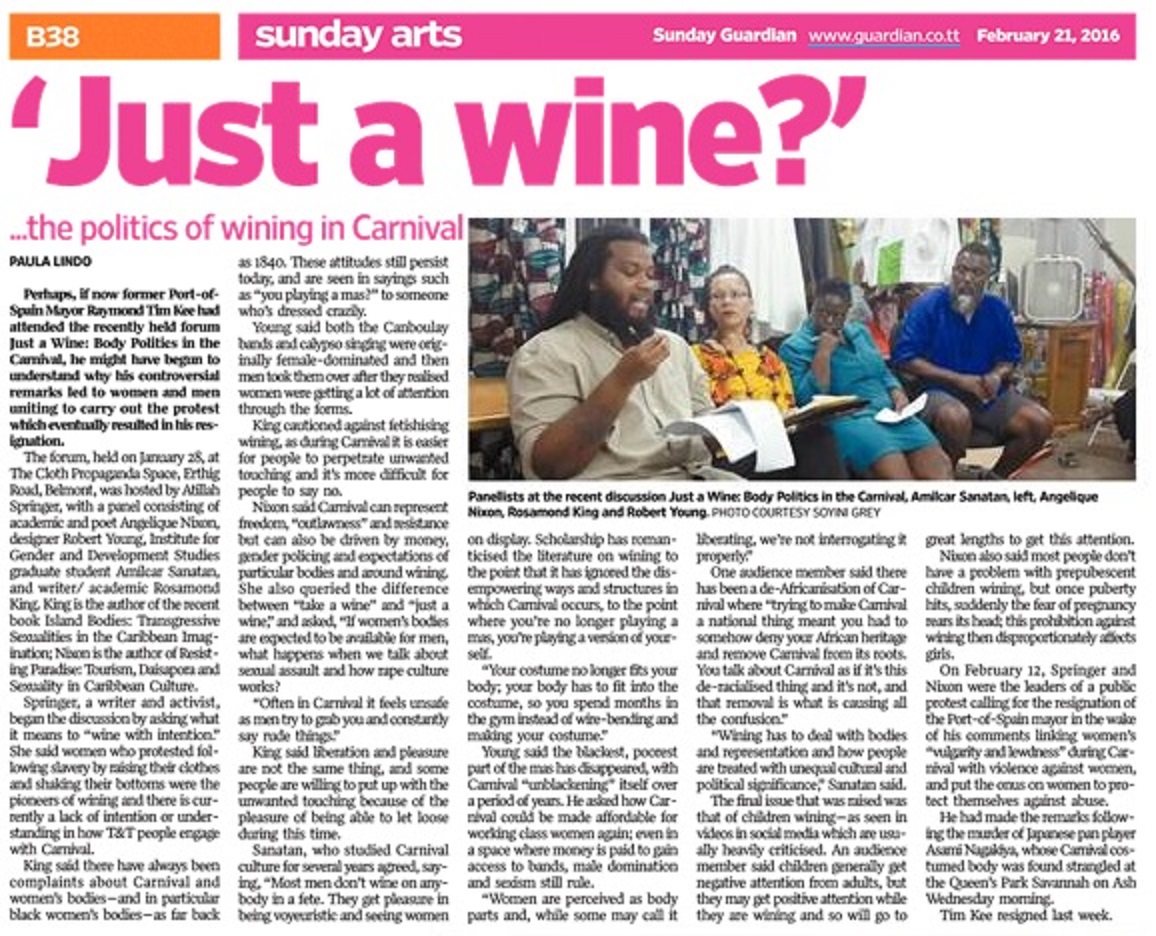
Perhaps if now ex- Port-of-Spain Mayor Raymond Tim Kee had attended the recently held forum, “Just a Wine: Body Politics in the Carnival,” he might have begun to understand why his controversial remarks led to women and men uniting to carry out the protest which eventually resulted in his resignation.
The forum, held on January 28 at The Cloth, Erthig Road, Belmont, was hosted by Atillah Springer, with a panel consisting of writer/poet Angelique Nixon, mas-man Robert Young, IGDS graduate student Amilcar Sanatan, and writer/teacher Rosamond King.
Springer began the discussion by asking what it means to wine with intention. She said women who protested following slavery by raising their clothes and shaking their bottoms were the pioneers of wining and there is currently a lack of intention or understanding in how Trinbagonians engage with Carnival.
King said there have always complaints about Carnival, women’s bodies and in particular black women’s bodies, as far back as 1840. These attitudes still persist today, and are seen in sayings such as ‘you playing a mas?’ to someone who’s dressed crazily. Young said both the Canboulay bands and calypso singing were originally female-dominated and then men took them over after they realized women were getting a lot of attention.
King also cautioned against fetishizing wining, as during Carnival it is easier for people to perpetrate unwanted touching and it’s more difficult for people to say no. Nixon said Carnival can be freedom, outlawness and resistance but can also be driven by money, gender policing and expectations of particular bodies and around wining. She also queried the difference between “take a wine” and “just a wine”, and asked, “if women’s bodies are expected to be available for men, what happens when we talk about sexual assault and how rape culture works. Often in Carnival it feels unsafe as men try to grab you and constantly say rude things.” King said liberation and pleasure are not the same thing, and some people are willing to put up with the unwanted touching because of the pleasure of being able to let loose during this time.
Sanatan agreed, saying “Most men don’t wine on anybody in a fete, they get pleasure in being voyeuristic and seeing women on display. Scholarship has romanticised the literature on wining to the point that it has ignored the disempowering ways and structures in which Carnival occurs, to the point where you’re no longer playing a mas, you’re playing a version of yourself. Your costume no longer fits your body, your body has to fit into the costume, so you spend months in the gym instead of wirebending and making your costume.”
Young said the blackest, poorest part of the mas has disappeared, with Carnival unblackening itself over a period of years. He asked how can Carnival be made affordable for working class women again. Young said even in a space where money is paid to gain access to bands, male domination and sexism still rule. “Women are perceived as body parts and while some may call it liberating, we’re not interrogating it properly.”
One audience member said there has been a de-Africanization of Carnival where “trying to make Carnival a national thing meant you had to somehow deny your African heritage and remove Carnival from its roots. You talk about Carnival as if it’s this de-racialized thing and it’s not, and that removal is what is causing all the confusion.”
Sanatan also said Carnival in T&T is conducted along a racial continuum of men and women and how they interact with each other, usually privileging white over brown over black bodies, which leads to a moral panic from some religious communities as Indian people gain increased visibility in this space. “Wining has to deal with bodies and representation and how people are treated with unequal cultural and political significance.” An audience member shared her story of playing mas with her lighter-skinned friend. “Black male Trinbagonians would prefer to dance with her, while foreigners would dance with me; unless my partner, who is white, is here, in which case the black Trinbagonians suddenly find me attractive.”
Nixon said if people are only allowed to be free for two days of the year, it speaks to the sexual repression of our society and the restrictions that are normally placed on citizens. An audience member said she saw Carnival as an opportunity for adults to engage in play and exploration, similar to what children do. Nixon also asked what it meant for people who did not identify with traditional gender roles and/or are same-sex/gender loving to have access to this freeness at Carnival.
The final issue that was raised was that of children wining as seen in videos in social media, which are usually heavily critcized. An audience member said children generally get negative attention from adults, but they may get positive attention while they are wining and so will go to great lengths to get this attention. Nixon also said most people don’t have a problem with prepubescent children wining, but once puberty hits, suddenly the fear of pregnancy rears its head, which disproportionately affects girls.
One audience member said everyone is in a state of becoming someone else during Carnival, especially when playing traditional mas, and Carnival is about occupying another identity. Another audience member said Carnival is a cultural space with potential for liberation for everyone, “but it comes from a specific history and once you come from a shared background of oppression you can come here and find healing but you have come to it at a specific point in your life where you need the liberation.”
Discover more from Paula Lindo - Our histories, stories, present, future.
Subscribe to get the latest posts sent to your email.
