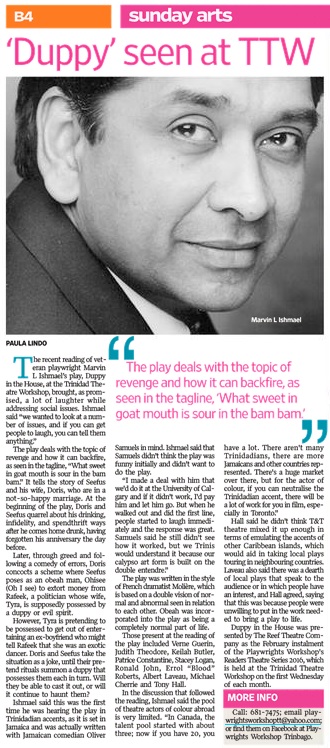
The recent reading of veteran playwright Marvin L Ishmael’s play, Duppy In The House, at the Trinidad Theatre workshop, brought, as promised, a lot of laughter while addressing social issues. Ishmael said “we wanted to look at a number of issues, and if you can get people to laugh, you can tell them anything.”
The play deals with the topic of revenge and how it can backfire, as seen in the tagline “What sweet in goat mouth is sour in the bam bam.” It tells the story of Seefus and his wife, Doris, who are in a not-so-happy marriage.
At the beginning of the play, Doris and Seefus quarrel about his drinking, infidelity, and spendthrift ways after he comes home drunk, having forgotten his anniversary the day before. Later, through greed and following a comedy of errors, Doris concocts a scheme where Seefus poses as an obeah man, Ohisee (Oh I see) to extort money from Rafeek, a politician whose wife Tyra is supposedly possessed by a ‘duppy’ or evil spirit. However, Tyra is pretending to be possessed to get out of entertaining an ex-boyfriend who might tell Rafeek that she was an exotic dancer. Doris and Seefus take the situation as a joke, until their rituals summon a duppy which possesses them each in turn. Will they be able to cast it out, or will it continue to haunt them?
Ishmael said this is the first time he was hearing the play in Trinidadian accents, as it is set in Jamaica and was actually written with Jamaican comedian Oliver Samuels in mind. Ishmael shared that Samuels didn’t think the play was funny initially and didn’t want to do the play. “I made a deal with him that we’d do it at the University of Calgary and if it didn’t work, I’d pay him and let him go. But when he walked out and did the first line, people started to laugh immediately and the response was great. Samuels said he still didn’t see how it worked, but we Trinis would understand it because our calypso art form is built on the double entendre.”
Issues of relationships between men and women were explored in the play. An interesting conversation between Seefus and Doris dealt with the ‘ramifications of being a man’ which seemed to mean keeping up with the boys at the bar and responding positively to any women approaching him. However, Seefus had a real problem with any semblance of ‘tit for tat’ when it came to Doris taking a lover, going as far as to fight a man he thought she had been sleeping with. Another thought-provoking relationship was that of Rafeek and Tyra, where she pretends to be possessed rather than tell him the truth of her past, for fear of his rejection even though they are married. This also plays into the notion that while men can play around, anything hinting of a scandal surrounding a woman can lead to her being shunned.
A jarring moment came when Seefus begins to lift Tyra’s skirts while she’s unconscious, in front of Doris and Rafeek and then gets vexed when turned back. No-one seemed to have a real problem with it, accepting it as something a man might try to do in the circumstances.
The play was written in the style of French dramatist Molière, which is based on a double vision of normal and abnormal seen in relation to each other. Thus, obeah was incorporated into the play as being a completely normal part of life.
Those present at the reading of the play included Verne Guerin, Judith Theodore, Keilah Butler, Patrice Constantine, Stacey Logan, Ronald John, Errol ‘Blood’ Roberts, Albert Laveau, Michael Cherrie and Tony Hall.
In the discussion which followed, Ishmael said the pool of theatre actors of colour abroad is very limited. “In Canada, the talent pool started with about three, now if you have 20, you have a lot. There aren’t many Trinidadians, there are more Jamaicans and other countries represented. There’s a huge market over there, but for the actor of colour, if you can neutralize the Trinidadian accent, there will be a lot of work for you in film, especially in Toronto.”
Hall said he didn’t think T&T theatre mixed it up enough in terms of emulating the accents of other Caribbean islands, which would aid in taking local plays touring in neighbouring countries. Laveau also said there was a dearth of local plays that speak to the audience or in which people have an interest, and Hall agreed, saying that this was because people were unwilling to put in the work needed to bring a play to life.
“Duppy in the House” was presented by The Reef Theatre Company as the February installment of the Playwrights Workshop’s Readers Theatre Series 2016, which is held at the Trinidad Theatre Workshop on the first Wednesday of each month.
For more information, call 681-7475, email: playwrightsworkshoptt@yahoo.com or find them on Facebook at Playwrights Workshop Trinbago.
Discover more from Paula Lindo - Our histories, stories, present, future.
Subscribe to get the latest posts sent to your email.
