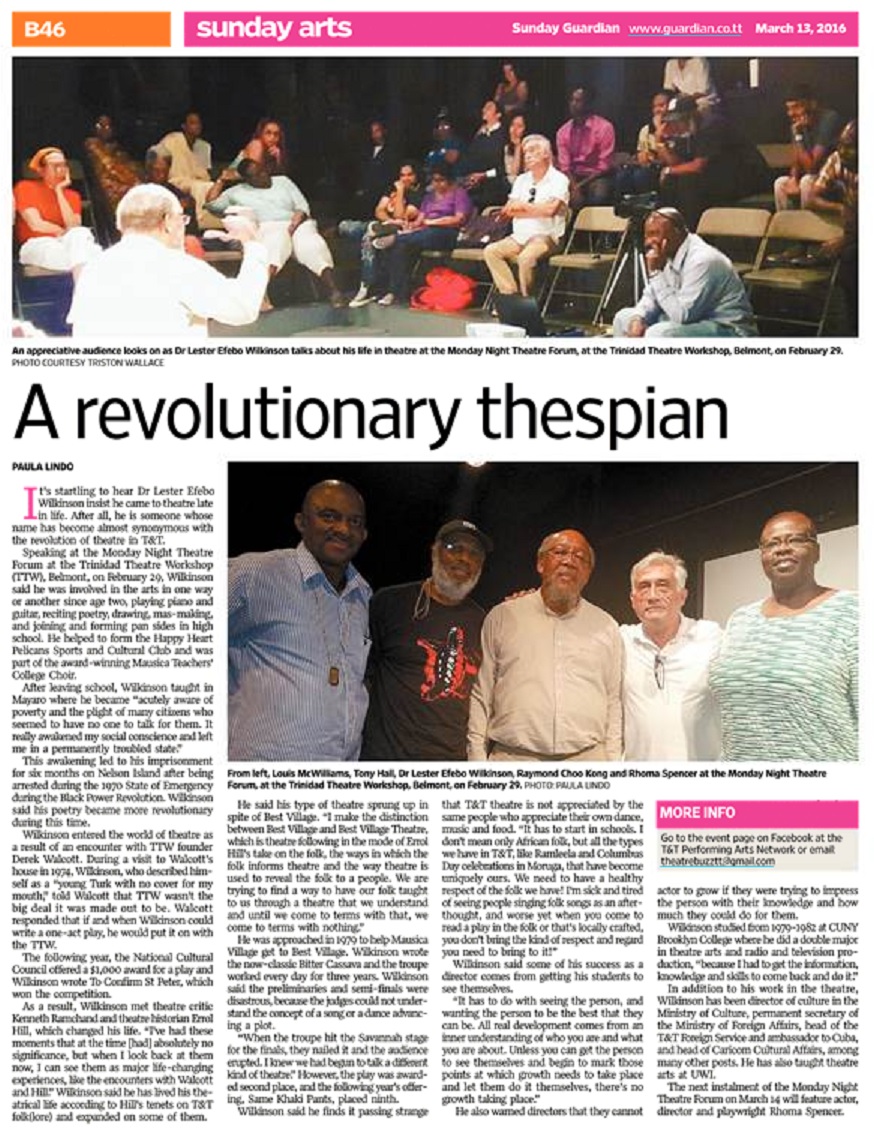
For someone whose name has become almost synonymous with the revolution of theatre in T&T, it’s startling to hear Dr. Lester Efebo Wilkinson insist he came to theatre late in life.
Speaking at the Monday Night Theatre Forum at the Trinidad Theatre Workshop (TTW) on February 29, Wilkinson said he was involved in the Arts in one way or another since age two, playing piano and guitar, reciting poetry, drawing, mas-making, and joining and forming pan sides in high school. He helped to form the Happy Heart Pelicans Sports and Cultural Club and was part of the award-winning Mausica Teachers’ College Choir.
After leaving school, Wilkinson taught in Mayaro where he became “acutely aware of poverty and the plight of many citizens who seemed to have no one to talk for them. It really awakened my social conscience and left me in a permanently troubled state.” This awakening led to his involvement in several movements and his imprisonment for six months on Nelson Island after being arrested during the 1970 State of Emergency. Wilkinson said his poetry became more revolutionary during this time.
Wilkinson entered the world of theatre as a result of an encounter with TTW founder Derek Walcott. During a visit to Walcott’s house in 1974, Wilkinson, who described himself as a “young Turk with no cover for my mouth,” told Walcott that TTW wasn’t the big deal it was made out to be. Walcott responded that if and when Wilkinson could write a one-act play, he would put it on with the TTW.
The following year, the National Cultural Council offered a $1,000 award for a play and Wilkinson wrote “To Confirm St. Peter,” which won the competition. As a result, Wilkinson met theatre critic Kenneth Ramchand and theatre historian Errol Hill, which changed his life. “I’ve had these moments that at the time have absolutely no significance, but when I look back at them now, I can see them as major life-changing experiences, like the encounters with Walcott and Hill.” Wilkinson said he has lived his theatrical life according to Hill’s tenets on T&T folk(lore) and expanded on some of them.
He was approached in 1979 to help Mausica Village get to Best Village. Wilkinson wrote “Bitter Cassava” and the troupe worked every day for three years. Wilkinson said the preliminaries and semi-finals were disastrous, because the judges could not understand the concept of a song or a dance advancing a plot. “When the troupe hit the Savannah stage for the finals, they nailed it and the audience erupted. I knew we had begun to talk a different kind of theatre.” However, the play was awarded second place, and the following year’s offering, “Same Khaki Pants” placed ninth.
Wilkinson studied from 1979 to 1982 at CUNY Brooklyn College where he did a double major in Theatre Arts, as well as Radio and Television production, “because I had to get the information, knowledge and skills to come back and do it.”
He said his type of theatre sprung up in spite of Best Village. “I make the distinction between Best Village and Best Village Theatre, which is theatre following in the mode of Errol Hill’s take on the folk, the ways in which the folk informs theatre and the way theatre is used to reveal the folk to a people. We are trying to find a way to have our folk taught to us through a theatre that we understand and until we come to terms with that, we come to terms with nothing.”
Wilkinson said he finds it passing strange that T&T theatre is not appreciated by the same people who appreciate their own dance, music and food. “It has to start in schools. I don’t mean only African folk, but all the types we have in T&T, like RamLeela and Columbus Day celebrations in Moruga, that have become uniquely ours. We need to have a healthy respect of the folk we have! I’m sick and tired of seeing people singing folk songs as an afterthought, and worse yet when you come to read a play in the folk or that’s locally crafted, you don’t bring the kind of respect and regard you need to bring to it!”
Wilkinson said some of his success as a director comes from getting his students to see themselves. “It has to do with seeing the person, and wanting the person to be the best that they can be. All real development comes from an inner understanding of who you are and what you are about. Unless you can get the person to see themselves and begin to mark those points at which growth needs to take place and let them do it themselves, there’s no growth taking place.” He also warned directors that they cannot begin to help the actor to grow if they were trying to impress the person with their knowledge and how much they could do for them.
In addition to his work in the theatre, Wilkinson was Director of Culture, Permanent Secretary of different Ministries, Head of the T&T Foreign Service and Ambassador to Cuba, among many other accomplishments.
The next installment of the Monday Night Theatre Forum on March 14 will feature actor, director and playwright Rhoma Spencer. Interested persons can find the event on Facebook at the Trinidad and Tobago Performing Arts Network or email theatrebuzztt@gmail.com.
Unedited notes below
Born in Tunapuna in 1947, Wilkinson said he was always involved in the arts in some way or another, playing piano at age two and reciting poetry and drawing art in school. Speaking at the Monday Night Theatre Forum at the Trinidad Theatre Workshop (TTW) on February 29, he reminisced about learning the art of mas-making through osmosis and using the guitar, his favourite instrument, to compose music and songs. Growing up, he played with steelbands Tropical Harmony and Nightingales and was part of a college boys and girls pan side with students of QRC and St. Mary’s College. He also helped to form the sports and cultural club, Happy Heart Pelicans Club, where he played Creeper Jones in ‘Flight of the Sparrow,” and was part of the Mausica Teachers’ College Choir, which won many awards at the Music Festival.
Wilkinson moved on to teach at Ortoire, Mayaro, where he said he “acutely aware of poverty and the plight of many citizens who seemed to have no one to talk for them”, having led a somewhat sheltered life. “I came across really abject poverty, children walking from St. Joseph Village to Ortoire barefoot with a little piece of roti or bake to share for four or five.” It really awakened my social conscience and has left me in the permanently troubled state in which I am. I don’t think I could ever grow past that point where I’m deeply concerned about what goes on in this life. As long as there is one person in this life who is dispossessed, who is oppressed in one way or the other, then we are all the poorer for it.” This awakening led to his involvement in several movements, including the recently formed NJAC, and his imprisonment for six months on Nelson Island after being arrested on the morning of April 21st 1970 during the State of Emergency. ““It’s part of my life I’m very proud about and if I had to do it over, I’d do it the same way, just be a bit more thoughtful this time so that before they catch me, some things would happen.” Wilkinson said this marked a turning point in his life, as his poetry became more revolutionary.
He said he entered the world of theatre as a result of an encounter with master playwright Derek Walcott. During a visit to Walcott’s house in 1974, Wilkinson, who described himself as a “young Turk with no cover for my mouth,” told Walcott that TTW wasn’t the big deal it was made out to be. Walcott responded that if and when Wilkinson could write a one-act play, he would put it on with the TTW. Wilkinson promptly forgot about the challenge.
The following year, poet Earl Lovelace told Wilkinson that the National Cultural Council was offering a $1,000 award for a play and he “had better write the play he said he would write.” After being reminded several times, Wilkinson sat down and wrote “To Confirm St. Peter,” which ended up winning the competition. When he went to collect his cheque in St. Clair, Wilkinson met theatre critic Kenneth Ramchand and theatre historian Errol Hill, another life-changing experience. “I’ve had these moments that at the time they have absolutely no significance, but when I look back at them now, I can see them as major life-changing experiences, like the encounter with Walcott and the encounter with Hill. I remember Ramchand saying in his assessment that it was an almost perfect one-act play, but hearing Errol Hill saying he would not have given it the first prize and his reasons had to do with the place of the ‘folk’ in our society. I didn’t understand and asked him to talk to me some more, and that ended up being a lifelong friendship until he died, where not only have I followed his arguments but I’ve extended a few of them, and I have lived my theatrical life in a sense according to those tenets of Errol Hill, and they are as valid today as they were 30, 40 years ago, and I wish we would listen to what he has to say and begin to make a theatre based on some concerns that he has.”
The following year, in 1976, I wrote Capital Death which was staged on TV, and found out from Tony Hall that theatre could be studied abroad.
I kept referencing Hill’s comments about the value of the folk, how they’re not as recognized as they should be and there are so many colourful characters, the Carnivals and the music and how it could be used to underscore the theatre, about the language and an idiom that could be used for the theatre.
In 1976, while teaching at the Malabar RC school, Wilkinson began teaching all the Arts to all the grades, including dance, choral speaking and art. He put on Christmas pageants incorporating Errol Hill’s folk, over three years. In 1979, when he realized he was getting no clear answers about different aspects of theatre in T&T, he decided to go abroad to study. Just as he was finishing up a pageant at Malabar RC, which had become very well-known, he was approached by Horace James to shoot the show for the following year. A friend who saw it on TV came to him and asked him to go to Mausica Village to help them to get to Best Village. Wilkinson said he had been violently opposed to how Best Village was being run, without any clear reason, but agreed to help Mausica Village. He appreciated that even though they knew nothing about theatre, they threw their whole beings into it. Wilkinson became determined to write a play that was not a Best Village play and wrote Bitter Cassava. The troupe worked every single day for three years. The first preliminary was a disaster he said, because the judges could not understand the concept of a song or a dance advancing a plot, and wanted to mark the production sections separately. After reworking it, the semi-final was a bit better, but he realized that he needed to know more about the theatre. When the troupe hit the Savannah stage, they nailed it and the audience was silent for a while, until it erupted. The play was a triple tragedy which was not something that was accustomed to be seen at a Best Village competition and I knew we had begun to talk a different kind of theatre. Mausica was awarded second place. Teh following year, they put on “Same Khaki Pants,” which came ninth. Ronnie Partap, who was working for Barataria, said Wilkinson had renewed his faith in Best Village. Wilkinson acknowledged he was riding on the backs of people like Earl Lovelace and Reginald Griffith, who invented the scrim in Best Village, and that began the road I’m still on after all these years.
In 1979 I decided I was gone and went to CUNY Brooklyn College where I did a double major in Theatre Arts and everything to do with it, as well as Radio and Television production, because I had get the information, knowledge and skills to come back and do it
Came back in 1982 when Jeff Henry had done Anansi Story with TTW and when the Best Village crowd came and saw Anansi Story, they said it was a Best Village play, and coould not understand the disconnect as to why the rest of the society was looking at Best Village in a disparaging manner and Anansi Story was getting all these accolades.
Mervyn de Goeas was the first person to tell me about the value of Same Khaki Pants, which I cannot see to this day. By 1984, we took Bitter Cassava into the National Drama Festival, it was magical and people in NDATT were against it because there was no script, but it won several awards that year, and Same Khaki Pants did the same the following year. I make the distinction between Best Village Theatre, which is theatre following in the mode of Errol Hill’s take on the folk and the ways in which the folk informs the theatre and the way the theatre is used to reveal the folk to a people, not Best Village per se, but Best Village theatre which is a form of theatre that’s dynamic and that grew to a large extent out of and in spite of the Best Village experience.
My journey has taken me through this dance with the folk through the Creative Arts Centre where I’ve taught, I was Director of Culture, Permanent Secretary of different Ministries, Head of T&T Foreign Service, Ambassador to Cuba, but I always kept my commitment to teach at the Department of Creative and Festival Arts, where I taught the Directing II Course and when I came back in 2010, I was asked to continue and I determined that it would become a signature course of the DCFA. I’ve seen where people look at students who get selected for Directing II differently and they themselves begin to work differently. So that’s part of the commitment that I’ve had to take the story of the folk and what the folk can do for the theatre into the University Halls. We tend to not remember theatre. There’s a mistaken belief that there’s a true line from the Greeks all the way down to today in the theatre, but that is not so. The historians tell us that when Rome died in the sixth century, the theatre died with it. It remained in four folk forms: wandering mimes, minstrelsy, some Carnivals and a player called the scop. Historian say the theatre rose again from these four wellsprings, beginning in the Church and then becoming more vernacular, and eventually growing into the forms we know today. So what was happening in Europe is what has been happening in the Caribbean, where we have been finding a way to have our folk taught to us through a theatre that we understand and until we come to terms with that, we come to terms with nothing.
The kind of work I did is reintroduced every day, when people try to vernacularize a foreign play, like 2015’s Cinderella: A T&T Musical. I find it passing strange that people who claim to appreciate soca and chutney and create their own dances when they go to parties, and who like bake and shark and who will talk about what sauce they have to get on doubles, I find it passing strange that their mouths don’t start to water the same way when they talk about theatre and the la jablesse and the lagahoo, etc.
“We need to have a healthy respect of the folk that we have! I’m sick and tired of seeing people singing folk songs as an afterthought! And worse yet when you come to read a play in the folk or that’s locally crafted, you don’t bring the kind of respect and regard you need to bring to it! Let me tell you, if you’re going to genuflect before Moliere and Ibsen and Chekov and Shaw and Shakespeare, before you do the math and say please show me these wares that you have, show me all these thoughts that you want to share with these people, please help me find a way to show them, if you genuflect before them, we call that adulation, then you damn well genuflect before Bitter Cassava, and ask Same Khaki Pants to show me your wares in the same way!” It has to start in schools, and when I say folk, I don’t mean only African folk, but all the types we have in T&T, like RamLeela and Columbus Day celebrations in Moruga, that have become uniquely ours. There are so many iconic moments we can present our young people with to fire them up and get them excited about this life and get them excited about who they are, that they will begin to do their part to bring new folk characters and who knows where it will go, but we have to begin.”
One of Wilkinson’s former students asked about the way he guides his students and how does he get the best out of his actors. “All real development comes from an inner understanding of who you are and what you are about. Unless you can get the person to see themselves and begin to mark those points at which growth needs to take place and let them do it themselves, there’s no growth taking place. You can’t really grow people unless they want to grow.” “When I teach directing, there are some clear processes that I can teach and there are some clear ways of searching for production values that I use, and ways to harness these values to your audience.” “But it has to do with seeing the person, and wanting the person to be the best that they can be and your finding those point of strengths in the person and those points of weakness and helping the person to see them so they can begin to suppress some of those weaknesses, but also to use some of those weaknesses, as they can sometimes be your strengths, depending on what your task is. I suspect that you cannot begin to help the person to grow if you are too caught up in trying to impress the person with how much you know and how much you can do for them.
Discover more from Paula Lindo - Our histories, stories, present, future.
Subscribe to get the latest posts sent to your email.
