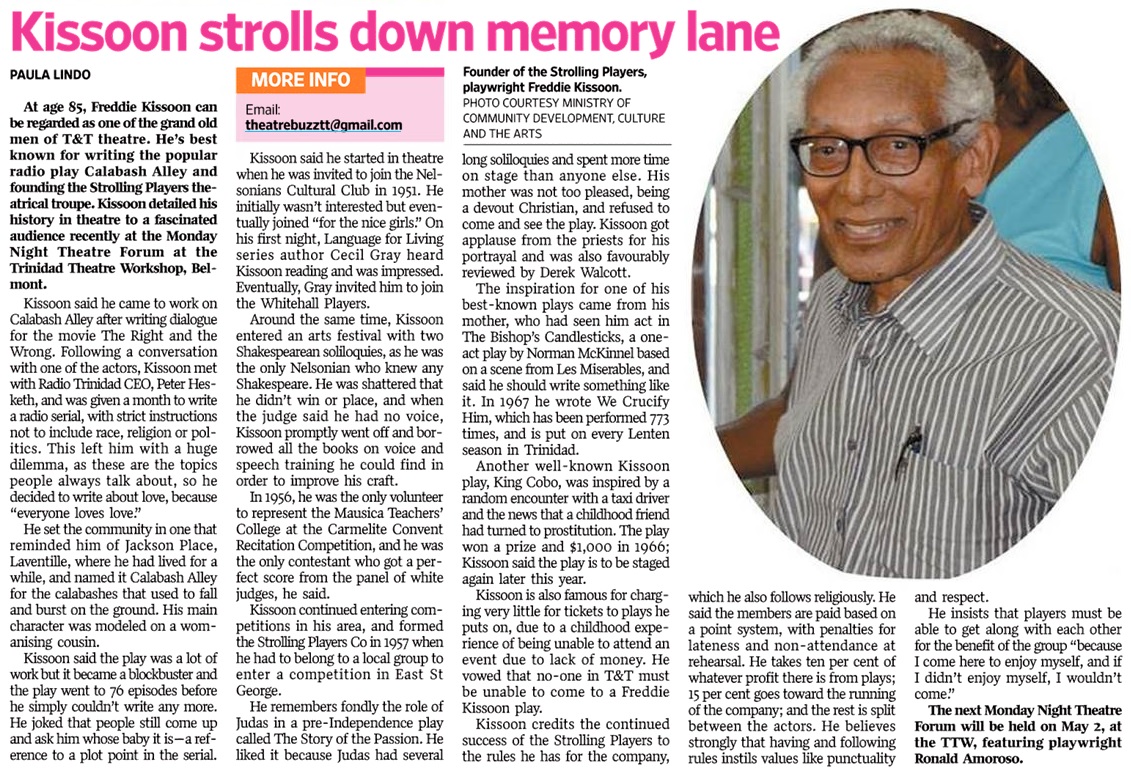
At age 85, Freddie Kissoon can be regarded as one of the grand old men of T&T theatre. He’s best known for being the creator of the popular radio play, Calabash Alley, and the founder of the Strolling Players theatrical troupe.
Kissoon detailed his history in theatre to a fascinated audience at the Monday Night Theatre Forum at the Trinidad Theatre Workshop recently.
Kisson said he came to work on Calabash Alley after writing dialogue for the movie “The Mystic Masseur,” which ended up winning best Film at an Atlanta Film Festival. Following a conversation with one of the actors, Kissoon met with Radio TT CEO, Peter Hesketh, and was given a month to write a radio serial, with strict instructions not to include race, religion or politics. This left him with a huge dilemma, as these are the topics people always talk about, so he decided to write about love, because “everyone loves love.”
He set the community in one that reminded him of Jackson Place, Laventille, where he had lived for a while, and named it Calabash Alley for the calabashes that used to fall and burst on the ground. His main character was modeled on a womanizing cousin.
Kissoon said the play was a lot of work but it became a blockbuster and the play went to 76 episodes before he simply couldn’t write any more. He joked that people still come up and ask him whose baby it is.
Kissoon said he got his start in theatre when he was invited to join the Nelsonians Cultural Club in 1951. He initially wasn’t interested but eventually joined “for the nice girls.” On his first night, Language for Living series author Cecil Gray, heard Kissoon reading and was impressed. Eventually, Gray invited him to join the Whitehall Players.
Around the same time, Kissoon entered the Arts Festival with two Shakespearean soliloquies, as he was the only Nelsonian who knew any Shakespeare. He was shattered that he didn’t win or place, and when the judge said he had no voice, Kissoon promptly went off and borrowed all the books on voice and speech training he could find in order he could improve his craft.
In 1956, he was the only volunteer to represent the Government Teachers Training College at the Carmelite Convent Recitation Competition, where he was the only contestant who got a perfect score from a panel of white judges. Kissoon continued entering competitions in his area, and formed the Strolling Players Company in 1957 when he had to belong to a local group to enter a competition in East St. George.
He remembers fondly the role of Judas in a pre-Independence play called “The Story of the Passion.” He liked it because Judas had several long soliloquies and spent more time on stage than anyone else. His mother was not too pleased, being a devout Christian, and refused to come and see the play. Kissoon got applause from the priests for his portrayal and was also favorably reviewed by Derek Walcott.
The inspiration for one of his most well-known plays came from his mother, who had seen him act in “the Bishop’s Tale” an adaption of a scene from Les Miserables, and said he should write something like it. In 1967, he wrote “We Crucify Him,” which has been performed 773 times, and is put on every Lenten season.
Another well-known play, King Cobo, was inspired by a random encounter with a taxi driver and the news that a childhood friend had turned to prostitution. The play won first prize in the PNM 10th anniversary competition in 1966 and netted the author $1,000. Kissoon said the play is to be staged again later this year. He speculated about bringing back some of the other plays he had done, but said too much would have to be changed in some to bring them up to date.
Kissoon is also famous for charging very little for tickets to plays he puts on, due to a childhood experience of being unable to attend an event due to lack of money. He vowed that no-one in T&T must be unable to come to a Freddie Kissoon play.
Kissoon credits the continued success of the Strolling Players to the rules he has for the company, which he also follows religiously. He said the members are paid based on a point system, with penalties for lateness and non-attendance at rehearsal. He takes 10% of whatever profit there is from plays, 15% goes toward the running of the company and the rest is split between the actors. He believes strongly in having and following rules, which instills values like punctuality and respect. He insists that players must be able to get along with each other for the benefit of the group “because I come here to enjoy myself, and if I didn’t enjoy myself, I wouldn’t come.”
Discover more from Paula Lindo - Our histories, stories, present, future.
Subscribe to get the latest posts sent to your email.

I am trying to track down Freddie’s son Richard. Can you assist?