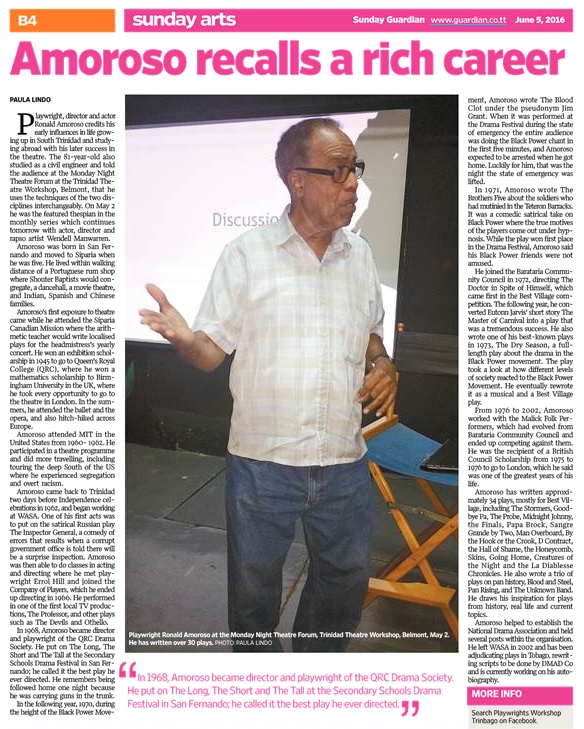
Playwright, director and actor Ronald Amoroso credits his early influences in life growing up in South Trinidad and studying abroad with his later success in the theatre. The 81-year-old also studied as a civil engineer and told the audience at the Monday Night Theatre forum that he uses the techniques of the two disciplines interchangeably.
Amoroso was born in San Fernando and moved to Siparia when he was five. He lived within walking distance of a Portuguese rum shop where Shouter Baptists would congregate, a dancehall, a movie theatre, and Indian, Spanish and Chinese families. Amoroso’s first exposure to theatre came while he attended the Siparia Canadian Mission where the Arithmetic Teacher would write localized plays for the Headmistress’s yearly concert. He won an exhibition scholarship in 1945 to go to Queen’s Royal College (QRC), where he won a Mathematics Scholarship to Birmingham University in the UK, where he took every opportunity to go to the theatre in London. In the summers, he attended the ballet and the opera, and also hitchhiked across the Continent. Amoroso then attended M.I.T. in the United States from 1960 to 1962. He participated in a theatre program and did more traveling, including touring the Deep South of the US where he experienced segregation and overt racism.
Amoroso came back to Trinidad two days before Independence Celebrations in 1962, and began working at WASA. One of his first acts was to put on the satirical Russian play “The Inspector General,” about the comedy of errors which results when a corrupt government office is told there will be a surprise inspection. Amoroso was now able to do classes in acting and directing, where he met Errol Hill and joined the Company of Players, which he ended up directing in 1966. He performed in one of the first TV productions, “The Professor” and other plays such as “The Devils” and “Othello.”
In 1968, he became director and playwright of the QRC Drama Society. He put on “The Long, The Short and The Tall,” at the Secondary Schools Drama Festival in San Fernando, which he called the best play he ever directed. He remembers being followed home one night, because he was carrying guns in the trunk.
The following year, during the height of the Black Power Movement in 1970, Amoroso wrote “The Blood Clot” under the pseudonym Jim Grant. When it was performed at the Drama Festival, during the State of Emergency (SoE), the entire audience was doing the Black Power chant in the first five minutes, and Amoroso expected to be arrested when he got home. Luckily for him, that was the night the SoE was lifted. In 1971, Amoroso wrote “The Brothers Five” about the soldiers who had mutinied in the Teteron Barracks, which was a comedic satirical take on Black Power where the true motives of the players come out under hypnosis. While the play won first place, Amoroso said his Black Power friends were not amused.
He joined the Barataria Community Council in 1972, where he directed “The Doctor in Spite of Himself,” which came first in the Best Village competition. The following year, he converted Eutonn Jarvis’ short story “The Master of Carnival” into a play, which was a tremendous success. He also wrote one of his best known plays in 1973, “The Dry Season”, a full length play about the drama in the Black Power movement. The play took a look at how different levels of society reacted to the Black Power Movement and was very popular. He eventually rewrote it as a musical and a Best Village play. From 1976 to 2002, Amoroso worked with the Malick Folk Performers, which had evolved from Barataria Community Council and ended up competing against them. He was the recipient of a British Council Scholarship from 1975 to 1976 to go to London, which he said was one of the greatest years of his life.
Amoroso has written approximately 34 plays, mostly for Best Village, including The Stormers, Goodbye Pa, The Probe, Midnight Johnny, The Finals, Papa Brock, Sangre Grande by Two, Man Overboard, By the Hook or the Crook, D Contract, The Hall of Shame, The Honeycomb, Skins, Going Home, Creatures of the Night and the La Diablesse Chronicles. He also wrote a trio of plays on the steelband history, Blood and Steel, Pan Rising, and The Unknown Band. He draws his inspiration for plays from history, real life and current topics.
Amoroso helped to establish the National Drama Association of T&T and held several posts within the organization. He left WASA in 2002 and has been adjudicating plays in Tobago, rewriting scripts to be done by DMAD Company and is currently working on his autobiography.
Unedited notes below
Ronald Amoroso credits his early influences in life growing up in South Trinidad and studying abroad with his later success in the theatre. 81-year-old Amoroso studied as a civil engineer and told the audience at the Monday Night Theatre forum that he uses the techniques between the two disciplines interchangeably.
He was born in San Fernando, and some of his earlier memories are of men dancing in skirts at an Indian wedding and [the tassas being drowned after Hosay]
When he moved to Siparia, he met various characters including one called Engine, who used to drive a donkey cart dressed in a black coat, tails and gloves. He also lived in close proximity to x Mohammed, later Hassanali, Cuthbert Joseph’s school, a Portuguese rum shop where the Shouter Baptists would congregate occasionally, a dancehall and Indian, Spanish and Chinese families. A woman called Ma Fidel was a neighbor and the inspiration for a character in “The Dry Season” while obliquely opposite his house was the Regent Theatre, where Amoroso used to run across to watch movies when he could get away from his father. “I didn’t mind getting a belt across from my hand for being naughty, but I hated being restricted from going to the movies.”
Amoroso’s first exposure to theatre came while he attended the Siparia Canadian Mission where the Arithmetic Teacher would write localized plays for the Headmistress’s yearly concert. The children made their own props and costumes, and even though the plays were adapted from British ones with fairies and elves, they were set in localized settings. He went to almost every church in the area, Presbyterian, Anglican, Catholic.
Amoroso won an exhibition scholarship in 1945 to go to Queen’s Royal College, and lived with his aunt in Tunapuna. He took Mathematics because he said he knew he couldn’t compete with those doing English and Literature. On his third try, he won a Mathematics Scholarship to Birmingham University in the United States, which had an excellent drama club and also the Birmingham Rep. He couldn’t participate in any of the productions because of his schedule, but attended some, and at every break he would go to London to watch theatre from the cheap seats. In the summers, he attended the ballet and the opera, and also hitchhiked across the Continent , staying at youth hostels. In his final year, he got a part in Arthur Miller’s “A Memory of Two Mondays” because they wanted a person of colour, and he said this is where he began his formal training in theatre. After finishing at Birmingham, Amoroso attended M.I.T. from 1960 to 1962. He wasn’t able to participate in theatre while studying there, but during his traveling during breaks, he took part in a training program in Colorado Springs, and in a bar in San Francisco, he saw a gay guy performing Carmen, which gave him some insight into how theatre could be enacted in a small space.
When his studies were finished, Amoroso got three months extension, which he spent touring the Deep South of the US where he experienced overt racism and segregation, as this was during the era of Martin Luther King and Malcolm X.
Amoroso came back to Trininad two days before Independence Celebrations in 1962, and walked straight into a job working on the Islandwide Sewerage Project, and later sat on the committee which formed WASA, where he worked for the next 40 years. One of his first acts was to put on the satirical Russian play “The Inspector General,” about the comedy of errors which results when a corrupt government office is told there will be a surprise inspection. Amoroso was now able to do classes in acting and directing, where he met Errol Hill and joined the Company of Players. He got the opportunity to do one of the first TV productions, “The Professor” and other plays such as “The Devils” and “Othello.” In 1966, he found himself directing the Company of Players, never having directed anything before and the group had to be kept active. Having problems to get rehearsal space, so had to practice in the gardens in front of President’s House. They would put on the shows for churches for free.
In 1968, he became director and playwright of the QRC Drama Society after being asked to direct a play the society was going to perform at the Secondary Schools Drama Festival in San Fernando.
In 1970, he put on what he called the best play he ever directed, “The Long, The Short and The Tall,” at the Festival, and QRC came second.
The following year, Black power was in force. Amoroso was amazed at the theatre being put on in Woodford Square. He couldn’t find a play with an all-male cast that was suitable for the times, so he decided to write one. At the time, plays had to be vetted by the Police Commissioner,as this was during the State of Emergency in 1970. He knew a Black Power Play would not pass muster, so he wrote “The Blood Clot” under the pseudonym Jim Grant. When it was performed at the Secondary Schools Drama Festival, the entire audience was doing the Black Power Chant in the first five minutes, and Amoroso expected to be arrested when he got home. Luckily for him, that was the night the SOE was lifted.
Amoroso also remembered being followed home one night on the highway, coming home from a performance of The Long, The Short and the Tall, because he had guns, borrowed from the cadets, in his trunk. Luckily, some of the cast members had seen what was going on and had also followed him to make sure nothing happened.
I called it Blood Clot because I looked at the Black Power thing as something like a blood clot which can save your life by preventing you from bleeding to death, but at the same time it can block the flow of blood and kill you, so it could work both ways, and the statement I was trinity make was that Black Power had its own powers but it also had problems.
In 1971, Amoroso was inspired to write “The Brothers Five” about the soldiers who had murine in the Teteron Barracks. The play was a comedic satirical take on Black Power where the true motives of the players come out under hypnosis. While the play won first place, Amoroso said his Black Power friends were not amused.
In 1972, he joined the Barataria Community Council, where he directed “The Doctor in Spite of Himself,” which came first in the Best Village competition, eve though he thought the drama was elementary.
The following year, Amoroso converted Eutonn Jarvis’ short story “The Master of Carnival” into a play, which came first in the National Carnival Council’s competiton. It starred Clem Haynes, who had been arrested during in the SoE. The play was a tremendous success and got positive reviews from Jeremy Taylor, for once. He then made it into a Best Village musical with Rhoma Spencer.
In 1973, he wrote one of his best known plays, “The Dry Season”, a full length play about the drama in the Black Power movement, which he said got him in trouble with Eintou Springer, who felt it was making fun of Makandal Daaga. Before the play could be put on, Amoroso had to meet with the police, and post plainclothes policemen in the audience. The play took a look at how different levels of society reacted to the Black Power Movement and was very popular. It was recently redone by a local playback theatre company, DMAD Company. He also made it into a Best Village play and a musical.
Amoroso has written approximately 34 plays, mostly for Best Village. These include The Stormers and Goodbye Pa.
He helped to establish the National Drama Association of T&T in 1975 and held several posts within the organization. He was the recipient of a British Council Scholarship from 1975 to 1976 to go to London. He said this was one of the greatest years of his life, as he was staying within walking distance of a theatre and the BBC. He went to see all the major shows, especially musicals. He found the South African musicals were very similar to Best Village.
From 1976 to 2002, Amoroso worked with the Malick Folk Performers, which had evolved from Barataria Community Council and ended up competing against them.
He wrote The Probe after an incident where a WASA trench collapsed, killing three and injuring two. Midnight Johnny was his first fully integrated Best Village musical, and Chucky won Best Actor. He got the ideas for some of his plays from calypsos. Blood and Steel was one of three plays he did on steelband history. The Finals featured Bertram “Mec Mec” Jones and Roma Spencer. Papa Brock was inspired by Papa Doc and Eric Gairy*
Amoroso helped to start the WASA Sport and Cultural Club and WASA fete. Went to Grenada just after the coup, combined Gairy and Papa Doc. The play failed, because it was too serious.
Sangre Grande by Two, written by Tony Hall,*** received a negative review from Willie Chen.
Man Overboard was about the Muslimeen coup and looters.
Pan Rising was the second steelband play, talking about violence.
By the Hook or the Crook, D Contract, The Hall of Shame, about a cricketer. Back to Basics, for calypsonians. The Honeycomb, home for battered girls. Skins was directed by Che Rodriguez. Going Home was directed by Rhoma Spencer and featured his favourite dance. Creatures of the Night showed the trials of a Best Village tutor and featured the Bat Dance.
The Unknown Band was his third steelband play. The La Diablesse Chronicles was one of the best, won first prize.
After leaving WASA in 2002 to present, been adjudicating in Tobago, rewriting scripts to be done by DMAD Company, and working on his autobiography.
Discover more from Paula Lindo - Our histories, stories, present, future.
Subscribe to get the latest posts sent to your email.
