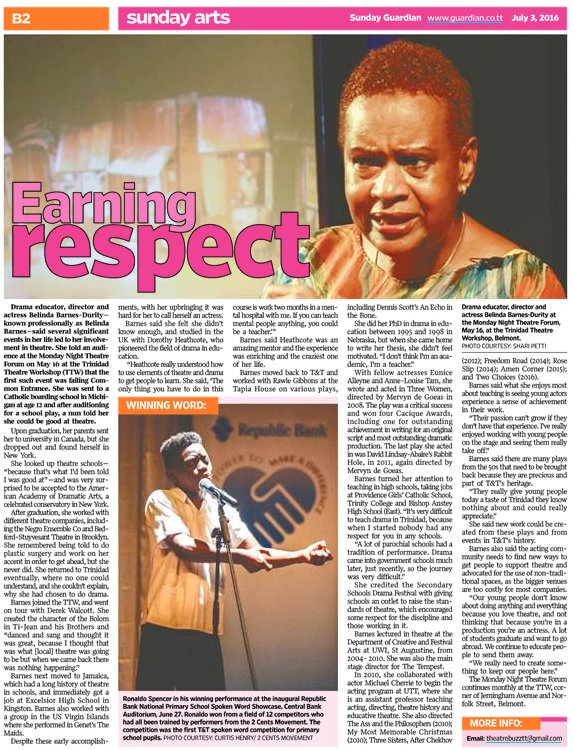
 Drama educator, director and actress Belinda Barnes said several significant events in her life led to her involvement in theatre. She told an audience at the Monday Night Theatre Forum at the Trinidad Theatre Workshop (TTW) that the first such event was failing Common Entrance. She was sent to a Catholic boarding school in Michigan at age 12 and after auditioning for a school play, a nun told her she could be good at theatre.
Upon graduation, her parents sent her to University in Canada, but she dropped out and found herself in New York. She looked up theatre schools “because that’s what I’d been told I was good at,” and was very surprised to be accepted to the American Academy of Dramatic Arts. After graduation, she worked with different theatre companies, including the Negro Ensemble Company and Bedford-Stuyvesant Theatre in Brooklyn. She remembered being told to do plastic surgery and work on her accent in order to get ahead, but she never did. She returned to Trinidad eventually, where no-one could understand, and she couldn’t explain, why she had chosen to do drama.
Barnes joined the TTW, and went on tour with Derek Walcott. She created the character of the Bolom in “Ti Jean and his Brothers” and “danced and sang and thought it was great, because I thought that was what theatre was going to be but when we came back there was nothing happening.”
Barnes next moved to Jamaica, which had a long history of theatre in schools, and immediately got a job at Excelsior High School in Kingston. Barnes also worked with a group in the US Virgin Islands where she performed in “The Maids.” She said it was hard for her to call herself an actress, due to her upbringing.
Barnes said she felt she didn’t know enough, and studied Drama in Education in the UK with Dorothy Heathcote, who pioneered the field. “Heathcote really understood how to use elements of theatre and drama to get people to learn. She said, “the only thing you have to do in this course is work two months in a mental hospital with me. If you can teach mental people anything, you could be a teacher.” Barnes said Heathcote was an amazing mentor and the experience was enriching and the craziest one of her life.
Barnes moved back to Trinidad and worked with Rawle Gibbons at the Tapia House on various plays, including “Echo in the Bone.” She did her PhD in Drama in Education between 1995 and 1998 at a University in Nebraska, but when she came home to write her thesis, she didn’t feel motivated because “I don’t think I’m an academic, I’m a teacher”. She called up fellow actress Eunice Alleyne and together they wrote and acted in “Three Women,” directed by Mervyn de Goeas in 2008. The last play she acted in was “The Rabbit Hole” in 2011, again directed by Mervyn de Goeas.
Barnes turned her attention to teaching in high schools, taking jobs at Providence Girls School, Trinity College and Bishop Anstey High School (East). “It’s very difficult to teach drama in Trinidad, because when I started nobody had any respect for you in any schools. A lot of parochial schools had a tradition of performance. Drama came into Government schools much later, just recently, so the journey was very difficult.” She credited the Secondary Schools Drama Festival with giving schools an outlet to raise the standards of theatre, which encouraged some respect.
Barnes lectured in Western Theatre History, Modern Theatre and Educative Theatre at the Department of Creative and Festival Arts at UWI, St. Augustine in 2004, and continued until 2010. She was also the main stage Director for “The Tempest.” In 2010, she collaborated with Michael Cherrie to begin the acting program at UTT, where she is an Assistant Professor in Acting, Directing, Theatre History and Educative Theatre. She also directed “The Ass and The Philosophers” (2010), “My Most Memorable Christmas” (2010), Three Sisters After Chekov” (2012); Freedom Road” (2014), “Rose Slip” (2014), “Amen Corner” (2015) and Two Choices (2016).
Barnes said what she enjoys most about teaching is seeing young actors experience a sense of achievement in their work. “Their passion can’t grow if they don’t have that experience. I’ve really enjoyed working with young people on the stage and seeing them really take off.”
Barnes said there are many plays from the 50s that need to be brought back because they are precious and part of T&T’s heritage. “They really give young people today a taste of Trinidad they know nothing about and could really appreciate.” She said new work can be created from these plays and from events in T&T’s history. Barnes also said the acting community needs to find new ways to get people to support theatre and advocated for the use of non-traditional spaces, as the bigger venues are too costly. “Our young people don’t know about doing anything and everything because you love theatre, and not thinking that because you’re in a production you’re an actress. A lot of students graduate and want to go abroad. We continue to educate people to send them away. We really need to create something to keep our people here.”
Originally published in the T&T Guardian on July 3, 2016
I’ve attached here my unedited notes from the lecture, as there are many things that had to be left out in the name of the word count.
Several significant events in her life led to her involvement in theatre. The first was failing Common Entrance, which was a disaster in her family, who were all very smart and they didn’t know what to do with her. After a year, she eventually got into a Catholic boarding school in Michigan at age 12, run by Dominican nuns. She spent four years there, didn’t know what had happened to her there. Best thing was, when she went in as a freshman, they said her parents must buy a season ticket to the Civic Auditorium in Grand Rapids, so once a month she had to dress up and go to this auditorim, so was exposed to different things like the Vienna Boy’s Choir, The King and I, and I enjoyed it. At the school they were putting on plays and to audition for a play, and she was cast as Tiger Lily, and people applauded her. She was the only black person in the school, and people would ask where she was from. You could only phone home on your birthday, so there was a distance, but I managed. A nun said I’d be good in theatre, but white people always think black people will always be good in theatre. I did a
After finishing, her father told her to go and live with her brother in Canada and go to University there. The curriculum was very different and she didn’t know a thing. She fell out with her brother, and somehow ended up in New York. She looked up theatre schools because that’s what she’d been told she was good at. and applied to the American Academy of Dramatic Arts, and I called and I applied, and auditioned, and was very surprised to be accepted. Her father said he’d never talk to her again if she decided to go to a theatre, but her elder sister said she’d pay for her to go. In her first class, where she was the only black one again, someone mentioned “black theatre” which astonished her.
She graduated, and jobs came her way. She was urged to do plastic surgery on her nose and breasts, in the 1970s, and work on her accent in order to get ahead, but she never did. Barnes worked with a theatre company that went to prisons, worked with Negro Ensemble Company, gave her her first job to go to Bed-Stuyvesant Theatre to do theatre in the street, and in different places in the US but had a longing for home so came back to Trinidad eventually, where she met with a lot of confusion and people wondering why she did drama of all things. “1. I don’t think any of my family’s friends knew I existed, and 2. because I’m home now they have to introduce me. And people wondered why drama, and I couldn’t answer them because I didn’t know, that was just how things happened.
I joined Trinidad Theater Workshop when I first came back, because they were really the theatre company to be with and there were all these actors like Albert Laveau and I walked in and I remember saying when am I going to do something and they said you have to wait and you had to wait on Derek to cast you, finally went on tour in St. Lucia, Grenada, Barbados, created the character of the Bolag and dance and sang and thought it was great, because I thought that was what theatre was going to be but when we came back there was nothing.
She went to Jamaica to meet a brother and got a job at Excelsior High School, Kingston, Jamaica, because a well-known Jamaican woman who runs a theatre in England now was leaving and they wanted someone to replace her. Jamaica was different as Jamaica has a long history of theatre in schools, so I worked there. Even though I was working as an actress, my heritage wouldn’t allow me to say I was an actress. Got involved with a group in the USVI, that’s when I did The Maids, two Americans and myself. Got into The Maids in USVI. When I finished there, I went back to Jamaica to teach, and met Dennis Scott, who had gone to study Drama in Education with the woman who pioneered it, Dorothy Heathcote. Even though I could act, I didn’t think I knew much, and I felt there was a lot I needed to know, I was never satisfied. She worked with Dorothy Heathcote to do Drama in Education, at the University of Newcastle which was the craziest experience of her life. She almost turned around and came straight back home, but her mother told her to stick it out, which she did. “It really paid off because she was a fantastic mentor. She was an actress and they told her she was too ugly to act, and would never make it, so she went into education. Heathcote really understood how to use elements of theatre and drama to get people to learn. She created a program and took 15 students every two years. I didn’t understand how big she was until I saw people coming from all over the world. The thing about it that was amazing, she said to us we had to follow her all over England or wherever it was to watch her teach. Went to Newcastle upon Tyne in the UK. She said, “the only thing you have to do in this course is work two months in a mental hospital with me.” We thought that was easy until I got into the mental institution, but her philosophy was very good, because she was making teachers and she said if you could teach mental people anything, you could be a teacher. I spent two months there and her mind and her approach was amazing. She said to me, “remember as a teacher, you are a doormat, the students will wipe their feet all over you and should be allowed to, but you must draw them up.” When I started teaching after graduating from there, I really believed and tried to emulate her philosophy, but time wears that out. Her foundation is in me and that was a really enriching experience. She spawned a lot of programs in Drama and Education “If you can teach mental people, you can teach.” Students will walk all over you but you have to draw them up. It was an enriching experience.
Came back to Trinidad, had a daughter. My parents said the only good stepfather was St. Joseph. My parents said the child couldn’t leave the house if I wasn’t there, so I had to come back.
When I came back I met and worked with Rawle Gibbons, who was now working on the whole work at the Tapia House, doing some very interesting work, yard theatre, and had early plays. They weren’t actors, just keen passionate people about theatre. “Echo in the Bone”
Went to visit a University in Nebraska, went to do graduate work, did PhD., was supposed to come home and write, didn’t have the same zeal because I don’t think I’m an academic, I’m a teacher, called Eunice Alleyne and said we must do our own work, ended up writing “3 Women.” It was different, directed by Mervyn de Goeas, It got everything out of me and that’s the thing about writing, writing and acting your stores helps to evoke your dark areas.
Was invited to join Mervyn and Andrew in their production of Rabbit Hole, it was difficult because I hadn’t acted for a long time. “If you’re actors, keep the memory going, don’t stop learning. I can’t memorize lines at all again, but we managed to get through it.” can’t remember any lines. It was a nice production, very warm, played grandmother in “Rabbit Hole” and that was the last production
“Being in Trinidad, it’s very difficult for you to get to work with a theatre company and once you’re teaching and having to put on plays, acting falls away and I think it did for me.
I’ve taught a lot, and it’s very difficult to teach drama in Trinidad, because when I started nobody had any respect for you in any schools. They’d always ask me to put on something and the parents would want to see their children on stage. It was really difficult because in a high school you had to put on shows.
“I have to give credit to Secondary Schools Drama Festival, because it was an outlet for schools to have an opportunity to raise the standards in the school and set up a kind of competition nationally, and that did encourage some respect. I’m talking about a time when drama was not in the school system. The schools I went to, the Catholic and Anglican churches understood this thing about performance, every school had a hall and you did something. A lot of parochial schools had a tradition of performance. Drama came into Government schools much later, just recently, so the journey was very difficult. Taught at Providence Girls High School Trinidad; University of Nebraska, Lincoln
Lecturer in Western Theatre History 1995-1998; Trinity College and Bishop Anstey High School (East,) Drama lecturer. (2005-2009), Director of Secondary Schools Drama Competition; University of the West Indies, Centre for the Creative Arts (2004-2010), Lecturer in Western Theatre History, Modern Theatre, Educative Theatre, Main stage Director ‘The Tempest’; University of Trinidad and Tobago (APA), Assistant Professor in Acting, Directing, Theatre History, Educative Theatre, Main Stage Director of yearly productions.
22:38 Luckily UWI opened up the DCFA and I’m sure that must have been a fight. Rawle Gibbons invited me to teach and to do a production there. In 2009 when NAPA was being built, it was a big concern because it was supposed to be a performing arts school and it was a big secret. I was very grateful to get the opportunity to start the acting programme with Michael Cherrie. DCFA and UTT, started the acting program with Michael Currie.
I like directing the most of all the things because it’s like giving birth, but it’s not a child, a play closes. What I enjoy most in directing is seeing young actors experience a sense of achievement in their work. I think there’s nothing as beautiful as that. They feel joy, they grow wings and feathers and I think it’s so good. Their passion can’t grow if they don’t have that experience. I’ve really enjoyed working with young people on the stage and seeing them really take off. That for me is the really rewarding part of it. The Ass and the Philosophers, My Most Memorable Christmas, Three Sisters After Chekov, Freedom Road, Rose Slip – one of the best T&T plays, really captures some of our past. It was beautiful. Also did Amen Corner. NAPA fell apart, so couldn’t stage plays there again, program moved to Chaguaramas, South and John Donaldson, which is sad because it’s a beautiful program where we’re all together and collaborate. I think 10 years from now we’ll see a new type of artist emerging with a sensitivity and an appreciation for all the Arts. Things take time and I appreciate what UTT has done to create this program.
“Keep interested in your career, however humble; it is a real possession in the changing fortunes of time.” That saying stuck with me when I wanted to find something else to do to make a living. We have been able to see theatre in our schools, it’s an examination subject in CXC and CAPE, it is in our universities and we have a performing arts school and we have lots of production companies emerging. Theatre peaks and falls, but it’s nice to know the theatre community is working so hard to sustain itself, and we all should applaud ourselves for that. I wish our students, our people in the arts who have never gone abroad could go abroad to see the seriousness, the focus, the importance in young people in developed countries and how they see theatre, to see how developed countries feel it necessary to market their theatre, that if our students who have never gotten the opportunity to go abroad got the opportunity, it would change our theatre, because everyone who has gone away that I know, comes back and says I have to work, they feel a difference and it’s very hard to see how people respond to theatre in our community, parents are still saying “Why you doing that? Can’t you find something else to do? How are you going to eat?” so that if we can really put our energies together to really make it work, I think and I believe we’ll be offering something to our wider community that would be so uplifting and something so beautiful.
There are lots of plays from the 50s that we don’t use and they’re really precious. This is our heritage. I think Rose Slip and Man Better Man needs to come back every five years and people need to see it as there are younger generations who would never have met it.. Douglas Archibald was really great, I’m reading another play of his, Junction Village and they’re beautiful plays, they really give young people today a taste of Trinidad they know nothing about and could really appreciate. I think we have certain classics that we should keep as part of our repertoire. We have to tease out those plays and someone has to take the responsibility of mounting them. need to see these plays, give young people a taste of Trinidad they know nothing about, part of our heritage.
It costs a lot of money to put on a play, this is why acting is so important and we need to find new ways to get people to support it. We’ve got to find new places to have theatre, not traditional places. I walk around the Savannah on a Sunday afternoon and the families are there and if someone could dare put up a stage and just come out and say come, they would get an audience. Our problem is sustaining what we do, because next week it might rain or something else might happen. Can’t depend on Queen’s Hall, NAPA and SAPA anymore, because it’s too costly. We encourage students to do one-person shows, and must feel the confidence to go and do it anywhere, but we’re not getting that yet, we need to get them to feel they could go out to any audience. People from abroad will put up a stage on the Brian Lara Promenade and do something on a Friday evening, but we’re not doing it why not us?
Our young people don’t know about doing anything and everything because you love theatre, and not thinking that because you’re in a production you’re an actress. There needs to be a revolution in theatre, there is a need for sacrifices. Need to do everything and not just because you did a production, you’re an actor/actress.
New work can also come from 50’s plays. These are the things we need to become aware of, so that we can tease out new works and new plays. People are more keen when it’s part of our history, when it’s in our ancestry and in our traditions. Other countries have been working at this for centuries and we’re now playing catchup with the developed world. Radio plays, doesn’t have to be long, can put together little pieces.
I always felt insecure being in theatre, so I don’t think anything could prevent that. I went on stage and did what I had to do on stage, but it’s when I got off the stage and had to face people, I was very insecure. “I feel it’s a law, you work hard, you persevere, you’re honest, it pays off. Your ship will come in one day, though never when we want it.”
Some people don’t have a choice when it comes to acting, you stick at it, constantly stick at it and find work. Lots of platforms to get it out.
The best thing for writing is to have a partner, your mind picks up things that relate to what you’re writing.
You can’t get from the fact that we are a jam-and-wine people and I don’t know where theatre fits into, that, I don’t even know if I want theatre to fit into that, popular entertainment. I don’t feel we have a responsibility. I think that is just an expression that really has our culture and society by grips and we have the theatre on one side.
There’s no provision for the people coming out of UTT and DCFA, there are no full-time theatre programs or a theatre season on a regular basis. Most students go into teaching, Other areas that acting skills could apply.
Want to set up a UTT Alumni group and a feeder school.
A lot of students graduate and want to go abroad. We continue to educate people to send them away. We really need to create something to keep our people here. We really need our students to do a lot more community service, we need to encourage them to give back something, whether it’s a hospital, an old people’s home, our graduates can’t just graduate with 20 hours of work. We need to in Trinidad to encourage our students to give back something, because they get this education free and it is a problem. They are so entitled, and added to that, they can do whatever they want and you can’t put them out of the school, so we have to redesign the system. The work is so different when they come outside and you try to train them a certain way.
Justina’s Calypso, was in “Who the Cap Fits” – television program
I feel I’m a natural comedian Flair for the dramatic.
Discover more from Paula Lindo - Our histories, stories, present, future.
Subscribe to get the latest posts sent to your email.
