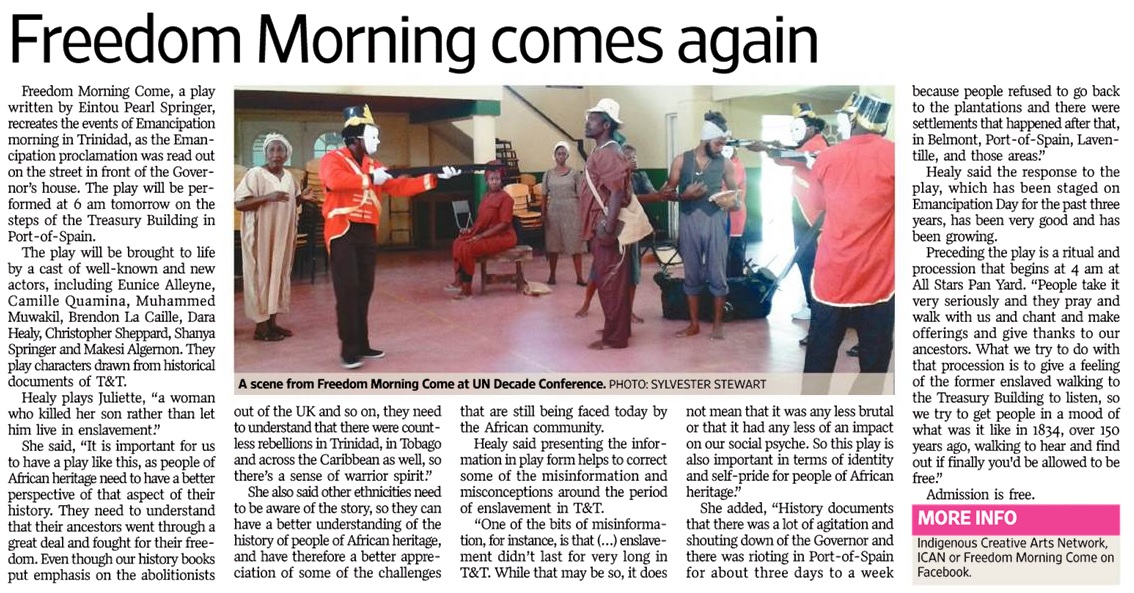
The Emancipation Day play, “Freedom Morning Come,” written by Eintou Pearl Springer recreates the events of Emancipation Morning in T&T, as the Emancipation Proclamation was read out on the streets of the Governor’s house. It will be performed at 6 am on August 1 on the steps of the Treasury Building in Port of Spain.
Originally published in the T&T Guardian on July 31, 2016
The play is brought to life by a cast of well-known and new actors, including Eunice Alleyne, Camille Quamina, Muhammed Muwakil. Brendon La Caille, Dara Healy, Christopher Sheppard, Shanya Springer and Makesi Algernon. They play characters drawn from historical documents of T&T.
The play follows the stories of the elder Ma Sandrin, who remembers her abduction and violation as if it were yesterday; Ma Titi, the priestess, whose husband never ate salt and was able to fly back home; Francois Tomby the Haitian who recounts stories of the 1804 Haitian Revolution; Juliette, the woman who killed her son rather than let him live in enslavement; Kojo, the field slave, given 200 lashes for playing his drum and Evelyn the house slave whose body is not her own.
Healy, who plays Juliette, “a woman who killed her son rather than let him live in enslavement,” said “it is important for us to have a play like this, as people of African heritage need to have a better perspective of that aspect of their history. They need to understand that their ancestors went through a great deal and fought for their freedom. Even though our history books put emphasis on the abolitionists out of the UK and so on, they need to understand that there were countless rebellions in Trinidad, in Tobago and across the Caribbean as well, so there’s a sense of warrior spirit.”
She also said other ethnicities need to be aware of the story, so they can have a better understanding of the history of people of African heritage, and have therefore a better appreciation of some of the challenges that are still being faced today by the African community.
Healy said presenting the information in play form will help to correct some of the misinformation and misconceptions around the period of enslavement in T&T. “One of the bits of misinformation for instance is that you would often hear people say that, well enslavement didn’t last for very long in T&T. While that may be so, it does not mean that it was any less brutal or that it had any less of an impact on our social psyche. So this play is also important in terms of identity and self-pride for people of African heritage. I think that through TV programs like Roots and so on, we have a better sense of the African-American experience, but we don’t really have a sense of what happened in our own country and I feel that it’s important for us to know what happened because people of African heritage need to have a better perspective of that aspect of their history, they need to understand that their ancestors went through a great deal and they fought for their freedom. Even though our history books put emphasis on the abolitionists out of the UK and so on, they need to understand that there were countless rebellions in Trinidad, in Tobago and across the Caribbean as well, so there’s a sense of warrior spirit. Other ethnicities need to be aware if it so they can have a better understanding of the history of people of African heritage, and have therefore a better appreciation of some of the challenges that are still being faced today by the African community. And so it is being done in a play form also to correct some of the misinformation and misconceptions, so it’s an easily palatable way of disseminating information and particular messages.”
The play takes place in front of the Treasury Building, which was the original site where the former slaves would have gathered to hear the Proclamation read in 1834. “History documents that there was a lot of agitation and shouting down of the Governor and there was rioting in Port of Spain for about three days to a week because people refused to go back to the plantations and there were settlements that happened after that, in Belmont, Port of Spain, Laventille and those areas.”
Healy said the response to the play, which is in its fourth year, has been very good and has been growing. Preceding the play is a ritual and procession which begins at 4 am at All Stars Pan Yard. “People take it very seriously and they pray and walk with us and chant and make offerings and give thanks to our ancestors. What we try to do with that procession is to give a feeling of the former enslaved walking to the Treasury Building to listen, so we try to get people in a mood of what was it like in 1834, over 150 years ago, walking to hear and find out if finally you’d be allowed to be free.”
Discover more from Paula Lindo - Our histories, stories, present, future.
Subscribe to get the latest posts sent to your email.
