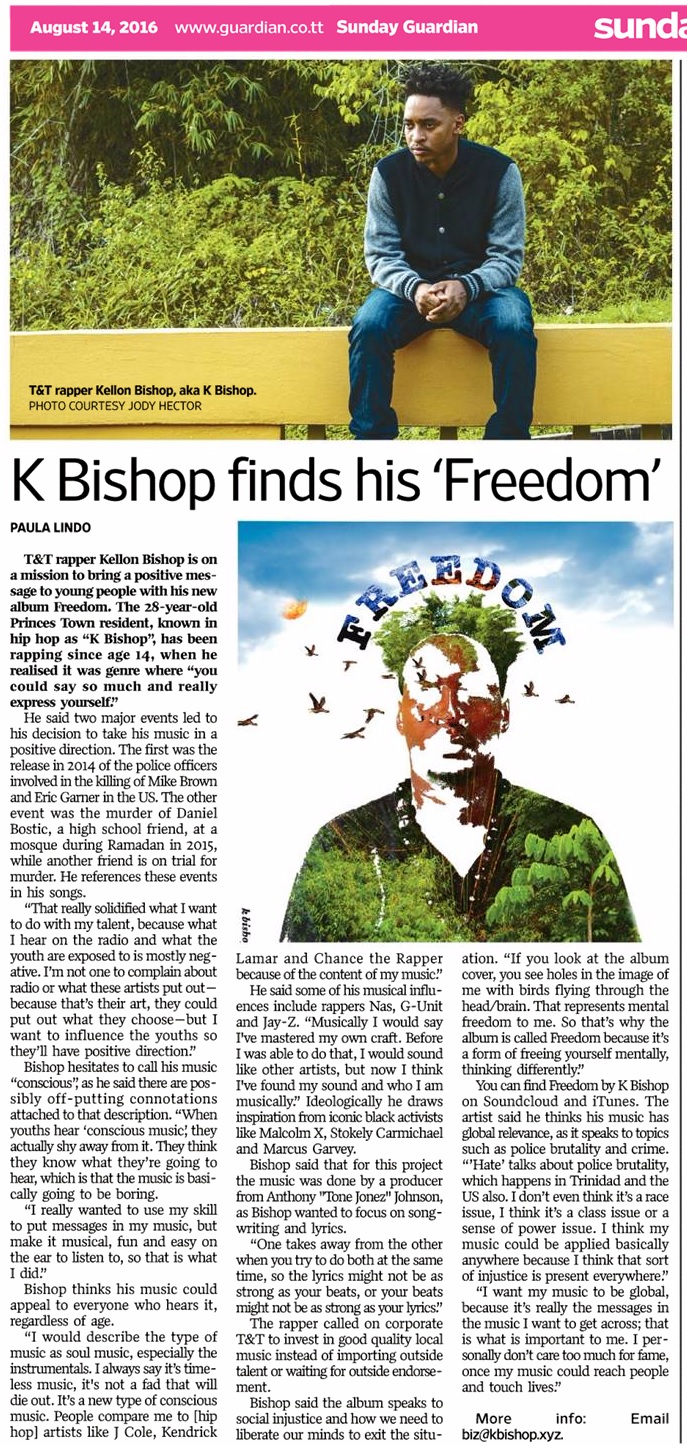
T&T rapper Kellon Bishop is on a mission to bring a positive message to young people with his new album, Freedom. The 28-year-old Princes Town resident has been rapping since age 14, when he realized it was genre where “you could say so much and really express yourself.”
He said two major events led to his decision to take his music in a positive direction. The first was the release in 2014 of the police officers involved in the killing of Mike Brown and Eric Garner in the US. The other event was the murder of a high school friend at a mosque during Ramadan in 2015, while another friend is on trial for murder. He references these events in his songs.
“That really solidified what I want to do with my talent, because what I hear on the radio and what the youth are exposed to is mostly negative. I’m not one to complain about radio or what these artists put out, because that’s their art, they could put out what they choose, but I want to influence the youths so they’ll have positive direction.”
Bishop hesitates to call his music “conscious”, as he said there are some negative connotations attached to that description. “When youths hear conscious music, they actually shy away from it, because they think they know what they’re going to hear, which is that the music is basically going to be boring. I really wanted to use my skill to put messages in my music, but make it musical, fun and easy on the ear to listen to, so that is what I did. That’s what influenced my music really, to try to get a sort of balance and an alternative to what the kids hear. The music is musical, but there are messages in the music.”
Bishop thinks his music will appeal to everyone who hears it, regardless of age. “I would describe the type of music as soul music, especially the instrumentals. I always say it’s timeless music, it’s not a fad that will die out. It’s a new type of conscious music. People compare me to artists like J Cole, Kendrick Lamar and Chance the Rapper because of the content of my music.”
He said some of his musical influences include rappers Nas, G-Unit and Jay-Z. “Musically I would say I’ve mastered my own craft. Before I was able to do that, I would sound like other artists, but now I think I’ve found my sound and who I am musically.” Ideologically he draws inspiration from greats like Malcolm X, Stokely Carmichael and Marcus Garvey.
Bishop said for this project, the music was done by a producer from Anthony “Tone Jonez” Johnson, as Bishop wanted to focus on the songwriting and lyrical aspect. “One takes away from the other when you try to do both at the same time, so the lyrics might not be as strong as your beats, or your beats might not be as strong as your lyrics.”
The rapper called on corporate T&T to invest in good quality local music instead of importing outside talent or waiting for outside endorsement.
Bishop said the album speaks to social injustice currently going on in society and how we need to liberate our minds to exit the situation. “This is not a physical chain, this is a mental freedom. If you look at the album cover, you’d see holes in the image of me with birds flying through the head/brain. That represents mental freedom to me. So that’s why the album is called Freedom because it’s a form of freeing yourself mentally, thinking differently, as opposed to what you’re exposed to daily.”
He said he thinks his music has global relevance, as it speaks to topics such as police brutality and crime. “”Hate” talks about police brutality, which happens in Trinidad and the US also. I don’t even think it’s a race issue, I think it’s a class issue or a sense of power issue. I think my music could be applied basically anywhere because I think that sort of injustice is present everywhere. In “Come for You,” I am depicting a familiar scene in the ghetto where you might hear the mother crying for her son, and saying he was a good boy, even if he was involved in a life of crime. I think that song is applicable everywhere, Trinidad, the US, the UK, wherever crime exists.”
“This music is more important than me. I can’t be in a million places at once, but my music can. I want my music to be global, because it’s really the messages in the music I want to get across, that is what is important to me. I personally don’t care too much for fame, once my music could reach people and touch lives, that’s my aim really.”
Discover more from Paula Lindo - Our histories, stories, present, future.
Subscribe to get the latest posts sent to your email.
