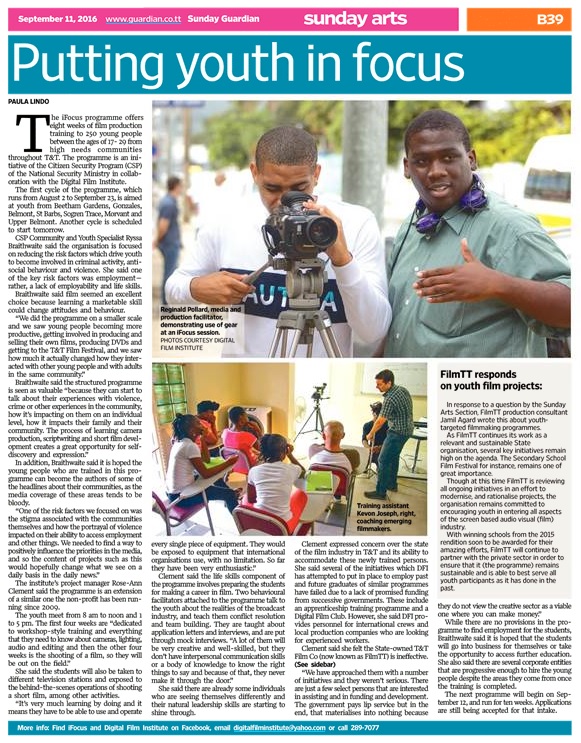
The i|Focus program offers eight weeks of film production training to 250 young people between the ages of 17 to 29 from high needs communities throughout T&T. The program is an initiative of the Citizen Security Program (CSP) of the National Security Ministry in collaboration with the Digital Film Institute.
The first cycle of the program, which runs from August 2 to September 23, is aimed at youth from Beetham Gardens, Gonzales, Belmont, St. Barbs, Sogren Trace, Morvant and Upper Belmont.
CSP Community and Youth Specialist Ryssa Braithwaite said the organization is focused on reducing the risk factors which drive youth to become involved in criminal activity, anti-social behaviour and violence. She said one of the key risk factors was employment or rather, a lack of employability and the life skills associated with these. Braithwaite said film seemed an excellent choice because learning a marketable skill could change attitudes and behaviour. “We did the program on a smaller scale and we saw young people becoming more productive, getting involved in producing and selling their own films, producing DVDs and getting to the Film Festival, and we saw how much it actually changed how they interacted with other young people and with adults in the same community.”
Braithwaite said the structured program is seen as valuable “because they can start to talk about their experiences with violence, crime or other experiences in the community, how it’s impacting on them on an individual level, how it impacts their family and their community. The process of learning camera production, scriptwriting and short film development creates a great opportunity for self-discovery and expression.”
In addition, Braithwaite said it is hoped the young people who are trained in this program can become the authors of some of the headlines about their communities, as the media coverage of these areas tends to be bloody. “One of the risk factors we focused on was the stigma associated with the communities themselves and how the portrayal of violence impacted on their ability to access employment and other things. We needed to find a way to positively influence the priorities in the media, and so the content of projects such as this would hopefully change what we see on a daily basis in the daily news.”
DFI Project Manager Rose-Ann Clement said the program is an extension of a similar program the non-profit has been running since 2009. The youth meet from 8 am to 12 pm and 1 pm to 5 pm. The first four weeks “will be dedicated to workshop style training and everything that they need to know about cameras, lighting, audio and editing and then the other four weeks is the shooting of a film, so they will be out on the field.” She said the students will also be taken to different television stations and exposed to the behind-the-scenes operations of shooting a short film, among other activities. “It’s very much learning by doing and it means they have to be able to use and operate every single piece of equipment. They would be exposed to equipment that international organizations use, with no limitation. So far they have been very enthusiastic.”
Clement said the life skills component of the program involves preparing the students for making a career in film. Two behavioural facilitators attached to the program talk to the youth about the realities of the broadcast industry, and teach them conflict resolution and team building. They are taught about application letters and interviews, and are put through mock interviews. “A lot of them will be very creative and well-skilled, but they don’t have interpersonal communication skills or a body of knowledge to know the right things to say and because of that, they never make it through the door.” She said there are already some individuals who are seeing themselves differently and their natural leadership skills are starting to shine through.
While there are no provisions to find employment for the people trained in the program, Braithwaite said it is hoped that the students will go into business for themselves or take the opportunity to access further education. She also said there are several corporate entities that are progressive enough to hire the young people despite the areas they come from once the training is completed.
Clement expressed concern over the state of the film industry in T&T and its ability to accommodate these newly trained persons. She said several of the initiatives which DFI has attempted to put in place to employ past and future graduates of similar programs have failed due to a lack of promised funding from successive governments. These include an apprenticeship training program and a Digital Film Club. However, she said DFI provides personnel for international crews and local production companies who are looking for experienced workers.
Clement said she felt the T&T Film Company is ineffective. “We have approached them with a number of initiatives and they weren’t serious. There are just a few select persons that are interested in assisting and in funding and development. The government pays lip service but in the end, that materializes into nothing because they do not view the creative sector as a viable one where you can make money.”
In response, FilmTT production consultant Jamil Agard wrote this about youth-targeted film programmes. “As FilmTT continues its work as a relevant and sustainable State organisation, several key initiatives remain high on the agenda. The Secondary School Film Festival, for instance, remains one of great importance. Though at this time FilmTT is reviewing all ongoing initiatives in an effort to modernise, and rationalise projects, the organisation remains committed to encouraging youth in entering all aspects of the screen based audio-visual (film) industry. With winning schools from the 2015 renditions soon to be awarded for their amazing efforts, FilmTT will continue to partner with the private sector in order to ensure that it (the programme) remains sustainable and is able to best serve all youth participants as it has done in the past.”
Discover more from Paula Lindo - Our histories, stories, present, future.
Subscribe to get the latest posts sent to your email.
