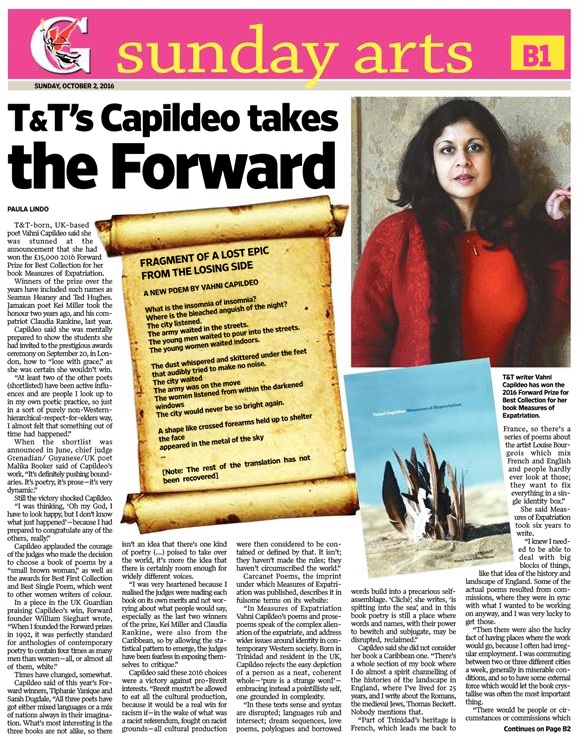
T&T born, UK based poet Vahni Capildeo said she was stunned at the announcement that she had won the £15,000 2016 Forward Prize for Best Collection for her book Measures of Expatriation. She said she was mentally prepared to show the students she had invited how to “lose with grace,” as she was certain she wouldn’t win.
“At least two of the other poets have been active influences and are people I look up to in my own poetic practice, so just in a sort of purely non-Western hierarchical respect for elders way, I almost felt that something out of time had happened. I was thinking “oh my God I have to look happy, but I don’t know what just happened” because I had prepared to congratulate any of the others really.”
Capildeo applauded the courage of the judges who made the decision to choose a book of poems by a “small brown woman,” as well as the awards for Best First Collection and Best Single Poem. “All three poets have got either mixed languages or a mix of nations always in their imagination. What’s most interesting is the three books are not alike, so there isn’t an idea that there’s one kind of poetry which is poised to take over the world, it’s more the idea that there is certainly room enough for widely different voices. I was very heartened because I realized the judges were reading each book on its own merits and not worrying about what people would say, especially as the last two winners of the prize, Kei Miller and Claudia Rankine, were also from the Caribbean, so by allowing the statistical pattern to emerge, the judges have been fearless in exposing themselves to critique.”
She also said these choices were a victory against pro-Brexit interests. “Brexit mustn’t be allowed to eat all the cultural production, because it would be a real win for racism if in the wake of what was a racist referendum, fought on racist grounds, all cultural production were then considered to be contained or defined by that. It isn’t, they haven’t made the rules, they haven’t circumscribed the world.” She added that two of the four nations in the United Kingdom, Northern Ireland and Scotland, did not vote for Brexit, but the referendum results are being presented in a way that “railroads the internal diversity of the Kingdom. It’s an internal colonialism and it’s dangerous, because you could see the Union split.”
Capildeo said she did not consider her book a Caribbean one, although it has been pigeonholed as such. “There’s a whole section of my book where I do almost a spirit channelling of the histories of the landscape in England, where I’ve lived for 25 years, and I write about the Romans, the medieval Jews, Thomas Beckett, nobody mentions that. Part of Trinidad’s heritage is French, which leads me back to France, so there’s a series of poems about the artist Louise Bourgeois which mix French and English and people hardly ever look at those, they want to fix everything in a single identity box.”
She said Measures of Expatriation took six years to write. “I knew I needed to be able to deal with big blocks of things, like that idea of the history and landscape of England. Some of the actual poems resulted from commissions, where they were in sync with what I wanted to be working on anyway, and I was very lucky to get those. Then there were also the lucky fact of having places where the work would go, because I often had irregular employment. I was commuting between two or three different cities a week, generally in miserable conditions and so to have some external force which would let the book crystallize was often the most important thing. There would be people or circumstances or commissions which would almost give me the excuse to go and work on it, when I didn’t have an external reward, like a prize or a job or a regular magazine outlet. It was a way of being able to shut my door and say, well I’m doing this for this. The external conditions for writing each book count a lot more than people realize, not only the internal impulse or imagination, but the actual externals of where can you sit and for how long.”
One of Capildeo’s main inspirations for writing poetry was her father, Devendranath Jawaharlal Capildeo, who was a self-published poet in T&T when she was growing up. “His books were on sale and his poems are in anthologies like Art for Stars, so the whole idea of writing poetry being an activity comes from seeing him do it.”
She said it angers her when journalists erase his memory in favour of V S Naipaul, who was her father’s first cousin. “It’s not like Trinidad has produced only one writer, and in some ways the writers who make up the texture of the collective language are often the ones who are not famous abroad, or not even famous here, but the work is done.”
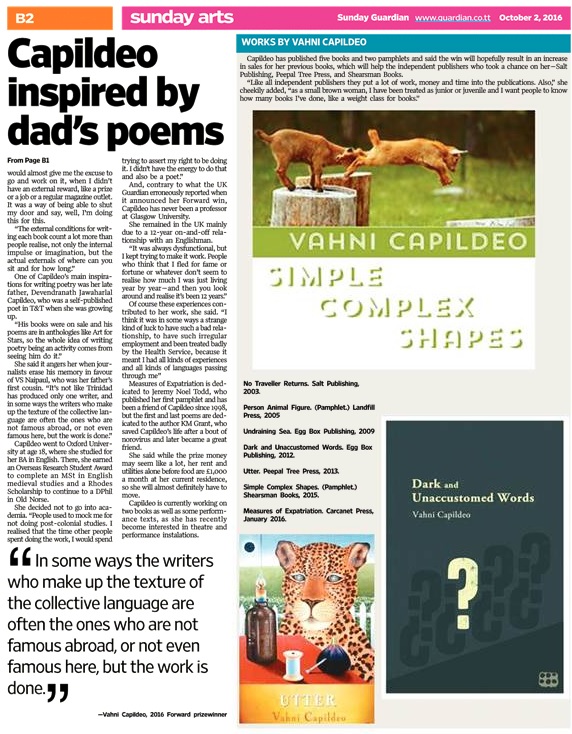
Capildeo has published five books and two pamphlets and said the win will hopefully result in an increase in sales for her previous books, which will help the independent publishers who took a chance on her – Salt Publishing, Peepal Tree Press and Shearsman Books. “Like all independent publishers they put a lot of work, money and time into the publications. Also, as a small brown woman I have been treated as junior or juvenile and I want people to know how many books I’ve done, like a weight class for books.”
Capildeo was born in T&T and went to Oxford University at age 18, where she studied for her BA in English, was awarded a Rhodes Scholarship to do her MS in Medieval History and moved on to a PhD in Old Norse. She decided not to go into academia because “people used to mock me for not doing post-colonial studies. I realized that the time other people spent doing the work, I would spend trying to assert my right to be doing it. I didn’t have the energy to do that and also be a poet.” She said she’d never been a Professor at Glasgow University. Capildeo remained in the UK mainly due to a 12-year on-and-off relationship with an Englishman. “It was always dysfunctional, but I kept trying to make it work. People who think that I fled for fame or fortune or whatever don’t seem to realize how much I was just living year by year and then you look around and realize it’s been 12 years.”
Of course these experiences contributed to her work, she said. “I think it was in some ways a strange kind of luck to have such a bad relationship, to have such irregular employment and been treated badly by the Health Service, because it meant I had all kinds of experiences and all kinds of languages passing through me”
Measures of Expatriation is dedicated to Jeremy Noel Todd, who published her first pamphlet and has been a friend of Capildeo’s since 1998, but the first and last poems are dedicated to the author K. M. Grant, who saved Capildeo’s life after a bout of norovirus and later became a great friend.
She said while the prize money may seem like a lot, her rent and utilities alone before food are £1,000 a month at her current residence, so she will almost definitely have to move.
Capildeo is currently working on two books as well as some performance texts as she has recently become interested in theatre and performance installations.
Discover more from Paula Lindo - Our histories, stories, present, future.
Subscribe to get the latest posts sent to your email.
