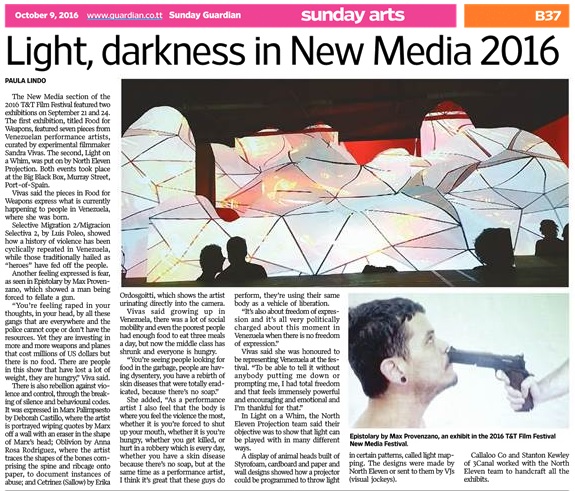
The New Media section of the 2016 T&T Film Festival featured two exhibitions on September 21 and 24. The first exhibition, titled “Food for Weapons” featured seven pieces from Venezuelan performance artists, curated by experimental film-maker Sandra Vivas.
The second, “Light on a Whim” was put on by North Eleven Projection, the official projection partners of ttFF. Both events took place at the Big Black Box, Murray Street, Port of Spain.
Vivas said the pieces express in different ways many of her feelings about what is currently happening to people in Venezuela, where she was born.
One feeling is the violence which is inflicted on peoples bodies by those with power, “whether it’s through the presentation of the body, the violence around it or telling a very intimate story that cannot be told with words, but it’s a secret that needs to be told somehow. It’s imposed on the body, whether it’s with a gun or with an oppressive discourse that is ever present.” “Selective Migration 2/Migracion Selectiva 2” by Luis Poleo showed how a history of violence has been cyclically repeated in Venezuela, while those traditionally hailed as “heroes” have fed off the people. Other pieces which portrayed this theme were “R.E.D.” by Raul Rodriguez, which showed multiple images of guns transposed with the human figure, as well as “Ichtys II” by Carlos Salazar Lermont, where the artist pressed his finger into himself and a fish for several minutes to show the contrast between life and death.
Another feeling expressed is fear, as seen in “Epistolary” by Max Provenzano, which showed a man being forced to fellate a gun. “You’re feeling raped in your thoughts, in your head, by all these gangs that are everywhere and the police cannot cope or don’t have the resources. Yet they are investing in more and more weapons and planes that cost millions of US dollars but there is no food, there are people in this show that have lost a lot of weight, they are hungry.”
There is also rebellion against violence and control, through the breaking of silence and behavioural codes, as expressed by “Marx Palimpesto” by Deborah Castillo, where the artist is portrayed wiping quotes by Marx off a wall with an eraser in the shape of Marx’s head; “Oblivion” by Anna Rosa Rodriguez, where the artist traces the shapes of the bones comprising the spine and ribcage onto paper, to document instances of abuse, and; “Cetrinez (Sallow)” by Erika Ordosgoitti, which shows the artist urinating directly into the camera.
Vivas said growing up in Venezuela, there was a lot of social mobility and even the poorest people had enough food to eat three meals a day, but now the middle class has shrunk and everyone is hungry. “You’re seeing people looking for food in the garbage, people are having dysentery, you have a rebirth of skin diseases that were totally eradicated, because there’s no soap.”
“As a performance artist I also feel that the body is where you feel the violence the most, whether it is you’re forced to shut up your mouth, whether it is you’re hungry, whether you get killed, or hurt in a robbery which is every day, whether you have a skin disease because there’s no soap, but at the same time as a performance artist, I think it’s great that these guys do perform, they’re using their same body as a vehicle of liberation. It’s also about freedom of expression and it’s all very politically charged about this moment in Venezuela when there is no freedom of expression.”
Vivas said she was honoured to be representing Venezuela at the festival. “To be able to tell it without anybody putting me down or prompting me, I had total freedom and that feels immensely powerful and encouraging and emotional and I’m thankful for that.”
In “Light on a Whim,” the North Eleven Projection team said their objective was to show that light can be played with in many different ways. A display of animal heads built of styrofoam, cardboard and paper and wall designs showed how a projector could be programmed to throw light in certain patterns, called light mapping. The designs were made by North Eleven or sent to them by VJs (visual jockeys). “The intention of this is in the long run to show stage designers, set designers, concerts that you could do so much more with your sets and your stages than just the bare bones.”
The word “LIGHT” was spelled out using LED throwies, which are comprised of an LED bulb, a battery and a magnet taped together, which can then be attached to any metal surface capable of holding a magnet. Shapes made out of chickenwire, cloth and paint, were set up on the stage and images projected onto them, in an effort to combine stage and set design, and designs were projected onto them during the night. Attendees entered the space through a tunnel of light comprised of LED lights on a frame. Callaloo Company and Stanton Kewley of 3 Canal worked with the North Eleven team to make all the exhibits, which were all handmade.
“Other than Divali with light strings and Christmas where it’s overkill on your own house, nobody really plays with light, so we basically wanted to show people how to play with light.”
Discover more from Paula Lindo - Our histories, stories, present, future.
Subscribe to get the latest posts sent to your email.
