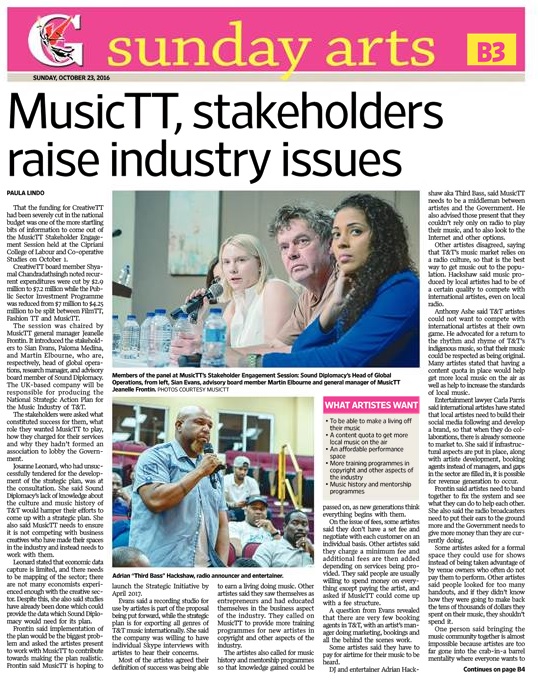
The revelation that the budget for CreativeTT had been severely cut in the 2016/2017 Budget was one of the more startling bits of information to come out of the MusicTT Stakeholder Engagement Session held at the Cipriani College of Labour and Cooperative Studies on October 1.
The revelation was made by CreativeTT Board Member, Shyamal Chandradathsingh, that recurrent expenditures were cut by TT$2.9 million to TT$7.2 million while the Public Sector Investment Program was reduced from TT$7 million to TT$4.25 million to be split between FilmTT, Fashion TT and MusicTT.
The session was chaired by MusicTT General Manager Jeanelle Frontin and introduced the stakeholders to Sian Evans, Head of Global Operations and Paloma Medina, Research Manager, and Martin Elbourne, Advisory Board Member, of Sound Diplomacy, the UK-based company that will be responsible for producing the National Strategic Action Plan for the Music Industry of T&T. Evans said a recording studio for use by artists is part of the proposal being put forward, while the strategic plan is for exporting all genres of T&T music internationally. She said the company was willing to have individual Skype interviews with artists to hear their concerns.
The stakeholders were asked what constituted success for them, what role they wanted MusicTT to play, how they charged for their services and why they hadn’t formed an association to lobby the government.
Most of the artists agreed their definition of success was being able to earn a living doing music as a 9 to 5 job, instead of working another job to pay their bills. Other artists said they saw themselves as entrepreneurs and had educated themselves in the business aspect of the industry. They called on MusicTT to provide training programs for new artists in copyright and other aspects of the industry. They said many new artists don’t try to find out what the reality of the music industry is before they get into it, and so can have unrealistic expectations. The artists also called music history and mentorship programs so that knowledge gained could be passed on, as new generations think everything begins with them.
On the issue of fees, some artists said they don’t have a set fee and negotiate with each customer on an individual basis. Other artists said they charge a minimum fee and additional fees are then added depending on what services are being provided. They said people are usually willing to spend money on everything except paying the artist, and asked if MusicTT could come up with a fee structure. Some artists said they have to pay for airtime for their music to be heard.
A question from Evans revealed that there are very few booking agents in T&T, with an artist’s manager doing marketing, bookings and all the behind the scenes work.
Adrian Hackshaw (Third Bass) said MusicTT needs to be a middleman between artists and the Government. He also advised those present that they can’t rely only on radio to play their music, and to also look to the Internet and other options. Other artists disagreed, saying that T&T is a radio culture, so that is the best way to get it out to the population. Hackshaw said music produced by local artists has to be of a certain quality to compete with international artists, even on local radio.
Anthony Ashe said T&T artists cannot want to compete with international artists at their own game. He advocated for a return to the rhythm and rhyme of T&T’s indigenous music, so that their music can be respected as being original. Many artists stated that having a content quota in place would help get more local music on the air as well as help to increase the standards of local music.
Frontin said artists need to band together to fix the system and see what they can do to help each other. She also said the radio broadcasters need to put their ears to the ground more and the Government needs to give more money than they are currently doing. Some artists asked for a formal space they could use for shows instead of being taken advantage of by venue owners who often do not pay them to perform. Other artists said people looked for too many handouts, and if they didn’t know how they were going to make back the tens of thousands of dollars they spent on their music, they shouldn’t spend it. One person said bringing the music community together is almost impossible because artists are too far gone into the crab-in-a barrel mentality where everyone wants to be in charge, instead of helping each other.
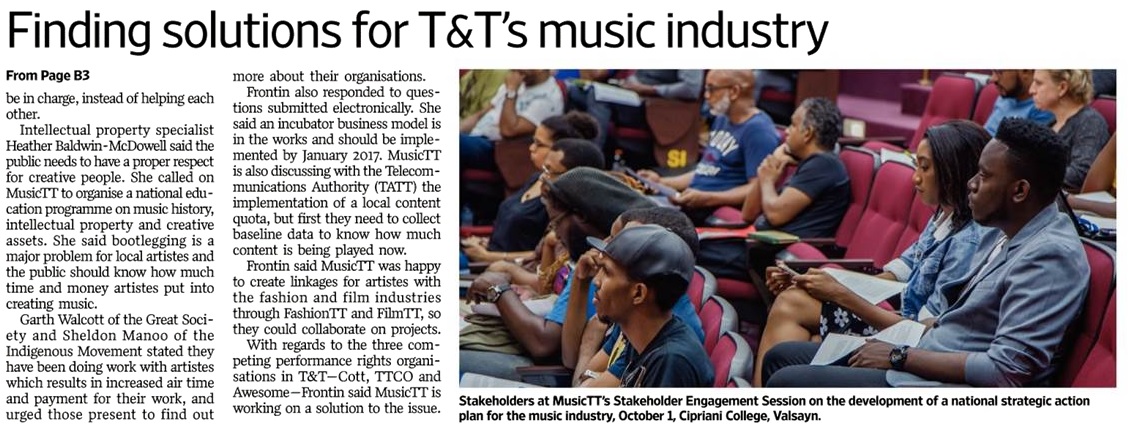
Intellectual Property Specialist Heather Baldwin-McDowell said the public needs to have a proper respect for creative persons.
She called on MusicTT to organize a national education program on music history, intellectual property and creative assets. She said bootlegging is a major problem for local artists and the public should know how much time and money artists put into creating music.
Entertainment lawyer Carla Parris said international artists have stated that local artists need to build their social media following and develop a brand, so that when they do collaborations, there is already someone to market to. She said if infrastructural aspects are put in place, along with artiste development, booking agents instead of managers, and gaps in the sector are filled in, it is possible for revenue generation to occur.
Things got a bit tense when Josanne Leonard, who had tendered for the strategic plan, said Sound Diplomacy’s lack of knowledge about the culture and music history of T&T would hamper their efforts to come up with a strategic plan. She also said MusicTT needs to ensure it is not competing with business creatives who have made their spaces in the industry and instead needs to work with them.
Leonard stated that economic data capture is limited, there needs to be mapping of the sector, and there are not many economists experienced enough with the creative sector. She also said many studies have already been done which could provide the data which Sound Diplomacy would need for its plan.
Garth Walcott of The Great Society and Sheldon Manoo of the Indigenous Movement stated they have been doing work with artists which results in increased air time and payment for their work, and urged those present to find out more about their organizations.
Frontin also responded to questions which were submitted electronically. She said an incubator business model is in the works and should be implemented by January 2017. MusicTT is also discussing with TATT the implementation of a local content quota, but first they need to collect baseline data to know how much content is being played now. Frontin said MusicTT was happy to create linkages for artists with the fashion and film industries through FashionTT and FilmTT, so they can collaborate on projects. With regards to the three copyright companies in T&T – COTT, TTCO and Awesome – Frontin said MUSICTT is working on a solution to the issue. She said implementation of the plan will be the biggest problem and asked the artists present to work with MusicTT to contribute towards making the plan realistic. Frontin said MusicTT is hoping to launch the Strategic Initiative by April 2017.
Discover more from Paula Lindo - Our histories, stories, present, future.
Subscribe to get the latest posts sent to your email.
