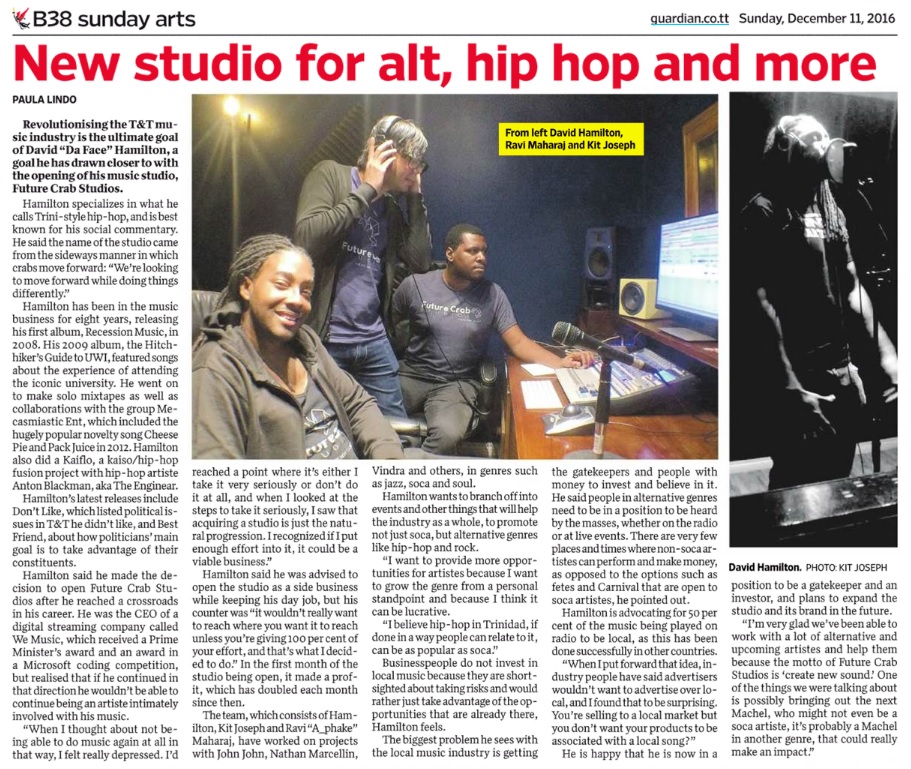
Revolutionizing the T&T music industry is the ultimate goal of David “Da Face” Hamilton, a goal he has drawn closer to with the opening of his music studio, Future Crab Studios.
Hamilton specializes in what he calls Trini-style hip-hop, and is best known for his social commentary. He said the name of the studio came from the sideways manner in which crabs move forward, “so we’re looking to move forward while doing things differently.”
Hamilton has been in the music business for eight years, releasing his first album, Recession Music in 2008. His 2009 album, the Hitchhiker’s Guide to UWI, featured songs about the experience of attending UWI. He went on to make solo mixtapes as well as collaborations with the group Meclasmiastic Ent, which included the hugely popular Cheese Pie and Pack Juice in 2012. Hamilton also did a Kaiflo, a Kaiso/Hip-hop fusion project with hip-hop artiste The Enginear. His latest releases include “Don’t Like,” which listed political issues in T&T which he didn’t like and “Best Friend” about how politicians’ main goal is to take advantage of their constituents.
Hamilton said he made the decision to open Future Crab Studios after he reached a cross-road in his career. He was the CEO of a digital streaming company called We Music, which received a Prime Minister’s award and an award in a Microsoft coding competition, but realized that if he continued in that direction he wouldn’t be able to continue being an artiste intimately involved with his music. “When I thought about not being able to do music again at all in that way, I felt really depressed. I’d reached a point where it’s either I take very seriously or don’t do it at all, and when I looked at the steps to take it seriously, I saw that acquiring a studio is just the natural progression. I recognized if I put enough effort into it, it could be a viable business.”
Hamilton said he was advised to open the studio as a side business while keeping his day job, but his counter was “it wouldn’t really want to reach where you want it to reach unless you’re giving 100% of your effort, and that’s what I decided to do.” In the first month of the studio being open, it made a profit, which has doubled each month since then. The team, which consists of Hamilton, Kit Joseph and Ravi Maharaj, have worked on projects with John John, Nathan Marcellin, Vindra and others, in genres such as jazz, soca and soul.
Hamilton wants to branch off into events and other things that will help the industry as a whole, to promote not just soca, but alternative genres which can make money if done properly, such as hip-hop and rock. “I want to provide more opportunities for artistes because I want to grow the genre from a personal standpoint and because I think it can be lucrative. I believe hip-hop in Trinidad, if done in a way people can relate to it, can be as popular as soca.” He believes businesspeople do not invest in local music because they are shortsighted about taking risks and would rather just take advantage of the opportunities that are already there.
The biggest problem Hamilton sees with the local music industry is getting the gatekeepers, people with money to invest, to believe in it, as many of them believe it is inferior. He said people in alternative genres need to be in a position to be heard by the masses, whether on the radio or at live events. Currently, he said there are very few places and times where non-soca artistes can perform and make money, as opposed to the options such as fetes and Carnival that are open to soca artistes.
Hamilton is advocating for 50% of the music being played on radio to be local, as this has been done successfully in other countries. “When I put forward that idea, industry people have said advertisers wouldn’t want to advertise over local, and I found that to be surprising.You’re selling to a local market but you don’t want your products to be associated with a local song?”
He is happy that he is now in a position to be a gatekeeper and an investor, and plans to expand the studio and its brand in the future. “I’m very glad we’ve been able to work with a lot of alternative and upcoming artistes and help them because the motto of Future Crab Studios is “create new sound.” One of the things we were talking about is possibly bringing out the next Machel, who might not even be a soca artiste, it’s probably a Machel in another genre, that could really make an impact.”
Discover more from Paula Lindo - Our histories, stories, present, future.
Subscribe to get the latest posts sent to your email.
