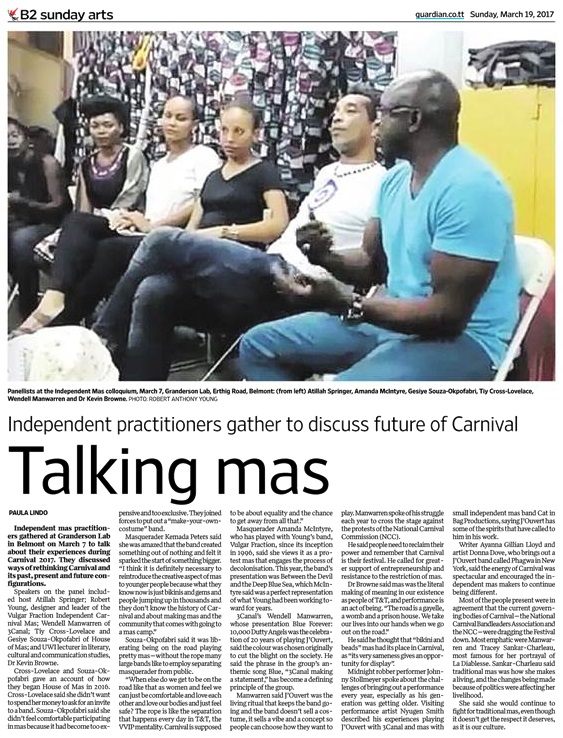
Independent mas practitioners gathered at Granderson Lab in Belmont on March 7 to talk about their experiences during Carnival. They discussed ways of rethinking Carnival and its past, present and future configurations.
Speakers on the panel included host Atillah Springer, designer and leader of the Vulgar Fraction Independent Carnival Mas[querade] group Robert Young, Wendell Manwarren of 3 Canal, Tiy Cross-Lovelace and Gesiye Souza-Okpofabri of House of Mas and UWI lecturer in Literary, Cultural & Communication Studies, Dr. Kevin Browne.
Cross-Lovelace and Souza-Okpofabri gave an account of how they began House of Mas in 2016. Cross-Lovelace said she didn’t want to spend her money to ask for an invite to a band. Souza-Okpofabri said she didn’t feel comfortable participating in mas because it had become too expensive and too exclusive. They joined forces to put out a “make your own costume” band. Masquerader Kemada Peters said she was amazed that the band created something out of nothing and felt it sparked the start of something bigger. “I think it is definitely necessary to reintroduce the creative aspect of mas to younger people because what they know now is just bikinis and gems and people jumping up in thousands and they don’t know the history of Carnival and about making mas and the community that comes with going to a mas camp.”
Souza-Okpofabri said it was liberating being on the road playing pretty mas. “When else do we get to be on the road like that as women and feel we can just be comfortable and love each other and love our bodies and just feel safe? The rope is like the separation that happens everyday in T&T, the VVIP mentality. Carnival is supposed to be about equality and the chance to get away from all that.”
Masquerader Amanda McIntyre, who has played with Young’s band, Vulgar Fraction, since its inception in 1996, said she views it as a protest mas that engages the process of decolonization. This year, the band’s presentation was “Between the Devil and the Deep Blue Sea,” which McIntyre said was a perfect representation of what Young had been working toward for years.
3 Canal’s Wendell Manwarren, whose presentation “Blue Forever – 10,000 Dutty Angels” was the celebration of 20 years of playing Jouvert, said the colour was chosen originally to cut the blight on the society. He said the phrase in the song Blue “3 Canal making a statement” has become a defining principle of the group. Manwarren said Jouvert is the living ritual that keeps the band going and the band doesn’t sell a costume, it sells a vibe and a concept so people can choose how they want to play. Manwarren spoke of his struggle each year to cross the stage against the protests of the NCC. He said people need to reclaim their power and remember that Carnival is their festival. He called for greater support of entrepreneurship and resistance to the restriction of mas.
Dr. Browne said mas is the literal making of meaning in our existence as Trinbagonians, and performance is an act of being. “The road is a gayelle, a womb and a prison house. We take our lives into our hands when we go out on the road.” He said he thought that bikini and beads mas had its place in Carnival, as “its very sameness gives an opportunity for display.”
Midnight Robber performer Johnny Stollmeyer spoke about the challenges of bringing out a performance every year, especially as his generation was getting older. Visiting performance artist Nyugen Smith described his experiences playing Jouvert with 3 Canal and mas with Cat in Bag Productions, saying Jouvert has some of the spirits that have called to him in his work.
Writer Ayanna Gillian Lloyd and artist Donna Dove, who brings out a Jouvert band called Pagwah in New York, said the energy of Carnival was spectacular and encouraged the independent mas makers to continue being different.
Most persons present were in agreement that the current governing bodies of Carnival, the NCBA and the NCC, were dragging the Festival down. Most emphatic were Manwarren and Tracey Sankar-Charleau, most famous for her portrayal of La Diablesse, who said traditional mas is how she makes a living, and the changes being made because of politics were affecting her livelihood. She said she will continue to fight for traditional mas even though it doesn’t get the respect it deserves, as it is our culture.
Discover more from Paula Lindo - Our histories, stories, present, future.
Subscribe to get the latest posts sent to your email.
