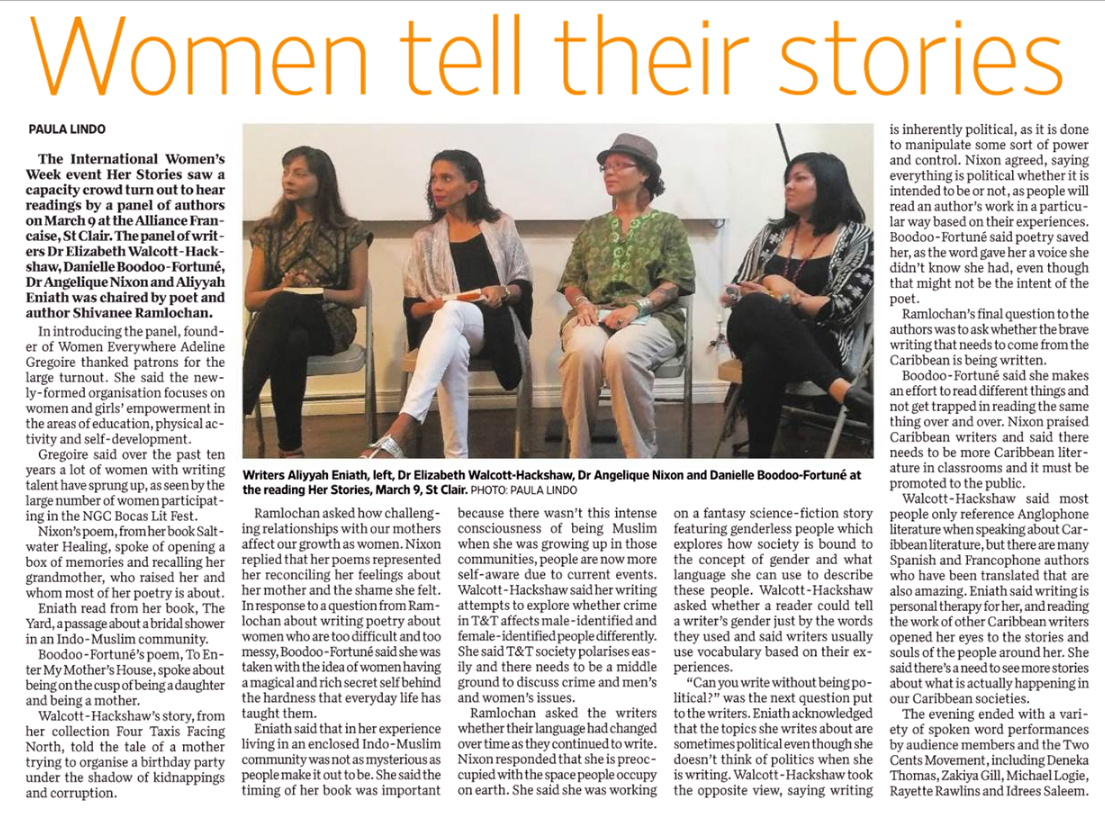
The International Women’s Week event, Her Stories, saw an capacity crowd turn out to hear readings by a panel of authors on March 9 at the Alliance Francaise.
The panel, consisting of writers Elizabeth Walcott-Hackshaw, Danielle Boodoo-Fortune, Dr. Angelique Nixon and Aaliyah Eniath, was chaired by poet and author Shivanee Ramlochan.
In introducing the panel, founder of Women Everywhere, Adeline Gregoire, thanked patrons for the amazing turnout. She said the newly formed organization focuses on women and girls’ empowerment in the areas of education, physical activity and self-development. Gregoire said over the past 10 years a lot of amazing writing talent has sprung up, most of whom have been women, as seen by the inclusion of women in the NGC Bocas Literary Festival.
Nixon’s poem from her book Saltwater Healing spoke of opening a box of memories and recalling her grandmother, who raised her and whom most of her poetry is about. Eniath read a passage from her book The Yard, about a bridal shower in an Indo-Muslim community. Boodoo-Fortune’s poem, To Enter My Mother’s House, spoke about being on the cusp of being a daughter and being a mother. Walcott-Hackshaw’s story, from Four Taxis Facing North told the tale of a mother trying to organize a birthday party under the shadow of kidnappings and corruption.
Ramlochan asked how challenging relationships with our mothers affect our growth as women. Nixon replied that her poems represented her reconciling her feelings about her mother and the shame she felt. In response to a question from Ramlochan about writing poetry about women who are too difficult and too messy, Boodoo-Fortune said she is taken with the idea of women having a magical and rich secret self behind the hardness that everyday life has taught them.
Eniath said her experience of living in an enclosed Indo-Muslim community was not as mysterious as people make it out to be. She said the timing of the book is important, because there wasn’t this intense consciousness of being Muslim when she was growing up in those communities, but people are now more self-aware due to current events. Walcott-Hackshaw said her writing attempts to explore whether crime in T&T affects male-identified and female-identified people differently. She said T&T society polarizes easily and there needs to be a middle ground to discuss crime and men’s and women’s issues.
Ramlochan asked the writers whether their language had changed over time as they continued to write. Nixon responded that she is preoccupied with the space people occupy on earth. She said she’s working on a fantasy science-fiction story featuring genderless people which explores how society is bound to the concept of gender and what language she can use to describe these people. Walcott-Hackshaw asked whether a reader could tell a writer’s gender just by the words they used and said writers usually use vocabulary based on their experiences.
“Can you write without being political?” was the next question put to the writers. Eniath acknowledged that the topics she writes about are sometimes political even though she doesn’t think of politics when she is writing. Walcott-Hackshaw took the opposite view, saying writing is inherently political, as it is done to manipulate some sort of power and control. Nixon agreed, saying everything is political whether it is intended to be or not, as people will read an author’s work in a particular way based on their experiences. Boodoo-Fortune said poetry saved her, as the word gave her a voice she didn’t know she had, even though that might not be the intent of the poet.
Ramlochan’s final question to the authors was to ask whether the brave writing that needs to come from the Caribbean is being written. Boodoo-Fortune said she makes an effort to read different things and not get trapped in reading the same thing over and over. Nixon said Caribbean writers are amazing and there needs to be more Caribbean literature in classrooms and promoted to the public. Walcott-Hackshaw said most people only reference Anglophone literature when speaking about Caribbean literature, but there are many Spanish and Francophone authors who have been translated that are also amazing. Eniath said writing is personal therapy for her, and reading the work of other Caribbean writers opened her eyes to the stories and souls of the people around her. She said there’s a need to see more stories about what is actually happening in our Caribbean societies.
The evening ended with a variety of spoken word performances by audience members and the Two Cents Movement, including Deneka Thomas, Zakiya Gill, Michael Logie, Rayette Rawlins and Idrees Saleem.
Discover more from Paula Lindo - Our histories, stories, present, future.
Subscribe to get the latest posts sent to your email.
