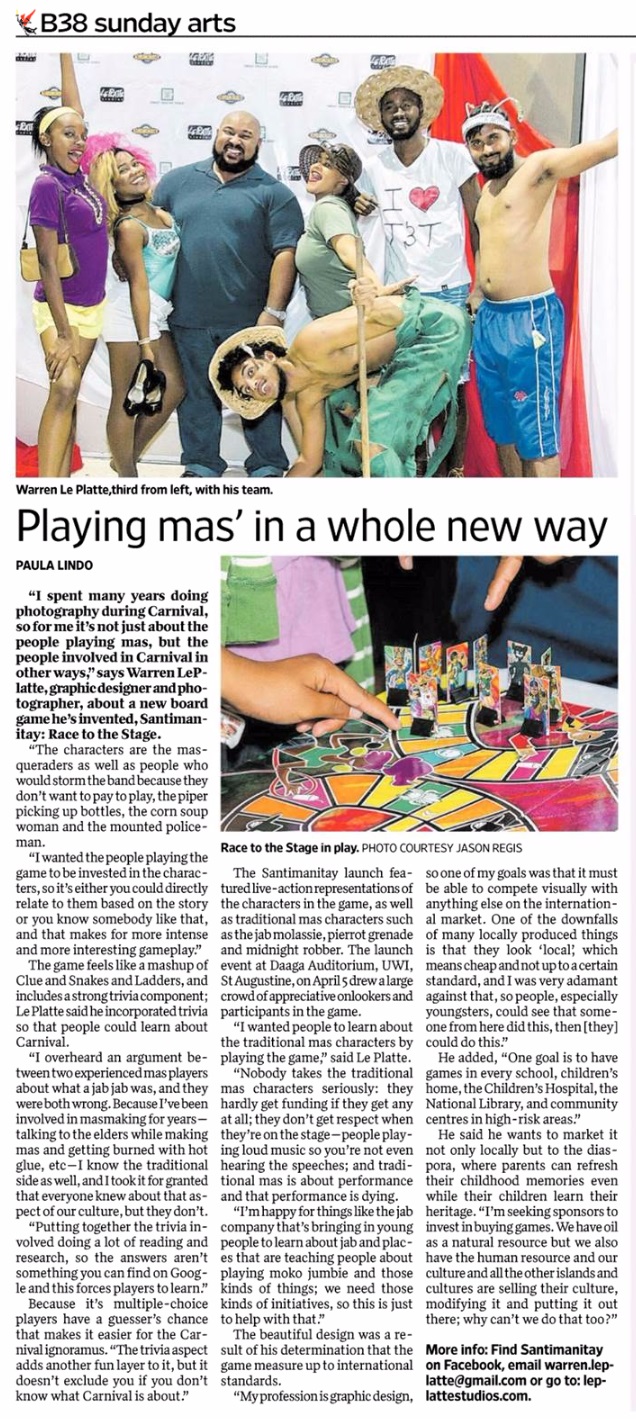
The launch of the Trinidadian board game, Santimanitay: Race to the Stage, featured live-action representations of the characters featured in the game, as well as traditional mas characters such as Jab Molassies, Pierrot Grenade and Midnight Robber.
The launch event at Daaga Auditorium, UWI St. Augustine on April 5 drew a large crowd of appreciative onlookers and participants in the game.
Creator Warren La Platte said he made the decision to have gamers play as people associated with Carnival instead of traditional mas characters because he wanted people to identify as the characters during gameplay.
He said this approach has been successful as people have taken on the personas of the characters during test runs of the games. “I wanted people to learn about the traditional mas characters by playing the game. I spent many years doing photography during Carnival, so for me it’s not just about the people playing mas, but the people involved in Carnival in other ways. So the characters are the masqueraders, as well as people who would storm the band because they don’t want to pay to play, the piper picking up bottles, the corn soup woman and the mounted policeman. I wanted the people playing the game to be invested in the characters, so it’s either you could directly relate to them based on the story or you know somebody like that, and that makes for more intense and more interesting gameplay.”
The game play is an amalgamation of different types of games, including Clue and Snakes and Ladders, and includes a strong trivia component which Le Platte said he incorporated so that people can learn about Carnival. “I overheard an argument between two experienced mas players about what a Jab Jab was, and they were both wrong. Because I’ve been involved in mas-making for years, talking to the elders while making Mas and getting burned with hot glue, etc., I know the traditional side as well, and I took it for granted that everyone knew about that aspect of our culture, but they don’t. Putting together the trivia involved doing a lot of reading and research, so the answers aren’t something you can find on Google and this forces players to learn.”
Le Platte said he felt teaching people about the mas characters was important. “Nobody takes the traditional mas characters seriously, they hardly get funding if they get any at all, they don’t get respect when they’re on the stage, people playing loud music so you’re not even hearing the speeches and traditional mas is about performance and that performance is dying. I’m happy for things like the Jab company that’s bringing in young people to learn about Jab and places that are teaching people about playing Moko Jumbie and those kinds of things, we need those kinds of initiatives, so this is just to help with that.”
La Platte said with repeated gameplay, players would learn the answers by heart, and because it’s multiple choice, players have a guesser’s chance which makes it easier for people who know nothing about Carnival. “The trivia aspect adds another fun layer to it, but it doesn’t exclude you if you don’t know what Carnival is about.
The beautiful design was a result of his determination that the game measure up to international standards. “My profession is graphic design, so one of my goals was that it must be able to compete visually with anything else on the international market. One of the downfalls of many locally produced things is that they look local, which means cheap and not up to a certain standard and I was very adamant against that, so if people, especially youngsters, could see that someone from here did this, then I could do this.”
He said he wants to market it not only locally but to the diaspora as a means of rebuilding a sense of national pride. “One goal is to have games in every school, Children’s Home, the Children’s Hospital, the National Library, and community centres in high risk areas. I’m seeking sponsors to invest in buying games. My primary target market is the diaspora, so that parents who have grown up here can play it with their children and talk about Carnival and T&T culture. The parents get to relive some of the things and the children get to learn about this, so it may encourage people to come back and want to learn more. We have oil as a natural resource but we also have the human resource and our culture and all the other islands and cultures are selling their culture, modifying it and putting it out there, why can’t we do that too?”
Discover more from Paula Lindo - Our histories, stories, present, future.
Subscribe to get the latest posts sent to your email.
