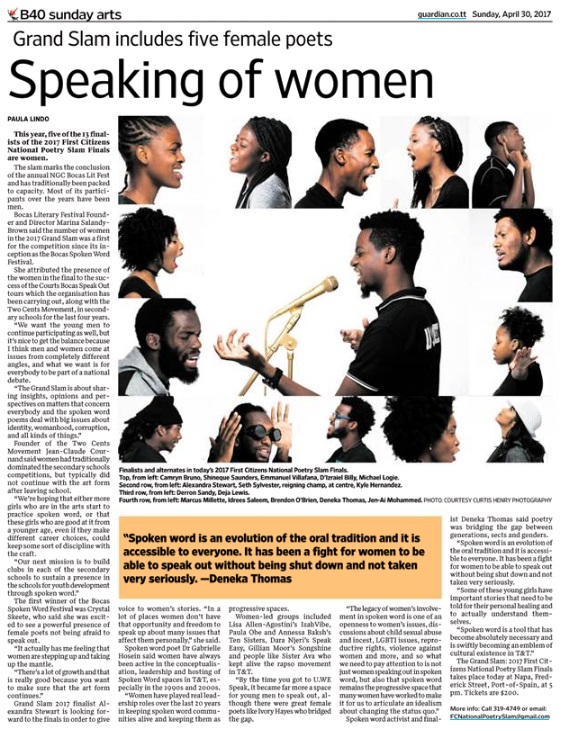
In recent times, T&T audiences have been accustomed to seeing and hearing male voices dominate the Spoken Word arena, despite a long history of women-led Spoken Word spaces and initiatives. This year, five of the 12 confirmed finalists of the 2017 First Citizens National Poetry Slam Finals are women and the hope is that one of them will take the grand prize.
Bocas Literary Festival Founder and Director Marina Salandy-Brown said this is a first for the competition since its inception as the Bocas Spoken Word Festival. She attributed the presence of the women in the final to the success of the Courts Bocas Speak Out tours which the organization has been carrying out, along with the Two Cents Movement in secondary schools for the last four years. “We want the young men to continue participating as well, but it’s nice to get the balance because I think men and women come at issues from completely different angles, and what we want is for everybody to be part of a national debate. The Grand Slam is about sharing insights, opinions and perspectives on matters that concern everybody and the Spoken Word poems deal with big issues about identity, womanhood, corruption, and all kinds of things.”
Founder of the Two Cents Movement, Jean-Claude Cournand, said women have traditionally dominated the secondary schools competitions, but typically do not continue with the artform after leaving school. “We’re hoping that either more girls who are in the Arts start to practice Spoken Word or these girls who are good at it from a younger age, even if they make different career choices, that they could keep some sort of discipline with the craft. Our next mission is to build clubs in each of the secondary schools to sustain a presence in the schools for youth development through Spoken Word.”
The first winner of the Bocas Spoken Word Festival was Crystal Skeete, who said she is excited to see a powerful presence of female poets not being afraid to speak out on several different issues. “It actually has me feeling that women are stepping up and taking up the mantle. There’s a lot of growth and that is really good because you want to make sure that the art form continues.”
Finalist Alexandra Stewart said she’s looking forward to the finals in order to give voice to women’s stories. “In a lot of places women don’t have that opportunity and freedom to speak up about many issues that affect them personally and I think so many women now have the opportunity to share, not just our stories but all the stories that don’t have the opportunity to be shared, which is a wonderful thing.”
Spoken Word poet Gabrielle Hosein said women have always been active in the conceptualization, leadership and hosting of Spoken Word spaces in T&T, especially in the 1990s and 2000s. “Women have played real leadership roles over the last 20 years in keeping Spoken Word communities alive and keeping them as progressive spaces. Women-led groups included Lisa Allen’s ‘IsahVibes,’ Paula Obe and Annessa Baksh’s ‘Ten Sisters,’ Dara Njeri’s ‘Speak Easy,’ Gillian Moor’s ‘Songshine’ and people like Sister Ava who kept alive the Rapso movement in T&T. By the time you got to U.WE Speak, it became far more a space for young men to speak out, although there were great female poets like Ivory Hayes who bridged the gap. The legacy of women’s involvement in Spoken Word is one of an openness to women’s issues, discussions about child sexual abuse and incest, LGBTI issues, reproductive rights, violence against women and more, and so what we need to pay attention to is not just women speaking out in Spoken Word, but also that Spoken Word remains the progressive space that many women have worked to make it for us to articulate an idealism about changing the status quo.”
Spoken Word activist and standby contestant Deneka Thomas said Spoken Word poetry is bridging the gap between generations, sects and genders. “The women of this country need the artform to address pressing matters affecting them in a way speaking out was not accessible before. Spoken word is an evolution of the oral tradition and it is accessible to everyone. It has been a fight for women to be able to speak out without being shut down and not taken very seriously. Some of these young girls have important stories that need to be told for their personal healing and to actually understand themselves. It is then important for us to hear them and to know exactly what they are going through. Spoken word is a tool that has become absolutely necessary and is swiftly becoming an emblem of cultural existence in T&T.”
The Grand Slam: 2017 First Citizens National Poetry Slam Finals takes place today at NAPA at 5 pm. Tickets are $200. For more information, call 319-4749 or email FCNationalPoetrySlam@gmail.com.
Discover more from Paula Lindo - Our histories, stories, present, future.
Subscribe to get the latest posts sent to your email.
