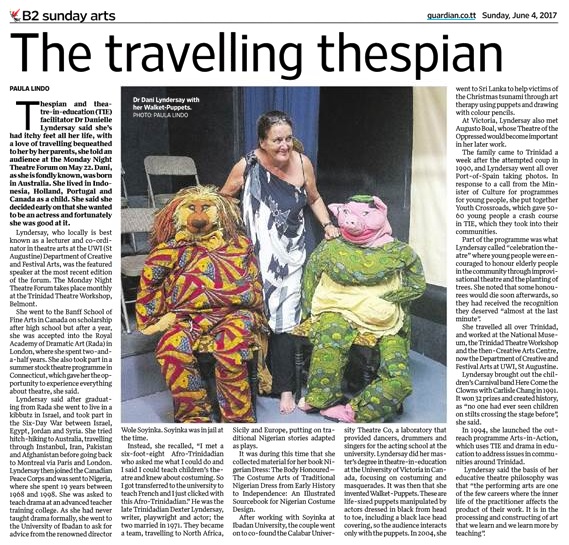
Thespian and theatre-in-education (TIE) facilitator Dr. Dani Lyndersay said she’s had itchy feet all her life, with a love of traveling bequeathed to her by her parents. Born in Australia, she lived in Indonesia, Holland, Portugal and Canada as a child. She said she decided early on that she wanted to be an actress and fortunately she was good at it.
She went to the Banff School of Fine Arts in Canada on scholarship after high school but after a year, she was accepted into the Royal Academy of Dramatic Art (RADA) in London, where she spent two and a half years. She also took part in a summer stock theatre program in Connecticut, which gave her the opportunity to experience everything about theatre, she told an audience at the Monday Night Theatre Forum on May 22.
Lyndersay said after graduating from RADA, she went to live in a kibbutz in Israel, and took part in the Six-Day War between Israel, Egypt, Jordan and Syria. She tried hitchhiking to Australia, traveling through Instanbul, Iran, Pakistan and Afghanistan before going back to Montreal via Paris and London. Lyndersay then joined the Canadian Peace Corps and was sent to Nigeria, where she spent 19 years between 1968 and 1998. She was asked to teach drama at an advanced teacher training college, which she had never taught formally and went to the University of Ibadan to ask for advice from the director, the renowned Wole Soyinka, who at the time was in jail. “I met a 6’8” Afro-Trinidadian who asked me what I could do and I said I could teach children’s theatre and knew about costuming. So I got transferred to the University to teach French and I just clicked with this Afro-Trinidadian.” He was Dexter Lyndersay, writer, playwright and actor and the two got married in 1971. They became a team, traveling to North Africa, Sicily and Europe, putting on traditional Nigerian stories adapted as plays. It was during this time that she collected material for her book “Nigerian Dress: The Body Honoured – The Costume Arts of Traditional Nigerian Dress from Early History to Independence: An Illustrated Sourcebook for Nigerian Costume Design.”
After working with Soyinka at Ibadan University, the duo went on to co-found the Calabar University Theatre Company, a laboratory which provided dancers, drummers and singers for the acting school at the University. Lyndersay did her Master’s Degree in Theatre in Education at the University of Victoria in Canada, focusing on costuming and masquerades. It was then that she invented Walket-Puppets, life-size puppets manipulated by actors dressed in black from head to toe, including a black lace head covering, so the audience interacts only with the puppets. Lyndersay also met Augusto Boal, whose “Theatre of the Oppressed” would become important in her later work.
The family came to Trinidad a week after the attempted coup in 1990, and Lyndersay went all over Port of Spain taking photos. In response to a call from the Minister of Culture for programs for young people, she put together “Youth Crossroads” which gave 50 to 60 young people a crash course in TIE, which they took into their communities. Part of the program was what Lyndersay called “Celebration Theatre” where young people were encouraged to honour elderly people in the community through improvisational theatre and the planting of trees. She noted that some honourees would die soon afterwards, so they had received the recognition they deserved “almost at the last minute.” She traveled all over Trinidad, and worked at the National Museum, the Trinidad Theatre Workshop and the then Creative Arts Centre, now the Department of Creative and Festival Arts at UWI St. Augustine.
Lyndersay brought out a children’s Carnival band “Here Come the Clowns” with Carlisle Chang in 1991, which won 32 prizes and created history, as “no-one had ever seen children on stilts crossing the stage before.” In 1994, she launched the outreach program Arts-in-Action (AiA), which uses Theatre in Education and Drama in Education to address issues in communities around Trinidad. In 2004, she went to Sri Lanka to help victims of the Christmas tsunami through art therapy using puppets and drawing with colour pencils.
Lyndersay said the basis of her educative theatre philosophy is that “the performing arts are one of the few careers where the inner life of the practitioner affects the product of their work. It is in the processing and constructing of art that we learn and we learn more by teaching.”
Unedited notes below
She comes by her travelling tendencies honeslty, as the child of two travelling parents and as the child of travelling parents, she became a traveller and had itchy feet all her life. She would teach children to read and write in the various countries she lived in, as well as making up improvisational schools.
Thespian and theatre-in-education (TIE) facilitator Dr. Dani Lyndersay said she’s had itchy feet all her life, with a love of traveling bequeathed to her by her parents. Born in Australia, she lived in Indonesia, Holland, Portugal and Canada as a child. She said she decided early on that she wanted to be an actress and fortunately she was good at it.
Following high school, Lyndersay got a scholarship to the Banff School of Fine Arts in Canada but after a year, she was accepted into the Royal Academy of Dramatic Art (RADA) in London, where she spent two and a half years, one of the happiest times of her life. During this time, she took part in a summer stock theatre program in Connecticut, which she said gave her the opportunity to experience everything about the theatre. She told the audience at the Monday Night Theatre Forum on May 22 that anyone who wants to be in theatre should do summer stock, because “if you survive it, you must want to be in theatre.”
Lyndersay said after graduating from RADA, she went to live in a kibbutz in Israel, a Jewish community where she learned Hebrew, picked fruits, milked sheep and ironed hundreds of men’s shirts. In 1967, during the Six-Day War between Israel, Egypt, Jordan and Syria, she participated by moving to another kibbutz on the Gaza Strip and packing bullets into belts and underground tunnels for the women and children. She then decided to hitchhike to Australia from Israel, beginning in Instanbul and traveling through Iran, Pakistan, Afghanistan where she turned back to a lack of funds and went back to Montreal via Paris and London. Lyndersay then joined CETA, the Canadian Peace Corps, hoping to be sent to Thailand so she could travel to India, but instead was sent to Nigeria, where she spent 19 years between 1968 and 1998. She said it was the most amazing country to be a part of. There, she was sent to an advanced teacher training college to teach drama, which she had never taught formally, so she was terrified. She traveled to the University of Ibadan to ask for advice from the director, the renowned Wole Soyinka, who at the time was in jail. “I met a 6’8” Afro-Trinidadian who asked me what I could do, to which I said I could teach children’s theatre and knew about costuming. So I got transferred to the University to teach French, which I hadn’t learned formally, and I just clicked with this Afro-Trinidadian.” He was Dexter Lyndersay, writer, playwright, actor and the two got married in 1971 with the children they taught as bridesmaids and groomsmen. They became a team, traveling to North Africa, Sicily, Europe and back to Nigeria, along with the two sons who eventually came along. Dexter would take traditional Nigerian stories and adapt them to play and he and Dani traveled around the country putting them on. It was the 19 years of traveling around the country that led to the collection of the material for her book “Nigerian Dress: The Body Honoured – The Costume Arts of Traditional Nigerian Dress from Early History to Independence: An Illustrated Sourcebook for Nigerian Costume Design.” After working with Wole Soyinka at Ibadan University, they went on to co-found the Calabar University Theatre Company, a laboratory which provided dancers, drummers and singers for the acting school at the University. After seven years, Lyndersay went to the University of Victoria in Canada to do her Master’s Degree in Theatre in Education (TIE), focusing on costuming and masquerades. It was here that she came up with the concept of Walket-Puppets, life-size puppets which actors could manipulate and interact with an audience. The actors are dressed in black from head to toe, including a black lace head covering, so the audience interacts only with the puppets. Lyndersay also met Augusto Boal, whose “Theatre of the Oppressed” would become important in her later work. She made black and white drawings from pictures, statues and books so there would be no copyright issue and looked at traditions like the fattening room, implements used for dressing, and styles used in cloth making, weaving and embroidery.
The family came to Trinidad a week after the attempted coup in 1990, and Lyndersay went all over Port of Spain on her bicycle, taking photos. In response to a call from the Minister of Culture for programs for young people, she put together “Youth Crossroads” which gave 50 – 60 young people a crash course in TIE, which they then took into their communities. She said she got to travel all over Trinidad, and worked at the National Museum, the Trinidad Theatre Workshop and the then Creative Arts Centre, now the Department of Creative and Festival Arts at UWI St. Augustine. Part of the Youth Crossroads program was what Lyndersay called “Celebration Theatre” where young people were encouraged to go out into their communities and honour elderly people who had contributed to the communities through improvisational theatre and the planting of trees. She noted that the honourees would die soon afterwards, meaning they had received the recognition they deserved “almost at the last minute.”
Lyndersay brought out a children’s Carnival band “Here Come the Clowns” with Carlisle Chang in 1991 with children walking on stilts, which won 32 prizes and created history, as “no-one had ever seen children on stilts crossing the stage before.” In 1994, she launched the outreach program Arts-in-Action (AiA), which uses Theatre in Education and Drama in Education to address issues in communities around Trinidad. In 2004, she went to Sri Lanka to help victims of the Christmas tsunami through Art therapy using puppets and drawing with colour pencils.
She said “with Playback Theatre, Celebrative Theatre, Celebrative Theatre, all the forms that interact directly with an audience, the more you give, the more you get out of the work. The more you let the participants participate, the more you learn as a facilitator.”
Lyndersay said the basis of her educative theatre philosophy is that “The performing arts are one of the few careers where the inner life of the practitioner affects the product of their work. It is in the processing and constructing of art that we learn and we learn more by teaching.”
Discover more from Paula Lindo - Our histories, stories, present, future.
Subscribe to get the latest posts sent to your email.
