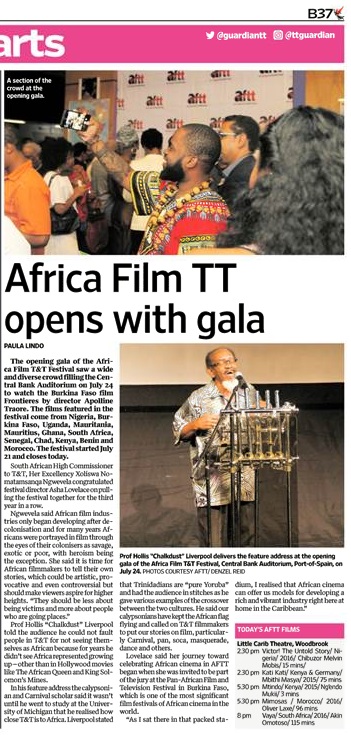
The Opening Gala of the African Film T&T Festival saw a wide and diverse crowd filling the Central Bank Auditorium on July 24 to watch the Burkina Faso film, Frontieres by director Apolline Traore. The films to be featured in the Festival from July 21 to 30 come from Nigeria, Burkina Faso, Uganda, Mauritania, Mauritius, Ghana, South Africa, Senegal, Chad, Kenya, Benin and Morocco.
High Commissioner from South Africa to T&T, Xoliswa Nomatamsanqa Ngwevela, congratulated Festival Director Asha Lovelace on pulling the Festival together for the third year in a row. Ngwevela said African film industries only began developing after decolonization and for many years, Africans were portrayed in film through the eyes of their colonizers as savage, exotic or poor, with heroism being the exception. She said it is time for African filmmakers to tell their own stories, which can be artistic, provocative and even controversial but should make viewers aspire for higher heights. “They should be less about being victims and more about people who are going places.”
Dr. Hollis “Chalkdust” Liverpool told the audience that he cannot fault people in T&T for not seeing themselves as African because for years he didn’t see Africa represented growing up, other than in movies like The African Queen and King Solomon’s Mines. He said it wasn’t until he went to study at the University of Michigan that he realized how close T&T is to Africa. Liverpool stated that Trinidadians are pure Yoruba and had the audience in stitches as he gave various examples of the crossover between the two cultures. He said our calypsonians have kept the African flag flying and called on T&T filmmakers to put our stories on film, particularly Carnival, steelpan, soca, masquerade, dance and others.
Lovelace said her journey toward celebrating African cinema in AFTT began when she was invited to be part of the jury at the Pan-African Film and Television Festival in Burkina Faso, which is one of the most significant film festivals of African cinema in the world.
“I learned that people took deep pride in these films and in telling their own stories, in a way that they were unable to do in colonial times. As a filmmaker working to bring Caribbean stories, told by Caribbean people, to the screen, I was inspired to see the support offered by the festival to films and filmmakers across Africa. As I sat there in that packed stadium, I realised that African cinema can offer us models for developing a rich and vibrant industry right here at home in the Caribbean.”
Lovelace said while exploring and sharing our stories in our own way is a defining aspect of what it means to be free, this power must be invested and supported by sponsors and the public. “As the fight against prejudice intensifies around the world, the arts can help us see each other as fully human. The stories we believe about ourselves, and others, shape how we move through the world. They can build walls that fail to keep us safe, or create spaces of truth, healing and connection.”
Discover more from Paula Lindo - Our histories, stories, present, future.
Subscribe to get the latest posts sent to your email.
