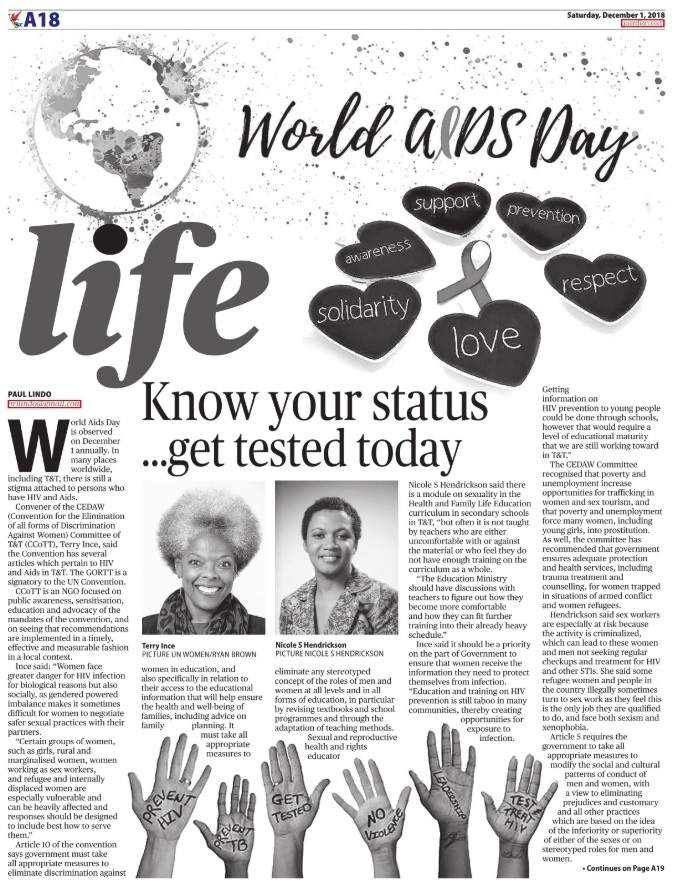
 World AIDS Day is observed on December 1 annually. In many places worldwide, including T&T, there is still a stigma attached to persons who have HIV and AIDS.
Convener of the CEDAW (Convention for the Elimination of all forms of Discrimination Against Women) Committee of T&T (CCoTT), Terry Ince, said the Convention has several articles which pertain to HIV and AIDS in T&T. The GORTT is a signatory to the UN Convention. CCoTT is an NGO focused on public awareness, sensitization, education and advocacy of the mandates of the Convention, and on seeing that recommendations are implemented in a timely, effective and measurable fashion in a local context.
Ince said “Women face greater danger for HIV infection for biological reasons but also socially, as gendered powered imbalance makes it sometimes difficult for women to negotiate safer sexual practices with their partners. Certain groups of women, such as girls, rural and marginalized women, women working as sex workers, and refugee and internally displaced women are especially vulnerable and can be heavily affected and responses should be designed to include best how to serve them.”
Article 10 of the Convention says Government must take all appropriate measures to eliminate discrimination against women in education, and also specifically in relation to their access to the educational information that will help ensure the health and well-being of families, including advice on family planning. It must take all appropriate measures to eliminate any stereotyped concept of the roles of men and women at all levels and in all forms of education, in particular by revising textbooks and school programmes and through the adaptation of teaching methods.
Sexual and reproductive health and rights educator Nicole S. Hendrickson said there is a module on sexuality in the Health and Family Life Education curriculum in secondary schools in T&T, “but often it is not taught by teachers who are either uncomfortable with or against the material or who feel they do not have enough training on the curriculum as a whole. The Education Ministry should have discussions with teachers to figure out how they become more comfortable and how they can fit further training into their already heavy schedule.”
Ince said it should be a priority on the part of Government to ensure that women receive the information they need to protect themselves from infection. “Education and training on HIV prevention is still taboo in many communities, thereby creating opportunities for exposure to infection. Getting information on HIV prevention to young people could be done through schools, however that would require a level of educational maturity that we are still working toward in T&T.”
The CEDAW Committee recognized that poverty and unemployment increase opportunities for trafficking in women and sex tourism, and that poverty and unemployment force many women, including young girls, into prostitution. As well, the Committee has recommended that Government ensure adequate protection and health services, including trauma treatment and counselling, for women trapped in situations of armed conflict and women refugees.
Hendrickson said sex workers are especially at risk because the activity is criminalized, which can lead to these women and men not seeking regular checkups and treatment for HIV and other STIs. She said some refugee women and people in the country illegally sometimes turn to sex work as they feel this is the only job they are qualified to do, and face both sexism and xenophobia.
Article 5 requires the Government to take all appropriate measures to modify the social and cultural patterns of conduct of men and women, with a view to eliminating prejudices and customary and all other practices which are based on the idea of the inferiority or superiority of either of the sexes or on stereotyped roles for men and women. Hendrickson said an example of discrimination is clearly seen in the behaviour of nurses in the health sector who tell young women they feel shouldn’t be having children “well you weren’t bawling so when you were taking the man, so don’t bawl when you having the baby.”
Ince said Government should put several measures in place to reduce HIV transmission and stigma in T&T. “To meet its obligations under the Convention, Government should consider measures to improve women’s sexual and reproductive health, including by ensuring access to prompt and appropriate treatment for sexually transmitted diseases. It should take legislative and other measures to curb dangerous cultural practices. Measures taken to combat violence against women should include a focus on the sexual abuse of girls by older men. Also, steps should be taken to ensure that information about specific threats to women’s reproductive health is incorporated into health education that is extended to men and women, and boys and girls. Effective prohibitions against trafficking and child prostitution must be put in place, and recovery and rehabilitation efforts must include HIV and AIDS treatment and counseling. Laws that criminalize or penalize commercial sex workers need to be reviewed, measures taken to protect them from violence, and HIV prevention information and treatment must be made available to them without coercion or penalty. Greater economic opportunities must be made available to women and girls, so that they have alternatives to trading sex for survival. Public education campaigns may be required to counteract discriminatory stigma against HIV positive women.”
Originally published in the Trinidad Guardian, December 1, 2018
Discover more from Paula Lindo - Our histories, stories, present, future.
Subscribe to get the latest posts sent to your email.
