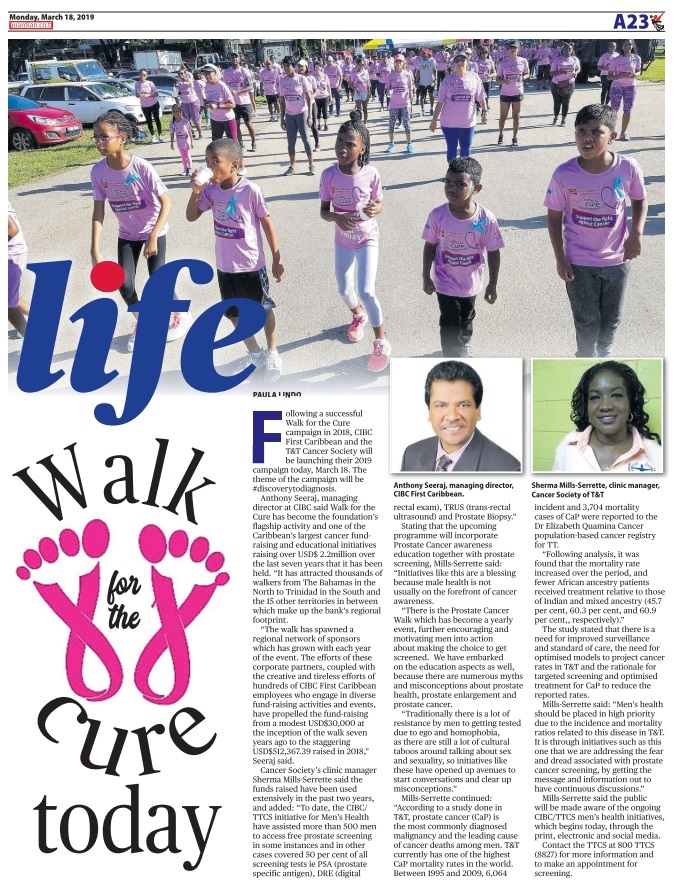
Following a successful Walk for the Cure campaign in 2018, CIBC First Caribbean (CIBCFC) and the T&T Cancer Society (TTCS) will be launching their 2019 campaign on March 18. The theme of the campaign will be #discoverytodiagnosis.
CIBCFC Managing Director Anthony Seeraj said Walk for the Cure has become the foundation’s flagship activity and one of the Caribbean’s largest cancer fundraising and educational initiatives raising over USD$2.2 million over the last seven years that it has been held. “It has attracted thousands of walkers from The Bahamas in the North to Trinidad in the South and the 15 other territories in between which make up the bank’s regional footprint. The walk has spawned a regional network of sponsors which has grown with each year of the event. The efforts of these corporate partners, coupled with the creative and tireless efforts of hundreds of CIBC First Caribbean employees who engage in diverse fundraising activities and events, have propelled the fundraising from a modest USD$30,000 at the inception of the walk seven years ago to the staggering USD$512,367.39 raised in 2018.”
TTCS Clinic Manager Sherma Mills-Serrette said the funds raised have been used extensively in the past two years. “To date, the CIBC/TTCS initiative for Men’s Health have assisted more than 500 men to access free prostate screening in some instances and in other cases covered 50% of all screening tests i.e. PSA (prostate specific antigen), DRE (digital rectal exam), TRUS (trans-rectal ultrasound) and Prostate Biopsy.”
She said the upcoming programme will incorporate Prostate Cancer awareness education together with prostate screening. “ Initiatives like this are a blessing because male health is not usually on the forefront of cancer awareness. There is the Prostate Cancer Walk which has become a yearly event, further encouraging and motivating men into action about making the choice to get screened. We have embarked on the education aspects as well, because there are numerous myths and misconceptions about prostate health, prostate enlargement and prostate cancer. Traditionally there is a lot of resistance by men to getting tested due to ego and homophobia, as there are still a lot of cultural taboos around talking about sex and sexuality, so initiatives like these have opened up avenues to start conversations and clear up misconceptions.”
Mills-Serrette said, “According to a study done in T&T, prostate cancer (CaP) is the most commonly diagnosed malignancy and the leading cause of cancer deaths among men. T&T currently has one of the highest CaP mortality rates in the world. Between 1995 and 2009, 6,064 incident and 3,704 mortality cases of CaP were reported to the Dr. Elizabeth Quamina Cancer population-based cancer registry for TT. Following analysis, it was found that the mortality rate increased over the period, and fewer African ancestry patients received treatment relative to those of Indian and mixed ancestry (45.7%, 60.3%, and 60.9%, respectively).”
The study stated that there is a need for improved surveillance and standard of care, the need for optimised models to project cancer rates in T&T and the rationale for targeted screening and optimised treatment for CaP to reduce the reported rates.
Mills-Serrette said “Men’s health should be placed in high priority due to the incidence and mortality ratios related to this disease in T&T. It is through initiatives such as this one that we are addressing the fear and dread associated with prostate cancer screening, by getting the message and information out to have continuous discussions.”
Mills-Serrette said the public will be made aware of the ongoing men’s health CIBC/TTCS initiatives, which begins on March 18, through the print, electronic and social media.
Contact the TTCS at 800 TTCS (8827) for more information and to make an appointment for screening.
Please see this article:
The burden of prostate cancer in Trinidad and Tobago: one of the highest mortality rates in the world.
Warner WA1,2,3, Lee TY4, Fang F5, Llanos AAM6, Bajracharya S7, Sundaram V8, Badal K9, Sookdeo VD10, Roach V11, Lamont-Greene M11, Ragin C12,13,14,15, Slovacek S3, Ramsoobhag K16, Brown J17, Rebbeck TR
18,19, Maharaj R10, Drake BF20,21.
Author information
Abstract
PURPOSE:
In Trinidad and Tobago (TT), prostate cancer (CaP) is the most commonly diagnosed malignancy and the leading cause of cancer deaths among men. TT currently has one of the highest CaP mortality rates in the world.
METHODS:
6,064 incident and 3,704 mortality cases of CaP occurring in TT from January 1995 to 31 December 2009 reported to the Dr. Elizabeth Quamina Cancer population-based cancer registry for TT, were analyzed to examine CaP survival, incidence, and mortality rates and trends by ancestry and geography.
RESULTS:
The age-standardized CaP incidence and mortality rates (per 100,000) based on the 1960 world-standardized in 2009 were 64.2 and 47.1 per 100,000. The mortality rate in TT increased between 1995 (37.9 per 100,000) and 2009 (79.4 per 100,000), while the rate in the US decreased from 37.3 per 100,000 to 22.1 per 100,000 over the same period. Fewer African ancestry patients received treatment relative to those of Indian and mixed ancestry (45.7%, 60.3%, and 60.9%, respectively).
CONCLUSIONS:
Notwithstanding the limitations surrounding data quality, our findings highlight the increasing burden of CaP in TT and the need for improved surveillance and standard of care. Our findings highlight the need for optimized models to project cancer rates in developing countries like TT. This study also provides the rationale for targeted screening and optimized treatment for CaP to ameliorate the rates we report.
KEYWORDS:
Cancer in populations of African ancestry; Cancer incidence; Cancer mortality; Cancer survival; Caribbean; Geography; Prostate cancer; Trinidad and Tobago
Discover more from Paula Lindo - Our histories, stories, present, future.
Subscribe to get the latest posts sent to your email.
