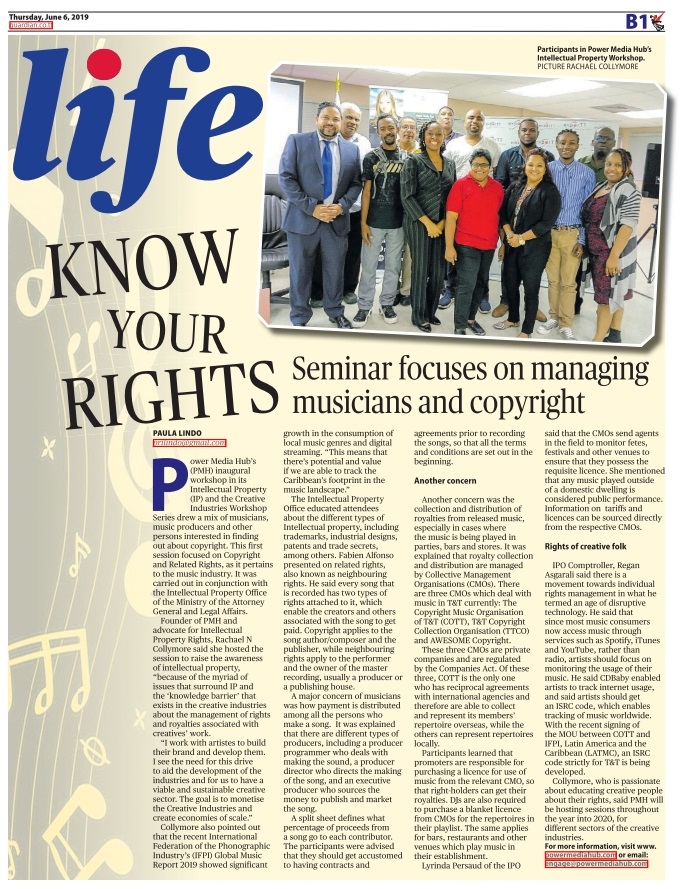
Power Media Hub’s inaugural workshop in its Intellectual Property and the Creative Industries Workshop Series drew a mix of musicians, music producers and other artistes interested in finding out about copyright. The session was carried out in conjunction with the Intellectual Property Office and the Ministry of the Attorney General and Legal Affairs.
Founder of PMH, Rachael Collymore, said she hosted the session to raise awareness of copyright issues “because there is a gap in knowledge in the creative industries about the rights associated with their work. I started working with artists to build branding and I want to educate them about intellectual property. There are a lot of artists with Caribbean roots who are positioning themselves within the space to appear unique. The goal is to monetise the Creative Industries, which are growing rapidly, especially music.”
The Intellectual Property Office educated attendees about the different types of intellectual property, including trademarks, industrial designs, patents and trade secrets, among others. The main focus of the session was copyright and neighbouring rights as they relate to the music industry.
Every song which is recorded has two types of rights attached to it, which enable the creators and others associated with the song to get paid. Copyright applies to the song author/composer and the publisher while neighbouring rights apply to the performer and the owner of the master recording, usually a producer or a publishing house.
A major concern of musicians is how payment is distributed among all the persons who make a song. It was explained that there are different types of producers, including a producer programmer who deals with making the sound, a producer director who directs the making of the song, and an economic producer who sources the money to publish and market the song. A split sheet defines what percentage of proceeds from a song goes to which persons. The artistes present were told that they should get accustomed to having contracts and agreements when recording songs, so that all the terms and conditions are set out in the beginning.
Another concern was the collection and distribution of royalties from released music, especially in cases where the music is being played in parties. It was explained that royalty collection and distribution are managed by CMOs (Collective Management Organisations). There are three CMOs which deal with music in Trinidad currently: Copyright Organisation of T&T (COTT), T&T Copyright Organisation (TTCO) and AWESOME Copyright. These three CMOs are private companies and are regulated by the Companies Act. Of these three, COTT is the only one which is able to collect and administer neighbouring rights for music. COTT is the only one which is able to represent an artiste’s repertoire internationally, while the others can represent repertoires nationally.
Participants learned that promoters are responsible for purchasing a license for use of music from the relevant Collective Management Organisation (CMO) so that royalties are paid to artistes. DJs purchase a blanket license from CMOs which pays royalties for songs that they use for their sets. Participants were also surprised to realise that bars, restaurants, gymnasiums, and other places which play music continuously are required to purchase a license for the music played. Lyrinda Persaud of the IPO said that the Office sends out people to monitor fetes, festivals and other places where music is played in order to ensure that copyright is collected. She mentioned that any music played outside of a domestic situation is deemed public performance, including cars with loud music, and copyright should be collected. Various CMOs should have the tariffs they charge and the performance spaces they charge for publicly available.
IPO Comptroller Raymond Asgarali said there is a movement towards individual rights management in what he termed an age of disruptive technology. He said that since most music consumers now access music through services such as Spotify, iTunes and YouTube, rather than radio, artists should focus on monitoring the usage of their music. He said CDbaby enabled artists to track internet usage, and said artists should get an ISRC code, which enables tracking of music worldwide. With the recent signing of the MOU between COTT and the International Federation of the Phonographic Industry (IFPI), Latin America and the Caribbean (LATMC), an ISRC code strictly for T&T is being developed.
Collymore, who is passionate about educating creative persons about their rights, said PMH will be hosting sessions throughout the year for different sectors of the creative industries.
Discover more from Paula Lindo - Our histories, stories, present, future.
Subscribe to get the latest posts sent to your email.
