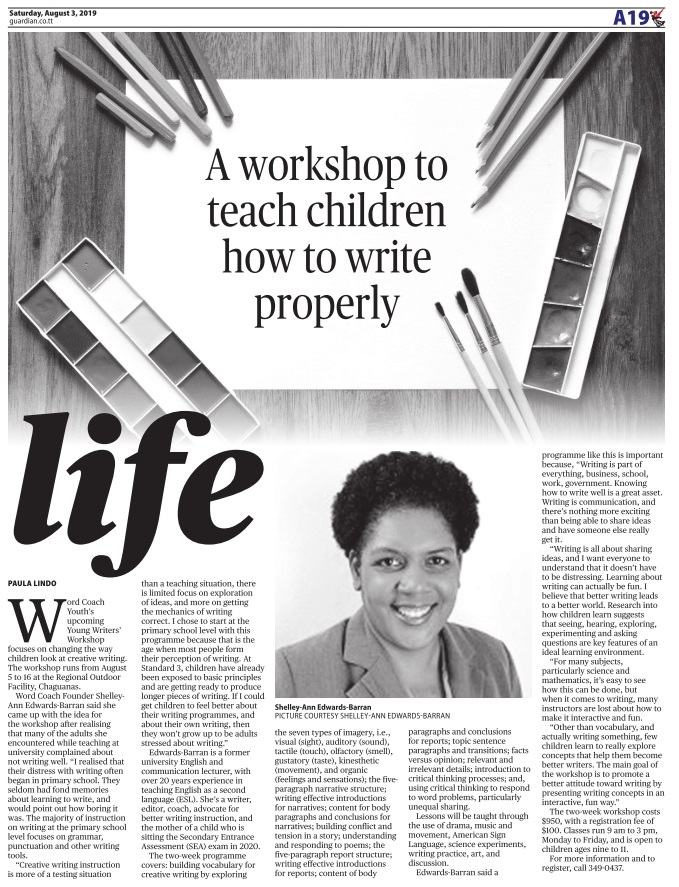
Werd Coach Youth’s upcoming Young Writers’ Workshop focuses on changing the way children look at creative writing. The Workshop runs from August 5 to 16 at the Regional Outdoor Facility, Chaguanas.
Werd Coach Founder Shelley-Ann Edwards-Barran said she came up with the idea for the workshop after realizing that many of the adults she encountered while teaching at university complained about not writing well. “I realized that their distress with writing often began in primary school. They seldom had fond memories about learning to write, and would point out how boring it was. The majority of instruction on writing at the primary school level focuses on grammar, punctuation, and other writing tools. Creative writing instruction is more of a testing situation than a teaching situation; there is limited focus on exploration of ideas, and more on getting the mechanics of writing correct. I chose to start at the primary school level with this programme because that is the age when most people form their perception of writing. At standard 3, children have already been exposed to basic principles and are getting ready to produce longer pieces of writing. If I could get children to feel better about their writing programmes, and about their own writing, then they won’t grow up to be adults stressed about writing.”
Edwards-Barran is a former university English and Communication Lecturer, with over 20 years experience in teaching English as a second language (ESL). She’s a writer, editor, coach, advocate for better writing instruction, and the mother of a child who is sitting the Secondary Entrance Assessment (SEA) exam in 2020.
The two-week program covers: building vocabulary for creative writing by exploring the seven types of imagery, i.e., visual (sight), auditory (sound), tactile (touch), olfactory (smell), gustatory (taste), kinesthetic (movement), and organic (feelings and sensations); the five-paragraph narrative structure; writing effective introductions for narratives; content for body paragraphs and conclusions for narratives; building conflict and tension in a story; understanding and responding to poems; the five-paragraph report structure; writing effective introductions for reports; content of body paragraphs and conclusions for reports; topic sentence paragraphs and transitions; facts versus opinion; relevant and irrelevant details; introduction to critical thinking processes; and, using critical thinking to respond to word problems, particularly unequal sharing. Lessons will be taught through the use of drama, music and movement, American Sign Language, science experiments, writing practice, art, and discussion.
Edwards-Barran said a programme like this is important because “Writing is part of everything, business, school, work, government. Knowing how to write well is a great asset. Writing is communication, and there’s nothing more exciting than being able to share ideas and have someone else really get it. Writing is all about sharing ideas, and I want everyone to understand that it doesn’t have to be distressing. Learning about writing can actually be fun. I believe that better writing leads to a better world. Research into how children learn suggests that seeing, hearing, exploring, experimenting and asking questions are key features of an ideal learning environment. For many subjects, particularly science and mathematics, it’s easy to see how this can be done, but when it comes to writing, many instructors are lost about how to make it interactive and fun. Other than vocabulary, and actually writing something, few children learn to really explore concepts that help them become better writers. The main goal of the workshop is to promote a better attitude toward writing by presenting writing concepts in an interactive, fun way.”
The two-week workshop costs $950, with a registration fee of $100. Classes run 9 am to 3 pm, Monday to Friday and is open to children ages nine to 11. For more information and to register, call 349-0437.
Discover more from Paula Lindo - Our histories, stories, present, future.
Subscribe to get the latest posts sent to your email.
