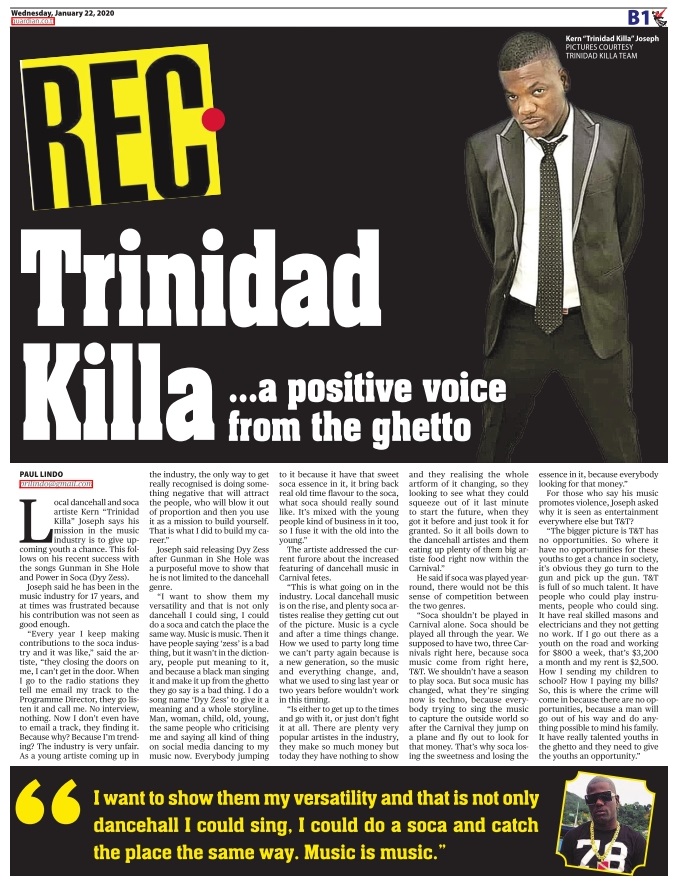
Local dancehall and soca artiste Kern “Trinidad Killa” Joseph says his mission in the music industry is to give upcoming youth a chance. This follows on his recent success with the songs Gunman in She Hole and Power in Soca (Dyy Zess).
Joseph said he has been in the music industry for 17 years, and at times was frustrated because his contribution was not seen as good enough. “Every year I keep making contributions to the soca industry and it was like, they closing the doors on me, I can’t get in the door. When I go to the radio stations they tell me email my track to the Programme Director, they go listen it and call me. No interview, nothing. Now I don’t even have to email a track, they finding it. Because why, because I’m trending? The industry is very unfair. As a young artiste coming up in the industry, the only way to get really recognized is doing something negative that will attract the people, who will blow it out of proportion and then you use it as a mission to build yourself. That is what I did to build my career.”
Joseph said releasing Dyy Zess after Gunman in She Hole was a purposeful move to show that he is not limited to the dancehall genre. “I want to show them my versatility and that is not only dancehall I could sing, I could do a soca and catch the place the same way. Music is music. Then it have the people saying ‘zess’ is a bad thing, but it wasn’t in the dictionary, people put meaning to it, and because a black man singing it and make it up from the ghetto they go say is a bad thing. I do a song name ‘Dyy Zess’ to give it a meaning and a whole story line. Man, woman, child, old, young, the same people who criticising me and saying all kind of thing on social media dancing to my music now. Everybody jumping to it because it have that sweet soca essence in it, it bring back real old time flavour to the soca, what soca should really sound like. It’s mixed with the young people kind of business in it too, so I fuse it with the old into the young.”
The artiste addressed the current furore about the increased featuring of dancehall music in Carnival fetes. “This is what going on in the industry. Local dancehall music is on the rise, and plenty soca artistes realize they getting cut out of the picture. Music is a cycle and after a time things change. How we used to party long time we can’t party again because is a new generation, so the music and everything change, and what we used to sing last year or two years before wouldn’t work in this timing. Is either to get up to the times and go with it, or just don’t fight it at all. It have plenty very popular artistes in the industry, they make so much money but today they have nothing to show and they realizing the whole artform of it changing, so they looking to see what they could squeeze out of it last minute to start the future, when they got it before and just take it for granted. So it all boil down to the dancehall artistes and them eating up plenty of them big artiste food right now within the Carnival.”
He said if soca was played year-round, there would not be this sense of competition between the two genres. “Soca shouldn’t be played in Carnival alone. Soca should be played all through the year. We supposed to have two, three Carnivals right here, because soca music come from right here, T&T. We shouldn’t have a season to play soca. But soca music has changed, what they’re singing now is techno, because everybody trying to sing the music to capture the outside world so after the Carnival they jump on a plane and fly out to look for that money. That’s why soca losing the sweetness and losing the essence in it, because everybody looking for that money.”
For those who say his music promotes violence, he asked why it is seen as entertainment every else but T&T? “The bigger picture is T&T has no opportunities. So where it have no opportunities for these youths to get a chance in society, it’s obvious they go turn to the gun and pick up the gun. T&T is full of so much talent. It have people who could play instruments, people who could sing. It have real skilled masons and electricians and they not getting no work. If I go out there as a youth on the road and working for $800 a week, that’s $3200 a month and my rent is $2500. How I sending my children to school? How I paying my bills? So, this is where the crime will come in because there is no opportunities, because a man will go out of his way and do anything possible to mind his family. It have real talented youths in the ghetto and they need to give the youths an opportunity.”
Discover more from Paula Lindo - Our histories, stories, present, future.
Subscribe to get the latest posts sent to your email.
