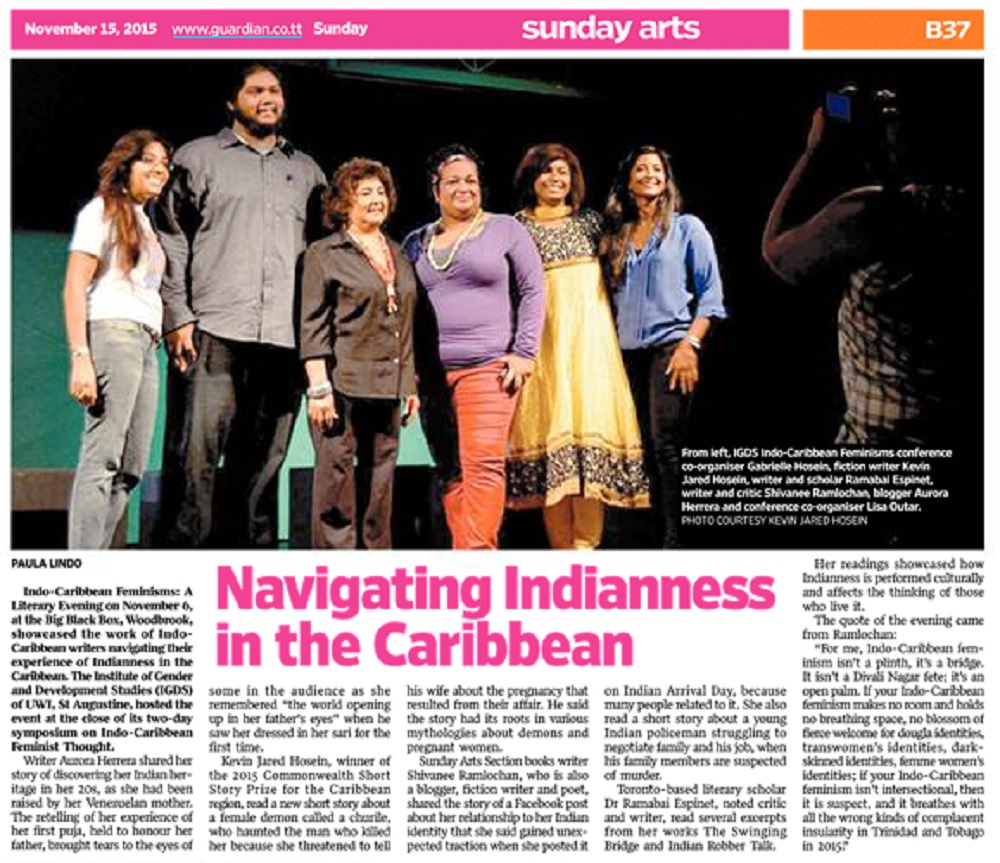
Indo-Caribbean Feminisms: A Literary Evening on November 6 showcased the work of Indo-Caribbean writers navigating their experience of Indianness. The event was hosted by the Institute of Gender and Development Studies following its two-day symposium on Indo-Caribbean Feminist Thought.
Guardian columnist Aurora Herrara shared her story of discovering her Indian heritage in her 20’s, as she’d been raised by her Venezuelan mother. The re-telling of her experience of her first puja, held to honor her father, brought tears to the eyes of some in the audience as she remembered “the world opening up in her father’s eyes” when he saw her in Indian wear for the first time.
Kevin Jared Hosein, winner of the 2015 Commonwealth Short Story Prize for the Caribbean region, read a new short story about a female demon called a churile, who haunted the man who killed her because she threatened to tell his wife about the pregnancy that resulted from their affair. He said the story found its roots in various mythologies about demons and pregnant women.
Shivanee Ramlochan, fiction writer and poet, shared the story of a Facebook post about her relationship to her Indian identity that she said gained unexpected traction when she posted it on Indian Arrival Day, because many people related to it. She also read a short story about a young Indian policeman struggling to negotiate family and his job, when his family members are suspected of murder.
Ramabai Espinet, noted critic and academic, read several excerpts from her works, “The Swinging Bridge” and “Indian Robber Talk.” Her readings showcased how Indianness is performed culturally and affects the thinking of those who live it.
The quote of the evening came from Ramlochan, who said “For me, Indo-Caribbean feminism isn’t a plinth, it’s a bridge. It isn’t a Divali Nagar fete; it’s an open palm. If your Indo-Caribbean feminism makes no room and holds no breathing space, no blossom of fierce welcome for dougla identities, transwomen’s identities, dark-skinned identities, femme women’s identities: if your Indo-Caribbean feminism isn’t intersectional, then it is suspect, and it breathes with all the wrong kinds of complacent insularity in Trinidad and Tobago in 2015.”
Discover more from Paula Lindo - Our histories, stories, present, future.
Subscribe to get the latest posts sent to your email.
