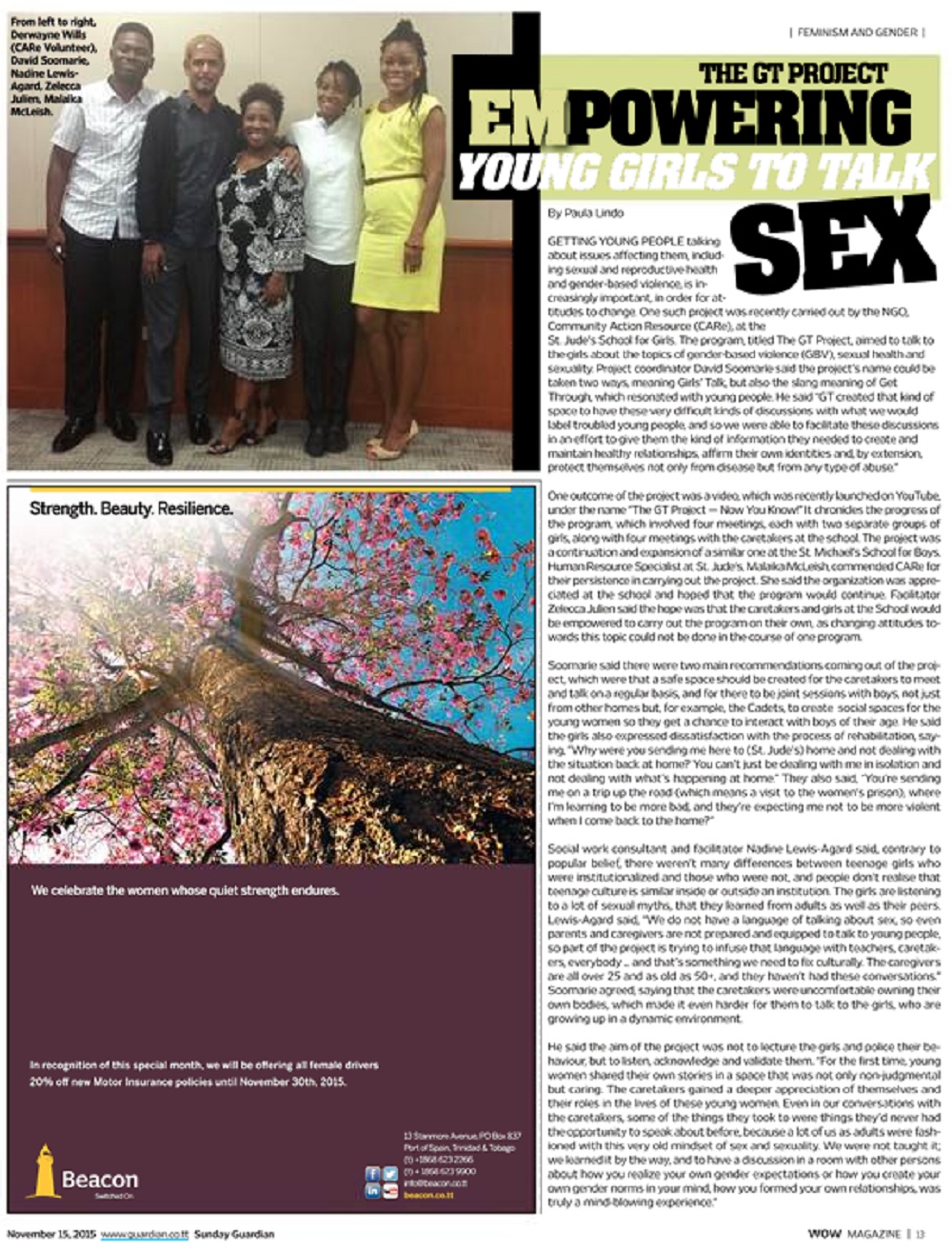
Getting young people talking about issues affecting them, including sexual and reproductive health and gender-based violence, is increasingly important, in order for attitudes to change. One such project was recently carried out by the non-governmental organization (NGO) Community Action Resource (CARe) at the St. Jude’s School for Girls.
The program, titled The GT Project, aimed to talk to the girls about the topics of gender-based violence (GBV), sexual health and sexuality. Project coordinator David Soomarie said the project’s name could be taken two ways, meaning Girl’s Talk but also the slang meaning of Get Through, which resonated with young people. He said “GT created that kind of space to have these very difficult kinds of discussions with what we would label troubled young people, and so we were able to facilitate these discussions in an effort to give them the kind of information they needed to create and maintain healthy relationships, affirm their own identities and by extension, protect themselves not only from disease but from any type of abuse.”
One outcome of the project was a video, which was recently launched on Youtube, under the name “The GT Project – Now You Know!” It chronicles the progress of the program, which involved four meetings each with two separate groups of girls, along with four meetings with the caretakers at the school. The project was a continuation and expansion of a similar one at the St. Michael’s School for Boys.
Human Resource Specialist at the School, Malaika McLeish, commended CARe for their persistence in carrying out the project. She said the organization was appreciated at the school and hoped that the program would continue. Facilitator Zelecca Julien said the hope was that the caretakers and girls at the School would be empowered to carry out the program on their own, as changing attitudes towards this topic could not be done in the course of one program.
Soomarie said there were two main recommendations coming out of the project, which were that a safe space should be created for the caretakers to meet and talk on a regular basis, and for there to be joint sessions with boys, not just from other homes but for example the Cadets, to create interactive social spaces for the young women so they get a chance to interact with boys of their age.
He said the girls also expressed dissatisfaction with the process of rehabilitation, saying “”why were you sending me here to the home and not dealing with the situation back at home, you can’t just be dealing with me in isolation and not dealing with what’s happening at home. They also said you’re sending me on a trip up the road (which means a visit to the women’s prison), where I’m learning to be more bad and they’re expecting me not to be more violent when I come back to the home.”
Social work consultant and facilitator Nadine Lewis-Agard said, contrary to popular belief, there weren’t many differences between teenage girls who were institutionalized and those who were not, and people don’t realize that teenage culture is similar inside or outside an institution. She also said the girls were listening to a lot of sexual myths, that they learned from adults as well as their peers. Lewis-Agard said “We do not have a language of talking about sex so even parents and caregivers are not prepared and equipped to talk to young people, so part of the project is trying to infuse that language with teachers, caretakers, everybody and that’s something we need to fix culturally. The caregivers are all over 25 and as old as 50+ and they haven’t had these conversations.”
Soomarie agreed, saying that the caretakers were uncomfortable owning their own bodies, which made it even harder for them to talk to the girls who are growing up in a dynamic environment.
He said the aim of the project was not to lecture the girls and police their behavior, but to listen, acknowledge and validate them. Soomarie said “for the first time, young women shared their own stories in a space that was not only non-judgmental but caring. The caretakers gained a deeper appreciation of themselves and their roles in the lives of these young women. Even in our conversations with the caretakers, some of the things they took to were things they’d never had the opportunity to speak about before, because a lot of us as adults were fashioned with this very old mindset of sex and sexuality. We were not taught it, we learned it by the way, and to have a discussion in a room with other persons about how you realize your own gender expectations or how you create your own gender norms in your mind, how you formed your own relationships, was truly a mind-blowing experience.”
Discover more from Paula Lindo - Our histories, stories, present, future.
Subscribe to get the latest posts sent to your email.
