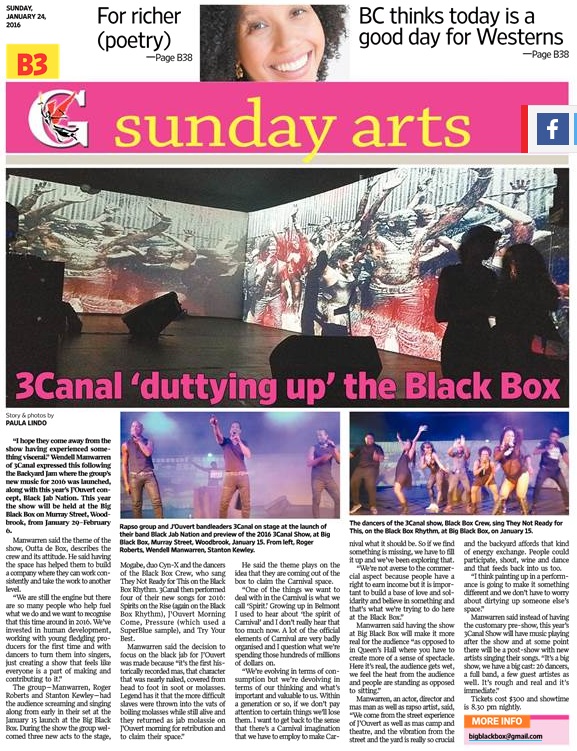
“I hope they come away from the show having experienced something visceral.” 3Canal’s Wendell Manwarren expressed the hope following the first Backyard Jam where the group’s new music for 2016 was launched, along with this year’s Jouvay concept, Black Jab Nation. This year, the show will be held at the Big Black Box on Murray Street, Port of Spain, from January 29 to February 6.
Manwarren said the theme of the show, “Outta de Box” describes the crew and its attitude. He said having the space has helped them to build a company where they can work consistently and take the work to another level. “We are still the engine but there are so many people that help fuel what we do and we want to recognize that this time around in 2016. We’ve invested in human development, working with young fledgling producers for the first time and with dancers to turn them into singers, just creating a show that feels like everyone is a part of making and contributing to it.”
If Friday’s show is anything to go by, attendees will not be disappointed by this year’s offerings. The group, Wendell Manwarren, Roger Roberts, and Stanton Kewley, began with “Last Carnival,” which had the audience screaming and singing along, followed by “Ah Love It,” “Over Me” and “Love Fire.” Next the group welcomed three new acts to the stage, Mogabe singing “Judgment,” duo Cyn-X performing “Wine and Jump Again” and last the dancers of the Black Box Crew, who sang “They Not Ready for This,” on the Black Box Rhythm. 3Canal then performed four of their new songs for 2016, “Spirits on the Rise” again on the Black Box Rhythm, “J’ouvert Morning Come,” “Pressure,” which used a SuperBlue sample, “Try Your Best” and the final song was the classic “Blue.”
Manwarren said the decision to focus on the Black Jab for Jouvay was made because “it’s the first historically recorded mas, that character that was nearly naked, covered from head to foot in soot or molasses. Legend has it that the more difficult slaves were thrown into the vats of boiling molasses while still alive and they returned as jab molassie on J’ouvert morning for retribution and claim their space.” He said the theme plays on the idea that they are coming out of the Box to claim the Carnival space.
“One of the things we want to deal with in the Carnival is what we call “Spirit.” Growing up in Belmont I used to hear about the Spirit of Carnival and I don’t really hear that too much now. A lot of the official elements of Carnival are very badly organized and I question what we’re spending those hundreds of millions of dollars on. We’re evolving in terms of consumption but we’re devolving in terms of our thinking and what’s important and valuable to us. Within a generation or so, if we don’t pay attention to certain things we’ll lose them. I want to get back to the sense that there’s a Carnival imagination that we have to employ to make Carnival what it should be. So if we find something is missing, we have to fill it up and we’ve been exploring that. We’re not averse to the commercial aspect because people have a right to earn income but it is important to build a base of love and solidarity and believe in something and that’s what we’re trying to do here at the Black Box.”
Manwarren said having the show at Big Black Box will make it more real for the audience “as opposed to in Queen’s Hall where you have to create more of a sense of spectacle. Here it’s real, the audience gets wet, we feel the heat from the audience and people are standing as opposed to sitting. We come from the street experience of Jouvay as well as mas camp and theatre, and the vibration from the street and the yard is really so crucial and the backyard affords that kind of energy exchange. People could participate, shout, wine and dance and that feeds back into us too. I think painting up in a performance is going to make it something different and we don’t have to worry about dirtying up someone else’s space.”
Manwarren said instead of having the customary pre-show, there will be music playing after the show and at some point there will be a post-show with new artists singing their songs. For Jouvay, the party will start at midnight and then take to the streets at 4 am. “It’s a big show, we have a big cast, 26 dancers, a full band, a few guest artistes as well. It’s rough and real and it’s immediate.”
Shows cost $300 and begin at 8:30 pm. The cost of the Jouvay package has not been finalized. Ticket bookings and further information: bigblackbox@gmail.com
Unedited interview below
“Try your best” was dedicated to Tallest Man who is the everything guy around here at the Black Box, and not just him, I dedicated it to the whole Black Box crew, all the people in the office, all the people that contribute to make this place what it is, because one of the things we really want to focus on this time around is, having this place has afforded us the opportunity to be able to build a company where we can work consistently and take the work to another level. As you saw tonight, the dancers have evolved into singers, we challenge them on every front and I won’t take no for an excuse, I think you could do something and I say, let’s do it and they respond, and I feeling like a proud papa. For me that’s the evolution of the whole vibration. We are still the engine but there are so many people that help fuel what we do and that’s what we want to recognize this time around in 2016.
The theme of the show is “Outta The Box” and this is the Big Black Box “Out and Bad” which helps describe the crew and it’s attitude and how we approach things, and the Black Jab Nation, you know we always try to find a typical character to ground whatever the J’ouvert vibe is. We always start from J’ouvert and then work backwards, start from J’ouvert and then we make the show and then we make the music and so on. The Black Jab is something we focused on this time around because it’s the first historically recorded mas, that character that was nearly naked, covered from head to foot in soot or molasses, and legend has it that the more difficult slaves were thrown into the vats of boiling molasses while still alive and they returned as jab molassie on J’ouvert morning to get their retribution, to claim their space and make whatever their statement is. So we’re just playing on that idea and saying out of the box we come and claim this Carnival space, and one of the things we want to deal with in the Carnival is what we call “Spirit,” because I remember as a youth growing up in Belmont I used to hear about the Spirit of Carnival. I don’t really hear that too much now and when I look around, a lot of the official elements of Carnival are very badly organized and I question what we’re spending those hundreds of millions of dollars on and I want to get back even to the sense that there’s a Carnival imagination that we all have to employ to make the Carnival what it should be. So if we find something is missing, we have to fill it up, so that’s what we’re trying to do, all respects to everybody who doing their thing, but we just think there’s another space and we’ve just been exploring it from a conceptual point of view. We try and keep it grounded and real in many ways, not that we are averse in the commercial aspect because we think this is a business and people have a right to earn income but it is important to build a base of love and solidarity and believe in something and that’s what we’re trying to do here at the Black Box.
All are welcome at J’ouvert because we just want to get back to that essence of J’ouvert, of playing a mass. A long time ago, I spoke to a man named Nari Approo, who’s a legendary Black Indian, and in a different country he’d be renowned, but in Trinidad, he’s just Nari, but Jeffrey Chuck, another legendary photographer, he introduced me to Nari and I said “Nari, what is mas?” and he said “Mas is about dance and fight, it’s about beauty and contestation,” because you have to claim a space, everybody fighting up for a space in the road or whatever. So what we’re focusing on too is this return of the rope, people roping off these bands and if you’re trying to cross from one side of the street to the next you could get beaten up. I have partners who ended up in the hospital trying to get from one side of the street to the next. And that’s something that was there in the early Carnival and then it was gotten rid of. So the fact that it came back in Carnival and it’s causing so much trouble as far as I’m concerned really means that I think we’re kind of ass backwards in many ways as a people sometimes, we’re not evolving, we’re devolving. We’re evolving in terms of consumption but we’re devolving in terms of our thinking and so on, what’s important and valuable to us, and I think our expression is of paramount importance and we need to pay more attention to it. When I say expression, I mean all aspects of the expression, from the written word to the spoken word, to the music to the dance to the costumes to the way we stage plays to the way we do our festivals, whether it’s Ram Leela or Carnival or Divali or whatever, there’s something that we do that’s special and if we don’t pay attention to it we could lose it and I think that’s one of the things that we’re looking around and we’re thinking within a generation or so, if we don’t pay attention to certain things we’ll lose them. I know time moves on and everything changes, but I think we have certain valuable things that we should try to retain.
We started with a more traditional J’ouvert set. The first song was “Last Carnival” because when the new Carnival comes around we always sing about the last one and praying for this one to be better. It’s one of our favourite songs and it’s one that the audience responds to immediately. We then went to a song called “Ah Love It,” which we all love. It was produced by Keshav Chandradathsingh, one of our favourite producers and one of the most humble and brilliant people you could ever hope to work with. After that we did “Over Me”,and then we went into “Love Fire” both also from Keshav, and then “Fire Bun Dem” which comments on the Carnival, if you’re only interested in the commercial aspects, you’re not really doing Carnival a service, you have to serve the Spirit.
Then we introduced the new artists, Mogabe singing Judgment, produced by DJ Rawkus and assisted by me. Next was Cyn-X who did Wine and Jump Again, followed by the Black Box Crew, with “Outta the Box, Out and Bad”.
Then we presented our new material, “Spirits on the Rise” on the same Black Box Rhythm and then “J’ouvert Morning Come” and “Pressure,” which used a SuperBlue sample, then “Try Your Best” and the final song was “Blue”
I hope they will come away from the show with a sense of something visceral. It being here at home in the Black Box may make it more real as opposed to in Queen’s Hall where you have to create more of a sense of spectacle, because you have the proscenium and the settings and the distance between the audience. Here it’s real, the audience gets wet and we feel the heat from the audience, we feel the people right there, people are standing as opposed to sitting. That’s one of the things we’ve been trying to deal with for a long time because we’re giving off energy and people are just sitting down and you can see they want to get up and dance and that actually has been a big big problem. We loved the relationship we had with Queen’s Hall, they allowed us to do a lot of stuff that many people didn’t do, we challenged them in many ways, we always thought that every year we’d have to find some new way to use the space, whether it’s to come from underneath or come from on top or whatever and they always worked with us and it’s the most technically equipped space in the country. But by the same token, we come from J’ouvert, we come from that street experience, we also come from mas camp and from theatre, and that vibration from the street and the yard is really so crucial and the backyard affords that kind of energy exchange. People come and they go and they’re standing up and they could participate and shout and wine and dance and that feeds back into us too, so it’s a different experience, and this time around because it’s in our backyard and it’s Black Jab we could paint up and we don’t have to study about if we’re going to dirty up someone else’s space and I think the act of painting up in a performance is going to make it something different. For me the vibe is just more real because we’re at home.
All shows will be held at the Big Black Box on Murray Street. The show will run every night from January 29 to February 6, starting at 8:30 and after the show, people are welcome to stay for the afterparty, as it’s Carnival week. There will be one more backyard jam and then the show starts and then it’s Carnival. the cost is $300 which is really good in these times. It’s a big show, we have a big cast, 26 dancers, a full band, a few guest artistes as well. It’s rough and real and it’s immediate, but it’s not cheap, there’ll be a lot of energy that’s been invested from the lighting to the sound to the design, even just the use of the pigment, we’ve been working on what’s the best pigment to use, that kind of thing. We had a photoshoot the other day that was very exciting. It just brings a more immediate sense to the whole performance, when you’re painted down your energy transforms.
J’ouvert may be around $400 and $500, the other backyard jam is next Friday and it’ll be free, hour-long set, may change the songs, have artists still working on their songs and people lining up to work on Black Box rhythm. One of the things we want to do is instead of having a pre-show, you come, you see the show, if you want to lime afterwards, there’s music playing and at some point we’ll have a post-show with new artists and whatnot singing their songs. Afterparty and show. J’ouvert starts at midnight and then goes onto the road at 4 am, we always wanted to do a J’ouvert party that spills over into the actual J’ouvert. We tried it last year but we didn’t have our own space to do it, so people came and they partied and the rest of the people joined us up at the park and then we took off.
People have been saying it’s a short season and they haven’t yet felt the Carnival vibe, but they felt it tonight and I felt it tonight more than any other time. We knew we had to prepare for it but tonight you could feel the energy and the excitement.
Trinidad right now there’s a kind of rage in the cage. How do you diffuse that? When you look at the news every day, the quality of murders that taking place. There’s a recession and nobody wants to hear that but it’s real. It’s a different time and we have to approach things differently and one of the things we have to do here is build a real vibe. We really invested in human development and that’s where we are right now, that’s what we’re doing. Whether it’s working with young fledgling producers for the first time and trusting to make songs with them, or working with dancers and turn them into singers, just creating a show that feels like everyone is a part of making and contributing to it. And this place, before we came here, this was the home of Godfrey Sealey, who was President of NDATT at one point, he was a renowned AIDS activist so he stood for certain things. So we think it’s important to do the same. WE always say to entertain and educate is rapsoman vibes, and we try to maintain that. We have no problem with other people who sing soca and do their thing and use the Carnival how they use it but we try to use it differently.
Discover more from Paula Lindo - Our histories, stories, present, future.
Subscribe to get the latest posts sent to your email.
