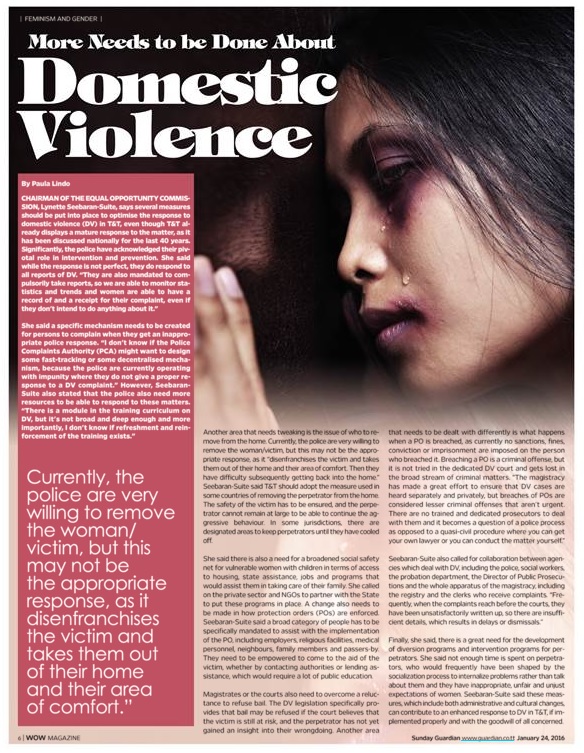
Chairman of the Equal Opportunities Commission, Lynette Seebaran-Suite, says there are several measures which need to be put into place to optimize the response to domestic violence (DV) in T&T. She said these measures are needed even though T&T already displays a mature response to DV, in that the topic is discussed on a national level and has been for the last 40 years.
She said in the beginning, the prevailing view was that this was a private matter to be kept in the bedroom and stakeholders were not interested in intervening, particularly the police, which left women at the mercy of their menfolk or their intimate partners. However, the issue has since been broadly acknowledged as a problem by society and since 1991, there has been legislation to provide a cheap, quick and easily accessible remedy in all 13 magisterial districts in T&T. This legislation was significantly improved on in 1991 and there are now many services in T&T to deal with DV, including hotlines, shelters, various Ministerial departments and a number of NGOs working in the field. A significant response is seen in the fact that there are over 11,000 DV cases going before a magistrate each year.
Seebaran-Suite said the most significant revolution in the thinking on DV is that the police have acknowledged their pivotal role in intervening and preventing DV. She said while the response is not perfect, under the legislation “they MUST respond to all allegations of domestic violence and by and large I would say that they do. Everybody will have their anecdote where they met an inappropriate response but for every allegation of an inappropriate response, you would have the unheard cases in which there has been a response. Not only are they mandated to intervene, but they are also mandated to compulsorily take reports so that we are able to monitor statistics and trends and women are able to have a record of their complaint, even if they do not intend to do anything about it, their complaint is recorded and they must be given a receipt for having made their complaint.”
One area that needs tweaking is the issue of who to remove from the home. Currently, when the police receive a report from a victim, their mandate is to see that the person and their children are safe, and “one gets the impression that they are operating under a policy directive to remove the victims from the scene of the aggression, so they are very willing to remove the woman/victim, but I suggest this is not the appropriate response, because it disenfranchises the victim, takes them out of their home and their area of comfort. It doubly victimizes them and then they have difficulty subsequently getting back into the home where there may be title issues, or the home may belong to the man, or the home may be jointly owned and they may be locked out and be accused of abandoning the home.”
Seebaran-Suite said in some countries, including the US and Canada, the perpetrator is removed from the home and this should be adopted in T&T. She said there are serious considerations attached to this move, because the safety of the victim has to be ensured, and the perpetrator cannot remain at large to be able to continue the aggressive behaviour. In some jurisdictions, there are designated areas to keep perpetrators overnight until they have cooled off and it can be determined whether they were under the influence of alcohol or drugs, whether they have some kind of mental illness, what is the particular stress that they are operating under that is causing them to act out.
A change also needs to be made in how protection orders (POs) are implemented and enforced, as once a victim receives an order, she is usually left on her own to enforce it. Seebaran-Suite said what needs to happen is that a broad category of onlookers and neighbours have to be specifically mandated to assist with the implementation of the PO, including employers, religious facilities, medical personnel, neighbours, family members and passersby. They need to be empowered to come to the aid of the victim, whether by contacting authorities or lending assistance. This would require a large degree of public education to get people to intervene in what they may continue to see as private business between two people. “But it is entirely inappropriate, especially in the situation of ultimate DV, where women are killed, for you to be hearing neighbours and onlookers saying that they were aware all along that threats were being issued. That means that the woman did not receive the backup and the network of protection after getting the remedy, after getting the PO.”
Another area in which the legislation or the response needs to be tweaked is that the magistrates or the courts need to overcome a reluctance to refuse bail. The domestic violence legislation specifically provides that bail may be refused if the court believes that the woman or the victim is still at risk, and that the perpetrator has not yet gained an insight into their wrongdoing, but the magistrates are often reluctant to refuse bail.
Another area that needs to be dealt with differently is what happens when a PO is breached, as currently no sanctions, fines, conviction or imprisonment are imposed on the person who breached it. However, breaching a PO is a criminal offense, but it is not tried in the dedicated domestic violence court, but in the broad stream of criminal matters where it gets lost. A great effort has been made on the part of the magistracy to ensure that domestic violence cases are heard in a separate court, by a separate magistrate, either at a separate time or an entirely dedicated magistrate in a separate room so it can be done privately, but breaches of POs are considered lesser criminal offenses that need not be dealt with urgently. There are no trained and dedicated prosecutors to deal with them and it’s now a question of a police process as opposed to a quasi-civil procedure where you can get your own lawyer or you can conduct the matter yourself.
Seebaran-Suite also called for collaboration between agencies which deal with domestic violence, including the police, social workers, the probation department, the Director of Public Prosecutions and the whole apparatus of the magistracy, including the reception of complaints, the registry and the clerks who receive complaints. “That is another area in which you need a dedicated workforce of persons who are experienced and sensitive in the taking of DV complaints, because frequently when the complaints reach before the courts, they have been unsatisfactorily written up, so there’s insufficient particularity in terms of exactly what you’re complaining about, the date, the time and the place and the fine details of the allegations, which results in delays or dismissals.”
She said a specific mechanism needs to be created for persons to complain when they do not get an appropriate police response. This needs to be separate and apart from the Police Complaints Authority, because that is too cumbersome to have to go and make a complaint to the PCA. “I don’t know if the PCA themselves might want to design some fast-tracking or some decentralized mechanism of complaints of inappropriate police response to DV, but as it stands now, the police are operating with impunity where they do not give a proper response to a DV complaint.”
However, Seebaran-Suite also stated that the police also need more resources to be able to respond to these matters. “We have to empower the police and we have to resource the police so that they are able to give appropriate responses to domestic violence matters. Police sometimes tend to be domestic violence abusers, they themselves are in a very stressful job, they have heavy workloads, they put themselves in the line of danger to protect and serve the public, so the public, the policymakers, the government, has to recognize the level of support and training and interventions that are needed by the police themselves right now.” The question of adequate resources and manpower has to be looked at, as well as training and retraining of the police, refreshers and updates. “I have had the opportunity to look at the curriculum and while there is a module on domestic violence, it’s not broad and deep enough and more importantly, the refreshing of the training and the reinforcement of the training is what I do not know whether it exists.”
She said there is also a need for a broadened social safety net for vulnerable women with children in terms of access to housing, state assistance, jobs and programs that would assist them in taking care of their family, because a measure of the sophistication of a society is you do not want a woman to have to make a choice to remain in an abusive relationship in order to be able to support herself and her children. However, she said that in this time of economic hardship, it is hard to call on the government to accept financial responsibility for these issues. “There are so many agencies in the society, NGOs, service organizations, charitable organizations, international organizations, do-good organizations, that are looking for programs to put in place and so there is a great opportunity for a lot of partnering between the State, which probably would act as the organizer and NGOs and service organizations to provide these services, because these are very expensive services to provide, it’s a difficult time to be calling on the government to be putting out more and more money in economic hard times. So that is an area for corporate responsibility and NGO responsibility to come to the fore and look at partnering to provide these programs.”
Finally, Seebaran-Suite said there is a great need for the development of diversion programs and intervention programs for perpetrators. She said a lot of the time is spent on victims and not enough time on perpetrators, because the perpetrators themselves would frequently have been shaped by the socialization process which ill-equips them to survive in relationships and treats men and women differently. Men are not encouraged in their socialization to speak about their problems and seek help, and also they are punished differently and more harshly than girls. “So it’s a double-edged sword, because on the one hand, they receive a lot of benefits and a lot of preferential treatment, and they’re encouraged not to take up responsibility and so on, but on the other hand, they also suffer from the socialization in that they internalize problems rather than talk about them, and then they have inappropriate expectations of women and they have very unfair and unjust expectations.”
Discover more from Paula Lindo - Our histories, stories, present, future.
Subscribe to get the latest posts sent to your email.
