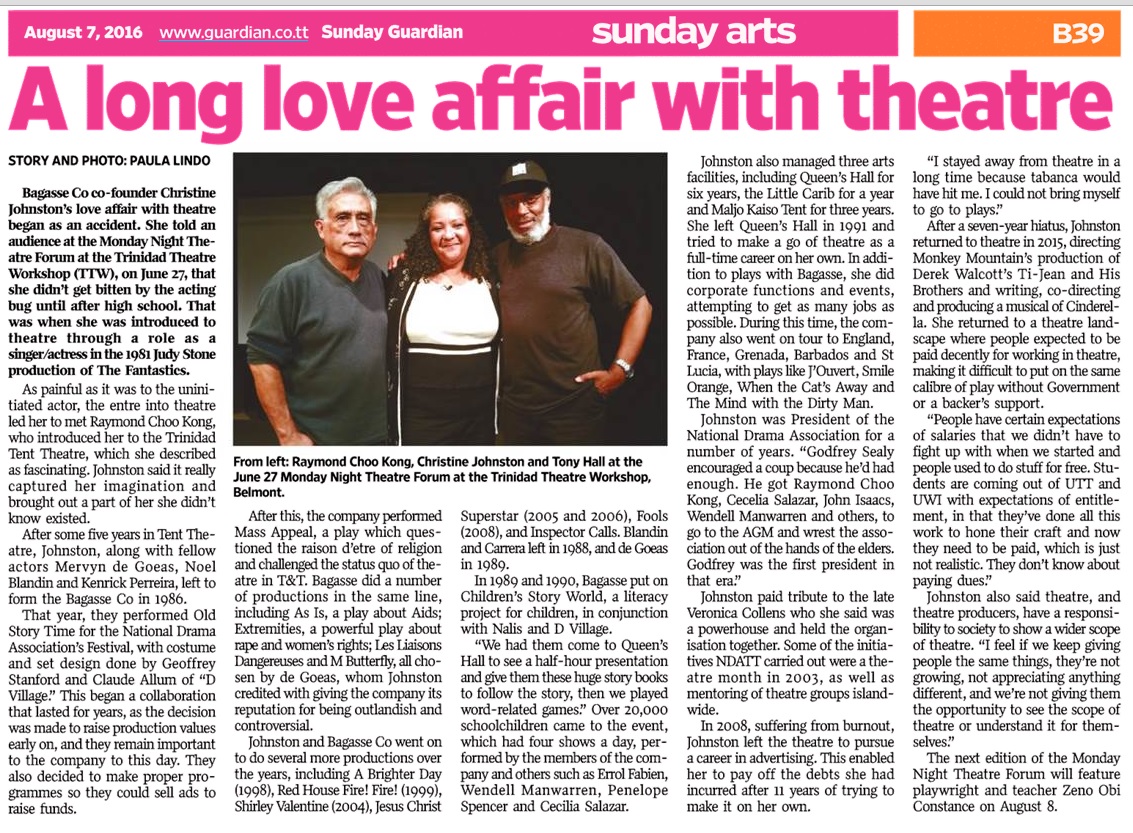
Bagasse Company co-founder Christine Johnston’s love affair with theatre began as an accident.
She said the experience was painful, as she knew nothing about theatre.
It was there she met Raymond Choo Kong, who introduced her to the Trinidad Tent Theatre (TTT), which she described as fascinating. Johnston said it really captured her imagination and brought out a part of her she didn’t know existed.
After approximately five years in TTT, Johnston, along with fellow actors Mervyn de Goeas, Noel Blandin and Kenrick Perreira, left to form the Bagasse Company in 1986, as they found the productions were getting too repetitious and they also wanted to get into mainstream theatre.
That year, 1986, they performed Old Story Time for the National Drama Association’s Festival, with costume and set design done by Geoffrey Stanford and Claude Allum of “D Village.” This began a collaboration which lasted for years, as the decision was made to raise production values early on, and they remain important to the Company to this day. They also decided to make proper programs so they could sell ads to raise funds.
After this, the company performed “Mass Appeal,” a play which questioned the raison d’etre of religion and challenged the status quo of theatre in T&T. Bagasse Productions did a number of productions in the same line, including “As Is,” a play about AIDS; “Extremities,” a powerful play about rape and women’s rights; “Les Liaisons Dangereuses” and “M. Butterfly,” all chosen by de Goeas, whom Johnston credited with giving the company its reputation for being outlandish and controversial. Johnston and Bagasse Company went on to do several more productions over the years, including A Brighter Day (1998), Red House Fire! Fire! (1999), Shirley Valentine (2004), Jesus Christ Superstar (2005 & 2006), Fools (2008), and Inspector Calls. Blandin and Carrera left in 1988, and de Goeas in 1989.
In 1989 and 1990, Bagasse Company put on “Children’s Story World,” a literacy project for children, in conjunction with NALIS and D Village. “We had them come to Queen’s Hall to see a half-hour presentation and give them these huge story books to follow the story, then we played word-related games.” Over 20,000 schoolchildren came to the event, which had four shows a day, performed by the members of the company and others such as Errol Fabien, Wendell Manwarren, Penelope Spencer and Cecilia Salazar.
Johnston also managed three arts facilities, including Queen’s Hall for six years, the Little Carib for a year and Maljo Kaiso Tent for three years. She left Queen’s Hall in 1991 and tried to make a go of theatre as a full-time career on her own. In addition to plays with Bagasse Company, she did corporate functions and events, attempting to get as many jobs as possible. During this time, the Company also went on tour with plays like J’ouvert, – England and France, Smile Orange – Grenada, When the Cat’s Away – Grenada and St. Lucia and The Mind with the Dirty Man – Barbados.
Johnston was President of the National Drama Association of T&T for a number of years. “Godfrey Sealy encouraged a coup because he’d had enough. He got Raymond Choo Kong, Cecelia Salazar, John Isaacs, Wendell Manwarren and others, to go to the AGM and wrest the Association out of the hands of the elders. Godfrey was the first President in that era.” Johnston paid tribute to Veronica Collins who she said was a powerhouse and held the organization together. Some of the initiatives NDATT carried out were a theatre month in 2003, as well as mentoring of theatre groups island-wide.
In 2008, suffering from burnout, Johnston left the theatre to pursue a career in advertising. This enabled her to pay off the debts she had incurred after 11 years of trying to make it on her own. “I stayed away from theatre in a long time because tabanca would have hit me. I could not bring myself to go to plays.”
After a seven year hiatus, Johnston returned to theatre in 2015, directing Monkey Mountain’s production of Derek Walcott’s Ti-Jean and His Brothers and writing, co-directing and producing “Cinderella – The Trinidad and Tobago Musical.” She returned to a theatre landscape where people expected to be paid decently for working in theatre, making it difficult to put on the same calibre of play without Government or a backer’s support. “People have certain expectations of salaries that we didn’t have to fight up with when we started, and people used to do stuff for free. Students are coming out of UTT and UWI with expectations of entitlement, in that they’ve done all this work to hone their craft and now they need to be paid, which is just not realistic. They don’t know about paying dues.”
Johnston also said theatre, and theatre producers, have a responsibility to society to show a wider scope of theatre. “I feel if we keep giving people the same things, they’re not growing, not appreciating anything different, and we’re not giving them the opportunity to see the scope of theatre or understand it for themselves.”
I’ve attached my unedited notes below
“It is important for a nation, in creating an identity, to celebrate our unique heritage, and not be limited in scope.” Natalia Dopwell, Creative Director of the Classical Music Development Foundation of T&T (CMDFTT), says it is for this reason the Foundation has commissioned “Songs of the Islands”, an albums of songs derived from music and poetry of the Caribbean and reinterpreted for classical performers. The album will be premiered for the first time on July 9 during the T&T Opera Festival 2016.
Dopwell said the idea for the collection came from her personal experience as a Trinidadian studying in New York and missing out on opportunities to perform because there was no suitable music from her home country. “Although we have a lot of music in this country, not very much of it was written down in a way where you could hand sheet music to a pianist and perform it. We have two collections of folk songs, one by Edwin Carter and the other by La Petite Musicale that were written down, which are actually quite difficult to get your hands on. However, the folk songs were never intended to be performed by solo performers in a concert setting, they’re more meant for large groups and choirs with a lot of movement and repeats and drums to make it interesting. For a solo performer, they don’t do anything vocally challenging and they tend to fall very flat so that’s why you don’t hear solo performers performing them very often. I just kept thinking it shouldn’t be so hard for Trinidadian singers to get their hands on music from our own country to perform in this way.”
Dopwell said she heard of Dominique LeGendre, a UK-based, Trinidad-born composer, while performing in a web-cast concert. LeGendre had composed a full-length opera, called “Bird of Night,” based on the Soucouyant, for the Royal Opera House, (ROH2) Covent Garden, in 2004. They began corresponding via email and LeGendre asked Dopwell with rapso group 3Canal and singer Nickolai Salcedo to sing in the workshop performance of “Jab Molassie,” a new music-theatre work commissioned by Calabash Foundation for the Arts, in 2014.
Based on this relationship, the CMDFTT commissioned LeGendre to compose the album using sources from T&T and the Caribbean. Dopwell said the three main sources are traditional spirituals, folk songs and poems from Caribbean poets like Claude McKay and Derek Walcott. “The folk songs are very light and fun to perform, and then she’s got some that are more like ballads and then you’ve got these spirituals that are more contemplative. There’s everything from spirituals to patois to folk songs to Call of the Rosebud which is a Jamaican patois poem, then some contemporary Caribbean writers. It’s all written for solo or duet voice and piano.”
The performers will include Dopwell, Eddie Cumberbatch, Danielle Williams, Leandra Head, Jude Balthazar, Rory Wallace and visiting Canadian husband and wife, Justin Welsh and Cara Adams. The two pianists, Dr. Jeffrey Middleton and Byron Burford, flew in from New York for the Opera Festival.
Dopwell said all but two of the song had never been performed before “with the exception of two from Derek Walcott that were debuted last year in three places: they were sung at the Bocas Literary Festival in Trinidad, and I also sang them in both Poland and London last year.”
Dopwell said one of the performers was blown away to hear about the collection. “He said when he heard we were doing/actually had some music written for Caribbean performers, he said he was blown away and so happy because he could finally say, maybe at the next recital he performs at, alongside Mozart and some spirituals, he could perform something from his own country in a concert hall and really stand up there and say “This is from my country.” I’m just happy to be able to have had the opportunity to create something new for classical singers from the Caribbean region, of which there are many, we have a long history of Caribbean classical singers that goes largely unnoticed and that history I think is important and I’m glad to be able to have created, to have allowed this collection to be created.”
She is happy that the collection has been created. “It was very difficult for me to have those opportunities be missed just because no-one had ever taken the opportunity to invest in this genre. It’s important for me because I know there are many other talented singers coming behind me that are going to face the same problem. I’m just happy to have had the opportunity to create something new for classical singers from the Caribbean region, of which there are many. We have a long history of Caribbean classical singers that goes largely unnoticed and that history is important.”
Discover more from Paula Lindo - Our histories, stories, present, future.
Subscribe to get the latest posts sent to your email.
