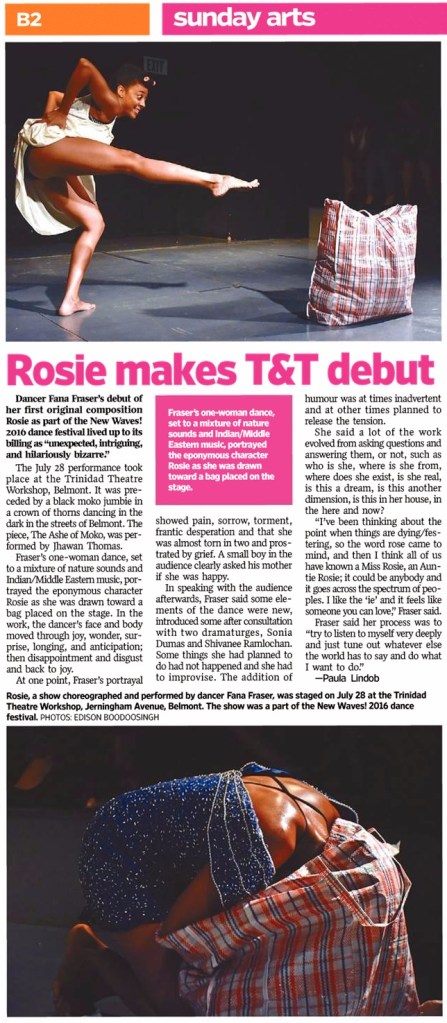
Dancer Fana Fraser’s debut of her first original composition “Rosie” as part of the New Waves! 2016 dance festival lived up to its billing as “unexpected, intriguing, and hilariously bizarre.”
The performance at the Trinidad Theatre Workshop was preceded by a black Moko Jumbie in a crown of thorns dancing in the dark in the streets of Belmont. The piece, “The Ashe of Moko” was performed by Jhawan Thomas.
Published in the T&T Guardian on August 7, 2016
Fraser’s dance, set to a mixture of nature sounds and Indian/Middle Eastern music, portrayed Rosie, as she was drawn toward a bag placed on the stage. Her facial expressions and body movements showed wonder, surprise, longing and anticipation as she slowly reached with every part of her being. She explored the wonderful object through touch, taste, smell, like a child at Christmas but one who is determined to savour the experience of opening a gift. She was clearly disappointed and disgusted upon opening the bag, and became almost manic, trying to scrub away an experience.
The sudden ringing of the phone introduced a new element, and the audience could clearly see and feel that the character had received bad news. Fraser’s portrayal clearly showed pain, sorrow, torment, frantic desperation and that she was almost torn in two and prostrated by grief. A small boy in the audience clearly asked his mother if she was happy. Slowly she remembered that she had been happy and went back to exploring the bag, diving headfirst into it at one point. Rosie eventually discovers a beautiful dress and becomes a whirling dervish of movement, frenziedly changing out of her nightgown. The change of attire leads to a change in character, and Rosie visibly becomes more powerful and sensuous. She proclaims “this is who I am supposed to be” through her body language and movement. The phone intrudes again, to bring her back to reality, and she fades into blackness as she reads a note she takes from the bag.
In speaking with the audience afterwards, Fraser said some elements of the dance were new, some after consultation with two dramaturges, Sonia Dumas and Shivanee Ramlochan, and others because some things she had planned to do had not happened and she had to improvise. The addition of humour was at times inadvertent and at other times planned to release the tension. She said a lot of the work evolved from asking questions and answering them, or not, such as who is she, where is she from, where does she exist, is she real, is this a dream, is this another dimension, is this in her house, in the here and now?
Fraser chose the name Rosie because “I’ve been thinking about the point when things are dying/festering, so the word rose came to mind, and then I think all of us have known a Miss Rosie, an Auntie Rosie, it’s not, it could be anybody and it goes across the spectrum of peoples, I like the ‘ie’ and it feels like someone you can love.”
Fraser said her process was to “try to listen to myself very deeply and just tune out whatever else the world has to say and do what I want to do.”
Discover more from Paula Lindo - Our histories, stories, present, future.
Subscribe to get the latest posts sent to your email.
