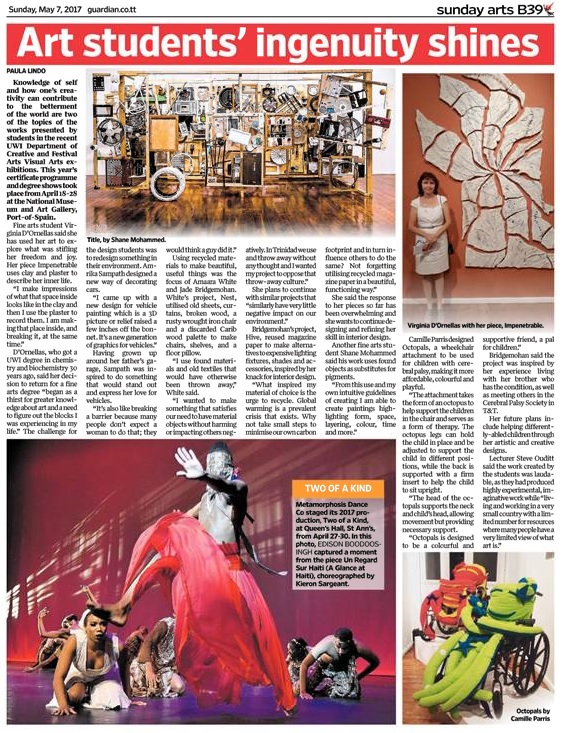
Knowledge of yourself and how your creativity can contribute to the betterment of the world around you are some of the topics creative persons confront as they develop their potential. This was evident in the exhibits presented by students in the recent UWI Department of Creative and Festival Arts Final Year Art Exhibition 2017 at the National Museum and Art Gallery, Port of Spain.
Fine Arts student Virginia D’Ornellas said she has used her art to explore what was stifling her freedom and joy. Her piece “Impenetrable” uses clay and plaster to describe her inner life. “I make impressions of what that space inside looks like in the clay and then I use the plaster to record them. I am making that place inside, and breaking it, at the same time.” D’Ornellas, who got a degree from UWI in Chemistry/Biochemistry 30 years ago, said her decision to return for a Fine Arts degree “began as a thirst for greater knowledge about art and a need to figure out the blocks I was experiencing in my life.” She hopes “my sculpture would provide some kind of reference point for people to explore the blocks to their sense of wholeness and joy in their own life.”
Another Fine Arts student, Shane Mohammed, said his piece, “Title,” is based on using found objects as substitutes for paints/pigments. “From this use and my own intuitive guidelines of creating I am able to create paintings highlighting form, space, layering, color, time and more.” He said he wishes to continue his concept of painting nationally and internationally, study abroad and bring his work back to T&T. “This project can be seen as a large scale debut of possibly a lifetime journey in the exploration and refining of painting with objects.”
The challenge for the Design students was to redesign something in their environment. Amrika Sampath’s designed a new way of decorating cars for those interested in car shows and the like. “I came up with a new design for vehicle painting which is a 3-D picture or relief raised a few inches off the bonnet. It’s a new generation of graphics for vehicles.” Having grown up in her father’s garage, Sampath said she was inspired to do something which would stand out and express her love for vehicles. “It’s also like breaking a barrier because many people don’t expect a woman to do that, they would think a guy did it.” In addition to opening a business under the name of her project, Nex Gen Graphics, Sampath also wants to teach artistic children that there are ways to make money from the Arts and they can follow their dreams to be an artist.
Using recycled materials to make beautiful, useful things was the focus of Amaara White and Jade Bridgemohan. White’s project, Nest, utilized old sheets, curtains, broken wood, a rusty wrought iron chair and a discarded Carib wood palette to make chairs, shelves, and a floor pillow. She said “I use found materials and old textiles that would have otherwise been thrown away. I wanted to make something that satisfies our need to have material objects without harming or impacting others negatively. In Trinidad we use and throw away without any thought and I wanted my project to oppose that throw-away culture.” She plans to continue with similar projects that “similarly have very little negative impact on our environment.”
Bridgemohan’s project, “Hive,” reused magazine paper to make alternatives to expensive lighting fixtures, shades and accessories, inspired by her knack for interior design. “What inspired my material of choice is the urge to recycle. Global warming is a prevalent crisis that exists. Why not take small steps to minimize our own carbon footprint and in turn influence others to do the same? Not forgetting utilizing recycled magazine paper in a beautiful, functioning way.” She said the response to her pieces so far has been overwhelming and she wants to continue designing and refining her skill in interior design.
Camille Parris designed “Octopus,” a wheelchair attachment to be used for children with Cerebral Palsy (CP), making it more affordable, colourful and playful. She said “the attachment takes the form of an octopus to help support the children in the chair and serves as a form of therapy. The octopus legs can hold the child in place and be adjusted to support the child in different positions, while the back is supported with a firm insert to help the child to sit upright. The head of the Octopals supports the neck and child’s head, allowing movement but providing necessary support. Octopals is designed to be a colourful and supportive friend/Pal for children with CP.” Bridgemohan said the project was inspired by her experience living with her brother who has CP as well as meeting others in the Cerebral Palsy Society in T&T. Her future plans include helping children who are differently abled through her artistic and creative designs.
Lecturer Steve Ouditt said the work created by the students was highly laudable, as they produced highly experimental, highly imaginative work “living and working in a very small country with a limited number for resources where many people have a very limited view of what art is.”
Discover more from Paula Lindo - Our histories, stories, present, future.
Subscribe to get the latest posts sent to your email.
