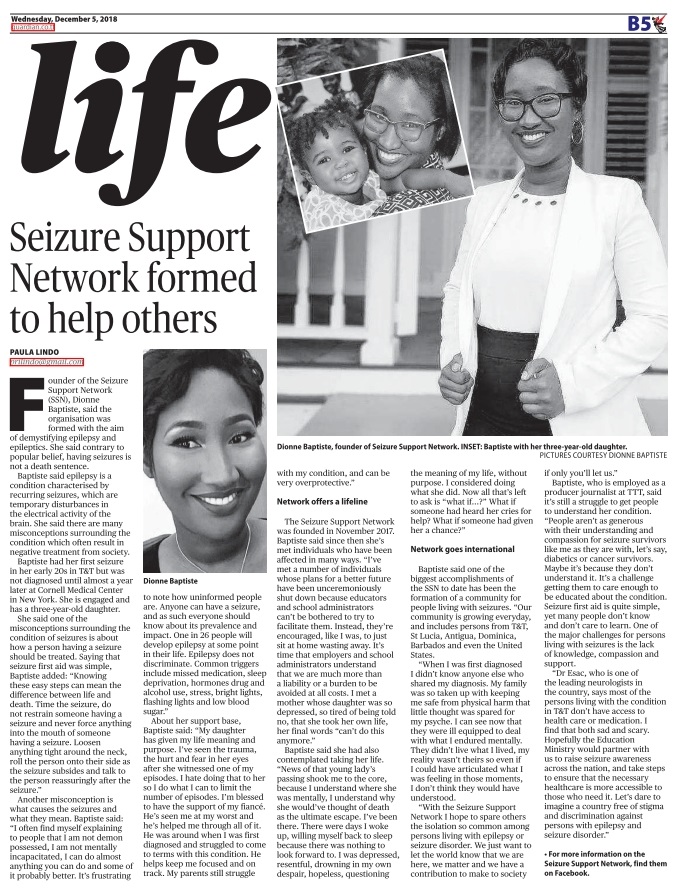
Founder of the Seizure Support Network (SSN), Dionne Baptiste, said the organization was formed with the aim of demystifying epilepsy and epileptics. She said contrary to popular belief, having seizures is not a death sentence.
Originally published in the T&T Guardian on December 5, 2018
Baptiste said epilepsy is a condition characterized by recurring seizures, which are temporary disturbances in the electrical activity of the brain. She said there are many misconceptions surrounding the condition which often result in negative treatment from society.
One of these misconceptions is about how a person having a seizure should be treated. She said seizure first aid was simple. “Knowing these easy steps can mean the difference between life and death. Time the seizure, do not restrain someone having a seizure and never force anything into the mouth of someone having a seizure. Loosen anything tight around the neck, roll the person onto their side as the seizure subsides and talk to the person reassuringly after the seizure.”
Another misconception is what causes the seizures and what they mean. Baptiste said “I often find myself explaining to people that I am not demon possessed, I am not mentally incapacitated, I can do almost anything you can do and some of it probably better. It’s frustrating to note how uninformed people are. Anyone can have a seizure, and as such everyone should know about its prevalence and impact. One in 26 people will develop epilepsy at some point in their life. Epilepsy does not discriminate. Common triggers include missed medication, sleep deprivation, hormones
drug and alcohol use, stress, bright lights, flashing lights and low blood sugar.”
Baptiste had her first seizure in her early twenties in T&T but was not diagnosed until almost a year later at Cornell Medical Center in New York. She is engaged and has a three-year-old daughter. “She’s given my life meaning and purpose. I’ve seen the trauma, the hurt and fear in her eyes after she witnesses one of my episodes. I hate doing that to her so I do what I can to limit the number of episodes. I’m blessed to have the support of my fiancé. He’s seen me at my worst and he’s helped me through all of it. He was around when I was first diagnosed and struggled to come to terms with this condition. He helps keep me focused and on track.”
She said her parents still struggle with her condition, and can be very overprotective. “If my mother calls and I don’t answer on the first ring she goes into a tail spin. My father is not as cautious. When I was forced to move back home for a year I had no privacy and they treated me like an invalid. I wasn’t allowed to lock the bathroom for fear I’d have an episode and they wouldn’t be able to reach me. Sometimes one or other of my relatives would pull a chair and sit outside the bathroom while I showered. I understood why they thought it necessary but it was frustrating. Sometimes they’d ask me to sing while I used the bathroom and if I stopped singing they’d assume something happened and come running. One time my mother was kneading flour in the kitchen. My father was playing music so I followed my mother in the kitchen. I was singing and dancing around the table when I had an episode. I hit my face on the edge of the table on my way down. My mother says there was so much blood. I still have the scar on my left cheek. It’s kind of a constant reminder that I can be perfectly fine one minute and far from it in the next. Unlike most seizure survivors I don’t get auras to precipitate my episodes.”
The Seizure Support Network was founded in November 2017. Baptiste said since then she’s met individuals who have been affected in many ways. “I’ve met a number of individuals whose plans for a better future have been unceremoniously shut down because educators and school administrators can’t be bothered to try to facilitate them. Instead, they’re encouraged, like I was, to just sit at home wasting away. It’s time that employers and school administrators understand that we are much more than a liability or a burden to be avoided at all costs. I met a mother whose daughter was so depressed, so tired of being told no, that she took her own life, her final words “can’t do this anymore.”
Baptiste said she had also contemplated taking her life. “News of that young lady’s passing shook me to the core, because I understand where she was mentally, I understand why she would’ve thought of death as the ultimate escape. I’ve been there. There were days I woke up, willing myself back to sleep because there was nothing to look forward to. I was depressed, resentful, drowning in my own despair, hopeless, questioning the meaning of my life, without purpose. I considered doing what she did. Now all that’s left to ask is “what if…?” What if someone had heard her cries for help? What if someone had given her a chance?”
Baptiste said one of the biggest accomplishments of the SSN to date has been the formation of a community for people living with seizures. “Our community is growing everyday, and includes persons from T&T, St Lucia, Antigua, Dominica, Barbados and even the United States. When I was first diagnosed I didn’t know anyone else who shared my diagnosis. My family was so taken up with keeping me safe from physical harm that little thought was spared for my psyche. I can see now that they were ill-equipped to deal with what I endured mentally. They didn’t live what I lived, my reality wasn’t theirs so even if I could have articulated what I was feeling in those moments, I don’t think they would have understood. With the Seizure Support Network I hope to spare others the isolation so common among persons living with epilepsy or seizure disorder. We just want to let the world know that we are here, we matter and we have a contribution to make to society if only you’ll let us.”
Baptiste, who is employed as a producer journalist at TTT, said it’s still a struggle to get people to understand her condition. “People aren’t as generous with their understanding and compassion for seizure survivors like me as they are with, let’s say, diabetics or cancer survivors. Maybe it’s because they don’t understand it. It’s a challenge getting them to care enough to be educated about the condition. Seizure first aid is quite simple, yet many people don’t know and don’t care to learn. One of the major challenges for persons living with seizures is the lack of knowledge, compassion and support. Dr Esac, who is one of the leading neurologists in the country, says most of the persons living with the condition in T&T don’t have access to health care or medication. I find that both sad and scary. Hopefully the Education Ministry would partner with us to raise seizure awareness across the nation, and take steps to ensure that the necessary healthcare is more accessible to those who need it. Let’s dare to imagine a country free of stigma and discrimination against persons with epilepsy and seizure disorder!”
For more information on the Seizure Support Network, find them on Facebook.
Discover more from Paula Lindo - Our histories, stories, present, future.
Subscribe to get the latest posts sent to your email.
